
But now, O Lord, You are our Father. We are the clay, and You are our pot maker. All of us are the work of Your hand. [Isaiah 64:8 (NLV)]
 When writing about giving God the glory and how we are but instruments of God’s grace in the world, I recalled a quote by Mother Teresa having to do with being God’s pencil. Wanting to quote it correctly, I Googled it. Along with the quote, I came across several versions of a parable about a pencil. Of unknown origin, it has been around for more than twenty years. Nevertheless, the parable was new to me and this is my version of “The Parable of the Pencil.”
Just before putting the pencil in its box, the Pencil Maker said there were several things it needed to know if it were to become the instrument He created it to be. “First, don’t ever try to be a stapler, scissors, paper clip, or ruler. Always remember you are a pencil and have been created with a definite purpose—to draw a line forming shapes, letters, and words that leave a definite message.”
The Pencil Maker continued, “Although small, you can accomplish great things, but only if you allow yourself to be held in someone’s hand.” Although He warned the pencil that there would be times of painful sharpening, the Maker explained that sharpening was the only way for it to become a better pencil. “Sometimes you’ll make mistakes,” he said, “but that’s to be expected so you’ve been equipped with an eraser just for such occasions.”
“Right now,” said the Pencil Maker, “your exterior is fresh and shiny and you’re quite beautiful. But, with use, your paint will chip, your wood get nicked, and you’ll grow smaller.” Explaining that the pencil’s quality wasn’t determined by its appearance, he added, “The most important part of you is the quality of the graphite on your inside.” After cautioning the pencil that, when too much pressure was applied, its tip might break, he added, “Don’t worry, you can be re-sharpened.”
The Pencil Maker finished up by telling his creation, “You are to leave your mark on every surface you touch. This can be hard work and you may grow tired. But,” he added, “regardless of your condition, you are expected to keep writing. It is for this purpose that you were made.” Understanding its maker’s instructions, the pencil promised to follow them and joyfully went into the box with purpose in its heart.
Of course, we’re not pencils and God is the one who made us but, like the pencil, we’ve been created with a particular purpose, role, and calling in the world. Rather than a student, it is God’s hand that holds us. The only way to achieve the great things He’s planned for us is by surrendering to His will. Rather than a pencil sharpener, it will be problems and difficult circumstances that sharpen and shape us. Like the pencil, we will err but we, too, can correct our mistakes and learn from them. Just as the pencil’s outward appearance is unimportant, so is ours. It’s what’s inside that counts! Rather than graphite, God cares about the quality of our hearts! While undue stress and strain can damage (and almost break) us, that only occurs when we step out of God’s will. Finally, like a pencil, we are to leave our mark on every situation and person with whom we interact. When we stay in God’s will and allow His hand to direct and move us, that mark will be His!
God used Mother Teresa to make His mark on the world and her life spoke volumes about God’s love. Like her, we’ve been given a purpose by our Maker—let us be the pencil in His hand and make that mark!
I am like a little pencil in his hand. That is all. He does the thinking. He does the writing. The pencil has nothing to do with it. The pencil has only to be allowed to be used. [Mother Teresa of Kolkata]
 At first, it seems that the “Parable of the Unforgiving Servant” should be called the “Parable of the Forgiven Servant.” After all, the king forgave his servant’s debt of 10,000 talents—the equivalent of billions of dollars. While the first part of the parable illustrates the value and extravagance of God’s forgiveness, it takes a dark turn in the second part when illustrating the reciprocal nature of His forgiveness—something the servant learned the hard way!
 The book of Leviticus outlined several things that could make someone ceremonially or ritually unclean. These things included bodily discharges, touching a corpse, and skin infections, as well as contact with any unclean person or thing. By Jesus’ day, even entering a Gentile’s home made someone unclean. Anything and anyone an unclean person touched became unclean and, anyone who touched them or what they touched also became unclean.
 Like Christians, Hindus believe that, when the body dies, the soul does not. Unlike Christians, however, Hindus believe that, after death, the soul lives on in an astral body until it is reborn in another physical body. This cycle is continually repeated until the soul reaches a certain state of perfection (moksha) and is released from the bondage of birth and death. At that time, like a drop of water that eventually merges into the ocean, the soul will finally merge into God and become one with its creator. Of course, once absorbed by the sea, the drop would cease to exist.
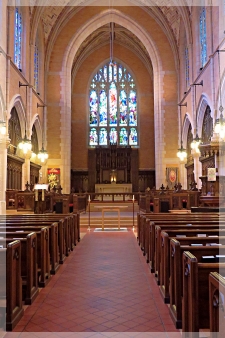 Since we both attended liturgical churches as girls, my friend and I were trying to recall the terms for the various parts of a traditional church building. We knew the foyer is called the narthex and the congregation sits the church’s nave. We also knew the altar rail usually separated the nave from the chancel in the front. It’s from the chancel that the service is conducted and where the altar, pulpit, and lectern are located. We even recalled that the sacristy was the room holding Communion supplies and linens. Since we were worshipping in a park that morning, my friend asked the location of our sanctuary. In historic usage, sanctuary and chancel were synonymous but, in modern usage, a sanctuary consists of the entire worship space of a church. With no building, we had no narthex, nave, or chancel but we did have a worship space; our sanctuary was a gazebo in a county park.
 In Acts 6, Luke writes about a problem with the Hellenistic Jewish believers. Meaning “to speak Greek” or “to make Greek,” Hellenism describes Jewish assimilation to the Greek language, manners, and culture. The process started in the 4th century BC with Alexander’s conquest of Palestine when Greeks settled into the land and, at the same time, Jews dispersed throughout Greek empire.
 Devotions of the Heart