
So you see, just as death came into the world through a man, now the resurrection from the dead has begun through another man. Just as everyone dies because we all belong to Adam, everyone who belongs to Christ will be given new life. [1 Corinthians 15:21-22 (NLT)]
For this is how God loved the world: He gave his one and only Son, so that everyone who believes in him will not perish but have eternal life. God sent his Son into the world not to judge the world, but to save the world through him. [John 3:16 (NLT)]
 In less than five minutes the house was ready for Easter. I’d hung out the spring wreath with its silk tulips, placed the resin Easter rabbit with his cart and eggs on the hall table, and put the three ceramic bunnies around the flowers on the table. With no grands visiting this year, I didn’t even have eggs to boil or baskets to fill! Since it took me days to ready the house for Christmas, I wondered why Easter doesn’t get the same amount of decoration and celebration. Granted, most of the holiday traditions for both holy days have pagan beginnings. Nevertheless, those customs have become part of our culture and Christmas seems to overshadow Easter by a mile.
Christmas has its own color scheme, its own genre of music, and its own beloved fictional characters, including a Grinch, a snowman, an elf on a shelf, and a red-nosed reindeer. We spend weeks decorating our homes, purchasing gifts, and preparing food. We have special Christmas attire ranging from Santa hats to candy cane jewelry and ugly holiday sweaters. People decorate trees, hang garlands and lights, dress up their dogs, and adorn their cars with reindeer horns. Every year sees at least one Christmas-themed movie release and we get a plethora of holiday-themed television shows throughout December. Christmas music is played from the first of November to New Year’s and our calendars are filled with dates for holiday parties and concerts. Easter traditions pale in comparison to Christmas. Even with Easter baskets and egg hunts, the Easter Bunny can’t hold a candle to Santa. The few Easter hymns are sung only a couple of Sundays and hard-boiled eggs and Peeps are second-rate when compared to the plethora of holiday treats, Christmas cookies, and peppermint bark! As far as celebrations go, Easter is sort of like the neglected step-child of holy days. Of course, it’s difficult to generate a festive spirit when Easter is preceded by a season of penitence and fasting and follows the darkest day in Christendom.
As much as I enjoy the traditions of Christmas (in spite of their pagan origins), Christmas really has nothing to do with decorating houses, baking cookies, hanging stockings, gift exchanges, sending cards, singing carols, or holiday parties. Although our sacred Christmas traditions emphasize Jesus’ birth with nativity scenes and pageants, that night in Bethlehem was just the beginning of a far greater story—the story of who Jesus was and what He did for us.
Granted, we usually consider a person’s arrival more reason to celebrate that his departure and we celebrate birthdays rather than dates of death but, in Christ’s case, it is just the opposite. The meaning of Christmas is actually found in the Easter story. Without Jesus’ death, resurrection, and ascension there would be no forgiveness, redemption, and salvation. Without Easter, the Christmas story would be no more than just a story. For me, the purpose of Christmas can be summed up in one word: Easter!
So, Merry Christmas and Happy Easter on this upcoming Resurrection Sunday!
Somehow we just don’t make the same boisterous fun of Holy Week that we do of Christmas. No one plans to have a holly, jolly Easter. … Easter may seem boring to children, and it is blessedly unencumbered by the silly fun that plagues Christmas. Yet it contains the one thing needful for every human life: the good news of Resurrection. [Frederica Mathewes-Green]
 When the Academy Awards were held recently, Oscars were presented for things like best director, best lead and supporting actors and actresses, and even best make-up and hair styling. If it’s true (as my theater teachers claimed) that, “There are no small parts, only small actors!” how is it that no awards were given to the best small part players? Regardless of the perfection with which they may have fulfilled their “bit parts”, their screen time was too short to be nominated for anything. To add insult to injury, they may have been known only as Dog Walker or Nurse #2! The small role, however, doesn’t mean the character played an insignificant part in the story. Nevertheless, after moving the story forward, the bit part players just fade into the background. Even so, while their names may be forgotten, the story wouldn’t have been the same had they not played their roles.
 The culture of the 1st century was agrarian in nature so the analogies used by Jesus and the evangelists often were those of agriculture – seeds, soil, fruit, and vines. For example, when writing about the characteristics in the lives of those who follow Jesus, Paul spoke of the fruit of the Spirit. But, if Paul were writing to modern industrial society, he might have used a different metaphor. Instead of the fruit of the Holy Spirit, we might have the Spirit’s toolbox. Rather than fruit, we’d have God’s tools to help us to build His Kingdom. The saw in the box would be God’s peace that cuts worry and fear out of our lives. The sandpaper would be kindness as it smooths out life’s rough edges. Protective gear like safety goggles and steel-toed shoes would be the self-discipline that protects us from sin. Duct tape and WD-40 would be as essential as love, a flashlight would shine our joy, and we’d have clamps to hold us tight to the faith. God’s word would be our blueprint and, instead of being connected to a vine, the power tools would be plugged into the Holy Spirit’s power. Regardless of the metaphor, the Holy Spirit provides us with what we need to be more like Christ.
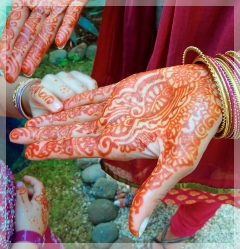 To the delight of the girls who attended the party, my daughter-in-law hired a Mehndi artist for my grand-daughter’s birthday celebration. Using a red-orange paste made from the dried leaves of the henna plant, the artist adorned the girls’ hands or arms with assorted intricate floral motifs. Since all of the family on her mother’s side is from India, this ancient form of body art is familiar to my grand. Although she’s attended several Mehndi parties, most of her guests have not. A Mehndi party for close friends and family is an important pre-wedding tradition in any Indian wedding. Along with plenty of food and music, there are henna artists. While they take only a few minutes painting designs on the guests, they spend several hours painting intricate geometric shapes and floral and paisley motifs on the bride’s hands, arms and feet. Hidden somewhere among the elaborate patterns on her body is the groom’s name.
 Let’s go back to the sixties—a time of “turn on, tune in, drop out”—a counter-culture of “flower power,” anti-war sentiment, and discontented disillusioned youth. When Chuck Smith saw these “hippies” on the California beaches, he said they needed a bath but, when his wife Kay saw them, she said they needed the Lord! Moving their message onto the streets and beach, they opened the doors of their church to those kids and anyone else who wanted to come in. Regardless of faith, background, attire, length of hair, addictions, political views, cleanliness, or finances, the church unconditionally welcomed everyone. While still preaching the uncompromising truth of the Gospel, what began as a congregation of 25, within eight years had to conduct three Sunday services in a 2,200-seat auditorium!
 Today, when someone is called the “salt of the earth,” the speaker probably means he or she is a dependable, unpretentious and honest person—someone of moral integrity. That is well and good as far as it goes, but Jesus meant more than that when He called us to be “the salt of the earth.”
 Devotions of the Heart