
Search me, O God, and know my heart; test me and know my anxious thoughts. Point out anything in me that offends you, and lead me along the path of everlasting life. [Psalm 139:23-24 (NLT)]
 The tradition of New Year’s resolutions goes back over 4,000 years to the ancient Babylonians (whose new year began in mid-March with the spring equinox). During their 12-day celebration called Akitu, they either crowned a new king or reaffirmed their loyalty to the old one. To ensure the gods’ favor, they promised to return borrowed items and pledged the repayment of all their debts.
Around 46 BC, Julius Caesar altered the calendar and began the year in January to honor the two-faced Janus—the Roman god who could look back into the past and forward into the future at the same time. Romans believed that the rest of the year would go pleasantly if that was how they spent its first day. Trying to spend January 1st as happily as possible, there were games, feasts, gifts, sweet treats, and plenty of wine while complaint, gossip, and quarrels were avoided. By making sacrifices to Janus and promising to live a better life, Romans believed the year ahead would bring prosperity and success.
Did you spend yesterday as pleasantly as possible—with no spats or spite? Did you start the new year with a resolution or two? While pledging to become a better person in the coming year or promising to return borrowed items and pay one’s debts are good goals for 2025, the majority of our New Year’s resolutions usually have something to do with health, exercise, or diet.
Before resolving to floss, eat more vegetables, or run a 5K, we should pray and ask God what He would like to see us change. “Search me, O God,” is what could be called a dangerous prayer because, when we ask God to search, we should be ready for what He finds. Chances are that it will have nothing to do with developing better dental or nutrition habits.
Asking God to examine our innermost being is like asking Him to perform exploratory surgery in search of sin. While a surgeon may not find a malignancy, God is sure to find plenty of areas in our lives that need excising or change. In medicine, a surgeon usually removes a malignancy if it is found. In God’s hospital, it’s a little different. If He finds disease or malignancy in our hearts, after pointing it out, He expects us to repent and turn away from it.
According to Drive Research, only 9% of those who make New Year’s resolutions successfully keep them all year. Sadly, our spiritual goals can fail as readily as the non-spiritual ones. For 20 years, one Christ-following friend has resolved to read the Bible, cover-to-cover; so far, she’s not gotten past Leviticus! Perhaps we’d do better if we remember that we can’t change by ourselves. While will-power alone might keep us away from Dunkin’ Donuts or Krispy Kreme (at least for a while), it’s not enough when we’re combating spiritual enemies. Fortunately, we are empowered by the Holy Spirit and, through Him, all things are possible—even reading the Bible.
Let us remember that Jesus is in the business of transformation. He transformed water into wine, the blind into the sighted, the lame into the strong, and the diseased into the healthy. He changed the churning sea into calm water, a few morsels of food into a feast, and the dead into the living. Jesus’ miracles of transformation continue today. He turns darkness into light, anger into peace, fear into hope, animosity into love, selfishness into generosity, mourning into joy, shame into honor, and sinners into saints. If you’re still not sure what your resolution should be, you can always borrow Jonathon Edward’s: “Resolution One: I will live for God. Resolution Two: If no one else does, I still will”
May you have a blessed new year.
The object of a new year is not that we should have a new year. It is that we should have a new soul. [G. K. Chesterton]
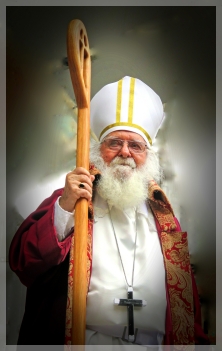 Sometime near the end of the 3rd century, the Bishop of Myra died and a conclave was held to elect his replacement. Legend has it that the bishops kept praying and voting but could not come to an agreement. In a stalemate, they prayed all night for God’s guidance. That night, one bishop heard a voice telling him that, at the hour of matins, the man who walked into the church was the one God wanted to shepherd His flock.
 The above words are from Mere Christianity by C.S. Lewis. For Lewis, those first moments of wakefulness were the most important ones of the day because they set one’s frame of mind. When God is our first thought of the day, we begin the morning with a sense of peace and power – peace because we know the day is in His hands and power because we know that through Him we can get through anything it throws at us. It’s as if an invisible barrier has been set up between us and the desires, troubles, and cares of the world in which we live.
 Jesus offered fishing advice to the disciples twice after they’d spent a night of fishing with absolutely nothing to show for it and, twice, after doing as He directed, they ended up with a miraculous catch of fish. The first time, their catch was so heavy that their nets began to tear and the two boats hauling it in nearly sunk from the weight! The second time, unable to pull the net into their boat, the men had to get out and drag it into shore!
 In Sharon Garlough Brown’s novel, Two Steps Forward, a character choses to pray the Hebrew word hineni during Advent. When another character calls it a beautiful but “costly” prayer, I grew curious about this word. Hineni is composed of two little words, hineh and ani. By itself, hineh is usually translated as “behold” but, when combined with ani (meaning “I”), it usually is translated as “Here I am,” “I’m here,” or “Yes.” However, like shalom, the Hebrew hineni loses the depth of its meaning in translation.
 I began my prayer with, “Lord, you’ve got to…” but got no further. “God doesn’t ‘got to’ do anything!” said a still small voice and the Spirit’s point was well taken. By beginning with an impertinent demand like a selfish petulant child in a toy store, I showed chutzpah of the worst kind and began again.
 Devotions of the Heart