
After three days they found Jesus sitting in the Temple with the teachers, listening to them and asking them questions. … When Jesus’ parents saw him, they were astonished. His mother said to him, “Son, why did you do this to us? Your father and I were very worried about you and have been looking for you.” Jesus said to them, “Why were you looking for me? Didn’t you know that I must be in my Father’s house?” [Luke 2:46-49 (NCV)]
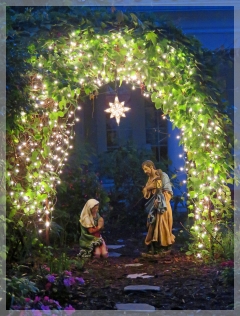
Last month, during my pre-dawn walks, I enjoyed seeing the bright holiday lights decorating many of our community’s homes. One morning, I passed by a beautifully lit arbor surrounding a nativity scene. Even though the twinkle lights and star didn’t fully illuminate the figures below them, I took a photo and hoped that a little Photoshop magic would result in a picture for a future devotion. When I finally got around to editing the photo, I discovered that Jesus was missing from the scene!
The missing baby reminded me of when my daughter’s family visited us several years ago. The young cousins were playing together at my son’s home. While the adults talked, the girls investigated the many toys in Mali’s toy chest. When Bree discovered parts from the Fisher Price Noah’s ark and nativity sets, she and Mali started rummaging through the box to find their various pieces. Bree started explaining the two stories to her younger cousin as they organized the figures. After digging to the bottom of the box, they realized one figure was missing. The girls jumped up and frantically dashed through the house toward Mali’s bedroom shouting, “We’ve lost baby Jesus!” Fortunately, after a thorough search, the missing baby was found among a few dust bunnies under Mali’s bed.
Mary and Joseph lost Jesus after they’d been in Jerusalem to celebrate the Passover. The city’s population had quadrupled as caravans of Jews from all over came to observe the holiday. Somehow, in the mayhem of people gathering to return to Nazareth, Mary and Joseph lost track of their boy and left Jerusalem without Him. Perhaps the people with the missing figure in their nativity had overlooked Jesus in a dark corner of their attic or lost him in the confusion of cartons and crates when they came to Florida. Like Mary, Joseph, and the little cousins, they didn’t notice they’d lost Jesus until they wanted Him! The same thing can happen to us in the challenges and chaos of our busy lives. Sometimes, we forget to bring Jesus with us and don’t even notice He’s missing until we need Him.
It’s important to remember that even though Mary and Joseph lost Jesus, they didn’t lose their relationship with Him. He remained their son but, by leaving Him behind, they lost His presence. The same thing can happen with us. When we lose Jesus, we don’t lose the salvation that comes with our relationship but we do lose His fellowship, our sense of His presence, and His peace and joy.
When the sheep can’t find the shepherd, it’s not the shepherd who is lost. The good shepherd is exactly where He belongs; it’s the sheep that have strayed. In actuality, Mary and Joseph were the ones who were lost, not Jesus. He was where He belonged—in His Father’s house studying God’s word. Our Lord promises He’ll never leave us but that pesky thing called free will allows us to leave Him and walk off on our own. When we feel empty or alone, when we wonder where Jesus is in our trouble, Jesus hasn’t forgotten about us. We are the ones who forgot and lost Him!
Yesterday, I walked by the house with the missing baby Jesus and was pleased to see that he’d been found and was in his rightful place. When Jesus is missing in our lives, like Joseph, Mary, Bree, Mali, and the people with the nativity scene, we must search until we find Him. Rather than looking in dark corners or under the bed, the first place to look might be where we’d expect to find Him—in His Father’s house and in His word.
 When an irrevocable law was signed that prohibited praying to anyone but King Darius, Daniel prayed! Knowing he’d be thrown into a den of lions for doing so, the devout man went home, opened the windows, and prayed to God just as he always had done. Rather than starting with a fervent plea for God’s help, however, Daniel began with a prayer of thanks. His prayer of thanksgiving showed Daniel’s faith in a good God who was present in all circumstances!
 Avoid foolish controversies, arguments about genealogies, quarrels, and fights about Moses’ Teachings. This is useless and worthless. [Titus 3:9 (GW)]
 Rescue me, O Lord, from liars and from all deceitful people. … How I suffer in far-off Meshech. It pains me to live in distant Kedar. I search for peace; but when I speak of peace, they want war! [Psalm 120:2,5-6 (NLT)]
 Psalms 120 through 134 have the superscription A Song of Ascents. What that means exactly, no one really knows. The original word translated as ascent was “stair” or “step” and some scholars believe the title refers to the temple’s fifteen steps leading from the Court of the Women into the Court of the Sons of Israel. Jewish tradition holds that Levites sang a different one of these psalms as they climbed the steps to the temple. Other scholars posit that the title of the psalms has to do either with the rising moods or thoughts in the psalms’ words or their rising pitch as they were sung.
 Don’t panic. I’m with you. There’s no need to fear for I’m your God. I’ll give you strength. I’ll help you. I’ll hold you steady, keep a firm grip on you. [Isaiah 41:10 (MSG)]
 Devotions of the Heart