
 You know the generous grace of our Lord Jesus Christ. Though he was rich, yet for your sakes he became poor, so that by his poverty he could make you rich. [2 Corinthians 8:9 (NLT)]
Yes, I am the gate. Those who come in through me will be saved. They will come and go freely and will find good pastures. The thief’s purpose is to steal and kill and destroy. My purpose is to give them a rich and satisfying life. [John 10:9-11 (NLT)]
Psst! I’m rich but, please, don’t report me to the IRS. If you tell them, they’ll want their ever-increasing percentage and it’s simply nor theirs to take. The riches I have won’t pay politicians’ salaries, build highways, or purchase helicopters. My true wealth has nothing to do with bank balances, investment strategies, crypto-currency, or real estate holdings. It can’t be held in a bank or brokerage account nor can it be spent at Saks or on Amazon. Better yet, my riches are never-ending; I simply can’t run out of them!
I have a sense of peace that far surpasses anything one gets from having enormous assets at Fidelity or Charles Schwab. I have a joy far greater than one could ever get from being listed as one of Forbes magazine’s richest people. I have a better future than someone possessing a hefty IRA or annuity fund. I am loved better and forgiven more than the richest person could be by his ever-hopeful heirs. Indeed, I am blessed beyond belief.
You see, I’m enjoying the riches that come from a relationship with God. Moreover, I don’t have to concern myself with the Dow Jones average, fret about P/E ratios, read Barron’s or The Economist, or worry about capital gains or volatile markets. All I have to do is realize my need for God, admit my sinfulness, and receive Jesus Christ as my Savior.
My faith isn’t in the dollar, Bitcoin, or yen; my faith is in the Lord. Rather than regularly calling my broker, I keep in touch with God through daily prayer. Instead of poring over The Wall Street Journal and Bloomberg Businessweek, I regularly read God’s word. Rather than listening to and following my financial advisor’s advice, I listen to (and obey) the voice of the Holy Spirit. Instead of having servants, however, I am expected to serve, but it is a small price to pay. If I do all of that, not only will I maintain the riches I already have, but my riches will continue to increase (and all with no tax consequences)!
Want to be rich? Count your blessings! [sign in front of a local church]
It is the heart that makes a man rich. He is rich or poor according to what he is, not according to what he has. [Henry Ward Beecher]
 Even though all that he lost was restored to Job at the end of Chapter 42, did the ten new children remove Job’s memory of his first ten or his sorrow at their deaths? While the new ones may have filled Job’s home with laughter again, there still would be an empty place in his heart from his loss. Although Job’s health was restored, would the scars from his boils be a daily reminder of his past afflictions? Would double his livestock be enough to make him forget the original herds and servants who had perished? How would experiencing the precariousness of life—the inexplicable randomness of misfortune—affect Job’s next chapter, the Chapter 43 of his life? Would he be more affectionate, patient, or protective of his children? Would he better appreciate and cherish every precious moment with which he was blessed?
 Yet God has made everything beautiful for its own time. He has planted eternity in the human heart, but even so, people cannot see the whole scope of God’s work from beginning to end. [Ecclesiastes 3:11 (NLT)]
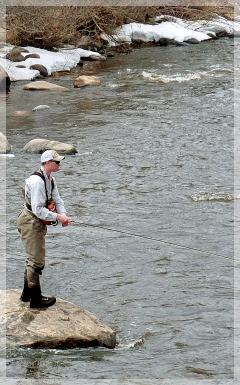 Even though I’m not an angler, whenever I read about casting my cares, I picture using a fly rod and casting my concerns out into the river so the fast moving water can carry them away to God. When we lived in the mountains, one of our favorite walking trails ran alongside the Yampa River and we often paused to watch as the fishermen (and women) cast their lines into the water. Fly fishing is all about the art of casting and a bit like poetry in motion. It was fascinating to watch an angler flick the rod back and forth, gradually increasing the speed of the motion, before finally casting the line forward so the fly would land in the perfect spot. Masquerading as a water insect, the fly is made of things like fur, feathers, fabric and tinsel and secured to a hook. Rather than purchasing flies, many fishermen spend hours tying their own flies. Not wanting to lose either fly or fish in the river, anglers use at least five different knots to securely connect the reel to the backing, fly line, leader, and tippet before finally tying on the fly.
 It’s often said that there are no atheists in foxholes. This maxim traces its beginnings back to 1914 and World War 1 when an English newspaper quoted a chaplain at a memorial service for a fallen soldier: “Tell the Territorials and soldiers at home that they must know God before they come to the front if they would face what lies before them. We have no atheists in the trenches. Men are not ashamed to say that, though they never prayed before, they pray now with all their hearts.” When we joined our northern church, it was during the Viet Nam War. I remember a young man in our new member class who’d drawn a low number in the draft lottery. Expecting to be in combat within the year, he confessed wanting to “get right” with God before that time came. Apparently, even the threat of a foxhole is enough to cause some people to rethink their relationship with the Almighty.
