IN PAIN

So to keep me from becoming conceited because of the surpassing greatness of the revelations, a thorn was given me in the flesh, a messenger of Satan to harass me, to keep me from becoming conceited. Three times I pleaded with the Lord about this, that it should leave me. But he said to me, “My grace is sufficient for you, for my power is made perfect in weakness.” [2 Corinthians 12:7-9 (ESV)]

But pain insists upon being attended to. God whispers to us in our pleasures, speaks in our conscience, but shouts in our pain: it is His megaphone to rouse a deaf world… [C.S. Lewis]

morning gloryDuring that dark time about which I recently wrote, I was in intense pain and it seemed like God had turned His back on me. When I confided to a friend that God seemed deaf to my pleas, she asked the simple question, “Have you turned it over to the Lord?” I assured her I had but, as the day wore on, I wondered if that were true.

In my prayers for relief, I was telling God the outcome I desired, but that really isn’t “turning it over” to Him. If any human had a direct line to God’s heavenly office, it would have been the Apostle Paul and yet God didn’t relieve him of whatever his thorn was! Instead of demanding the result I wanted, I had to place myself in God’s loving hands as did Paul and pray for God’s grace and the power to accept what He’d placed in my lap.

Each morning, I prayed for grace enough for the day—for the strength, endurance, peace, patience, courage, and joy needed to get through the next twenty-four hours. I asked God to reassure me of His lovingkindness and to protect me from the doubt, fear, and negativity Satan was whispering in my ears. The hardest thing, however, was to hand the outcome of my upcoming surgery into His loving hands. I had to trust in His plan and presence regardless of its outcome. The physical pain remained but, with the power of the Spirit, I dealt with it.

I don’t think God decides our fate with a toss of the dice and, while a quick view of my MRI told me the why of my present physical pain, I asked God to help me understand its purpose. Paul knew his thorn was to keep him from being conceited; what was my pain telling me? In The Problem of Pain, C.S. Lewis points out how easy it is to ignore God when all is well. “We will not seek it [our happiness] in Him as long as He leaves us any other resort where it can even plausibly be looked for. While what we call ‘our own life’ remains agreeable we will not surrender it to Him.” Admittedly, I’d been in a state of “meh” and become self-sufficient rather than God-dependent and lax in my spiritual disciplines. Like the Apostle Paul, perhaps I’d become too sure of myself; the intense pain reminded me of my need for God!

As C.S. Lewis wisely pointed out, an intellectual understanding of pain is far easier than the fortitude, courage, and patience needed to endure it. It’s far easier to talk the talk than walk the walk! Nevertheless, endure it we must and through the power of the Holy Spirit, we can!

By the time this devotion is published, I will have had the surgery that, God willing, will relieve my pain. While I don’t know what my future holds, I do know who holds it in His loving hands and I trust that He will supply me with all I need to face whatever it may be.

And we know that for those who love God all things work together for good, for those who are called according to his purpose. … Who shall separate us from the love of Christ? Shall tribulation, or distress, or persecution, or famine, or nakedness, or danger, or sword?… No, in all these things we are more than conquerors through him who loved us. For I am sure that neither death nor life, nor angels nor rulers, nor things present nor things to come, nor powers, nor height nor depth, nor anything else in all creation, will be able to separate us from the love of God in Christ Jesus our Lord. [Romans 8:28, 35, 37-39 (ESV)]

Copyright ©2025 jsjdevotions. All rights reserved.

WHERE IS HE?

How long, Lord? Will you forget me forever? How long will you hide your face from me? How long must I wrestle with my thoughts and day after day have sorrow in my heart? How long will my enemy triumph over me? Look on me and answer, Lord my God. Give light to my eyes, or I will sleep in death, and my enemy will say, “I have overcome him,” and my foes will rejoice when I fall. [Psalm 13:1-4 (NIV)]

yellow crowned night heronWhen I first started reading the psalms, I suspected David might have been bi-polar—his highs seemed so high and his lows so very low; now I understand that he was just being truthful. In his psalms, David unabashedly expressed his deepest feelings to God. Pouring out his soul, he openly shared his emotions—whether anger, disappointment, sorrow, regret, shame, joy, love, fear, doubt, or even his desire for vengeance upon his enemies. No matter how troubled he was, David never was afraid to speak from his heart. I’m not sure we are willing to be as vulnerable and straightforward in our prayers as was David.

Thinking God had forgotten him (or was deliberately ignoring him), David dared to complain of the Lord’s unkindness in Psalm 13. In A Grief Observed, C.S. Lewis expressed a similar feeling of being ignored by the Lord. After noting how present God seemed in the good times, Lewis asked “where is God?… Go to Him when your need is desperate, when all other help is vain, and what do you find? A door slammed in your face, and a sound of bolting and double bolting on the inside. After that, silence.” He asked, “Why is He so present a commander in our time of prosperity and so very absent a help in time of trouble?”

Indeed, it is easy to see God in times of safety, prosperity, and health. We perceive in Him a hillside of flowers but not when a wildfire destroys an entire town. We see His work in the birth of a child but not in a child’s death at the hands of a school shooter. We feel His presence when a loved one defeats cancer but He seems absent when we suffer from chronic pain. C.S. Lewis warned that the danger we face in those dark times is not so much that we’ll stop believing in God but that we’ll come to believe that God is not good! We’re tempted to give up on Him because it seems He’s given up on us!

In this fallen world, there will be times when, like C.S. Lewis and David, it seems that God has turned his back to us. We feel forsaken and disregarded. Having recently gone through a dark time when it felt like God’s office door was closed to me, I found myself praying the words of Psalm 13. Fortunately, I didn’t stop at the first four verses. After expressing his feeling of being abandoned, David turned to praise and proclaimed his confidence in God’s love, faithfulness, and deliverance.

Like David, I will trust in the Lord’s goodness in all things—even those things I don’t understand. Rather than believing in the goodness of life, I will choose to believe in the goodness of God.

But I trust in your unfailing love; my heart rejoices in your salvation. I will sing the Lord’s praise, for he has been good to me. [Psalm 13:5-6 (NIV])

But this I call to mind, and therefore I have hope: The steadfast love of the Lord never ceases; his mercies never come to an end; they are new every morning; great is your faithfulness. “The Lord is my portion,” says my soul, “therefore I will hope in him.” [Lamentations 3:21-24 (ESV)]

Copyright ©2025 jsjdevotions. All rights reserved.

THE DARK VALLEY

Yea, though I walk through the valley of the shadow of death, I will fear no evil: for thou art with me; thy rod and thy staff they comfort me. [Psalm 23:4 (KJV)]

deer - young buckIn Psalm 23, the King James version translates the original Hebrew “gay tsalmaveth”  as “valley of the shadow of death.” A more accurate translation, however, would be a dark valley or a valley of death-like darkness. While people often associate this psalm with death, it uses the metaphor of sheep and their shepherd and sheep have no concept of death. But, because of their near-sightedness and poor depth perception, they are reluctant to move into dark places. Nevertheless, whether referring to the unknown, danger, or even death, David’s words are ones of comfort and hope to all who read them—we are not alone as we travel through the dark valleys of life.

My friend Joe recently told me about his sister’s final hour after a long and grueling battle with cancer. As Joe sat on the bed beside the dying woman, she suddenly sat up and stared ahead at a painting on the opposite wall. When he asked what had her attention, she replied with a question of her own: “Don’t you see?” Looking at the picture, all he saw was a landscape with trees, rolling hills, and a few birds high in the sky. “What?” he asked his sister as she kept her eyes straight ahead. “Him! Don’t you see Him?” When Joe asked who, she said it was Jesus, adding, “He’s smiling at me.” Smiling herself, his sister lay back against her pillow, closed her eyes, and died within the hour. Since that day, Joe has looked at that picture many times and can find nothing that even resembles a person, let alone Jesus. I suggested that, rather than seeing something in the painting, his sister was seeing someone in front of the painting—the good shepherd who would accompany her through the dark valley into the light.

My friend Carol’s Uncle Stan was an avid outdoorsman and lover of nature. Having been defeated by heart disease, Stan’s hospital bed was placed by the picture window in his Northwoods home. Shortly before his passing, a three-point buck emerged from the woods and slowly approached the house. The magnificent creature stood by the window and seemed to stare in at him. Eventually, the buck lay down beneath the window and, like the rest of Stan’s family, kept the man company for the next few hours until he peacefully passed into God’s arms. Carol believes the buck’s presence was God’s way of comforting Stan as he took his final journey.

Death is inevitable and as much a part of life as birth; as Christians, we have no reason to fear it. Nevertheless, we still face the end of life with some trepidation. After all, it is our final surrender. Even though Scripture assures us that death takes us home to the Lord, the moment of death remains a mystery. Will there be a flash of light, a heavenly chorus, or a dark tunnel? Lazarus didn’t say and neither Trip Advisor nor Yelp have posted any reviews. I suspect it is both the most terrible and yet the most beautiful moment of our lives. Let us take comfort from the encouraging words of the 23rd Psalm that we are under God’s care and safe in His presence when we enter any shadowy valley—even the valley of death.

Was the buck’s extraordinary visit just a coincidence or was it a gift from God? Did Joe’s sister see Jesus or was it the hallucination of a dying woman on opioids? We’ll never know. I tend to think it was God’s way of assuring both of those dying believers (and their families) that they would not be making their final journey through that dark valley alone. The good shepherd was right beside them.

Death is not the end of the road; it is only a bend in the road. The road winds only through those paths through which Christ Himself has gone. This Travel Agent does not expect us to discover the trail for ourselves. Often, we say that Christ will meet us on the other side. That is true, of course, but misleading. Let us never forget that He walks with us on this side of the curtain and then guides us through the opening. We will meet Him there, because we have met Him here. [Erwin Lutzer]

Jesus said unto her, I am the resurrection, and the life: he that believeth in me, though he were dead, yet shall he live: And whosoever liveth and believeth in me shall never die. [John 11:25-26 (KJV)]

Copyright ©2024 jsjdevotions. All rights reserved.

SHALOM

Shalom I leave you, My shalom I give to you; but not as the world gives! Do not let your heart be troubled or afraid. [John 14:27 (TLV)]

zebra swallowtailToday’s verses are from the Tree of Life Version (TLV) that was produced by a diverse team of Christian and Messianic Jewish scholars. With the possible exception of the book of Job, all the Bible’s writers were Jews and Jesus was a Hebrew-speaking Jewish rabbi. No matter how good the translation, there are times English doesn’t capture the fullness of the original words used and this translation embraces the rich Hebrew roots of Christianity. To help the reader better understand the intent of the original manuscripts, some original Hebrew names, like Adonai  (Lord) and Elohim (God), Ruach ha-Kodesh (Holy Spirit), and Messiah Yeshua (Jesus Christ) were used and some Hebrew terms, like shalom, amen, hineni, matzah, and mikveh (ritual bath), were restored. Fortunately, this translation offers a glossary for its Gentile readers.
Shalom is one of those beautiful Hebrew words that loses its full meaning when translated into English. Usually translated as peace, shalom is more than a sense of calm, serenity, or the absence of hostilities or war. Meaning wholeness, soundness, health, safety, harmony, tranquility, and prosperity, shalom conveys an inward sense of fullness and completeness in mind, body, and circumstance. With its implication of permanence, a connection to God is necessary for shalom. As Jefferson Bethke says, “Shalom is when you are dancing to the rhythm of God’s voice.”

Rather than Hebrew or Aramaic, the language of the people, the New Testament’s writers wrote in Greek, the language of scholars. They weren’t in error in their reporting nor did the Bible’s translators err in their renditions; they simply were limited by the language they used. Neither Greek nor English have a word that fully captures the spiritual depth of shalom.

On the night of Jesus’ birth, when the multitude of angels announced “Peace on earth!” they wouldn’t have used the Greek word eiréné used by Luke. [2:14] Those shepherds were Jewish and the word would have been shalom. When Jesus told the woman with the blood to go in peace and be healed, it was to go in shalom not eiréné, the word Mark used. [5:34] Eiréné, defined as peace, quietness, national tranquility, or absence of conflict, doesn’t fully apprehend shalom’s meaning.

Addressing people with “Hello” or “Good Morning” is simply a greeting but, when “Shalom” is used as a greeting or farewell, it is a blessing of peace. The Jews of Jesus’ day regularly greeted one another with shalom or shalom aleichem (peace be upon you). The person then returned the blessing with aleichem shalom (unto you peace). Since a connection with God is essential to shalom, both greeting and response were a way of bringing godliness into their encounter and the physical world with their words.

When the angel Gabriel visited Mary, he didn’t greet her with chaire, the Greek word translated as “hail” or “greetings.” [Luke 1:28] He would have blessed her with the word shalom. When Jesus greeted the women Easter morning, He would have said “Shalom” and, when He appeared to the disciples later that day, He probably said “Shalom aleichem!”  Considering their shock at seeing the risen Christ, it’s understandable why both women and disciples failed to properly return His greeting with “Aleichem shalom!”

Shalom is a blessing of peace—peace throughout the world and in one’s personal life—and it is one of the greatest blessings one can give or receive. The peacemakers to whom Jesus referred in the Beatitudes weren’t mediators or political negotiators. They were people whose connection with God gave them shalom. They became peacemakers by transferring their inner sense of fullness, harmony, and well-being (their shalom), to the world around them.

The full meaning of shalom reminds us that true peace is not the absence of conflict or trouble; it is the presence of God. Shalom, my friends; shalom!

In the Bible, shalom means universal flourishing, wholeness, and delight—a rich state of affairs in which natural needs are satisfied and natural gifts fruitfully employed, a state of affairs that inspires joyful wonder as its Creator and Savior opens doors and welcomes the creatures in whom he delights. Shalom, in other words, is the way things ought to be. [Cornelius Plantinga]

So Messiah’s community throughout all Judea and Galilee and Samaria had shalom and was built up. Walking in the fear of the Lord and in the comfort of the Ruach ha-Kodesh, it kept multiplying. [Acts 9:31 (TLV)]

Copyright ©2024 jsjdevotions. All rights reserved.

HE WAS BETRAYED

On the way, Jesus told them, “All of you will desert me. For the Scriptures say, ‘God will strike the Shepherd, and the sheep will be scattered.’ But after I am raised from the dead, I will go ahead of you to Galilee and meet you there.” [Mark 14:27-28 (NLT)]

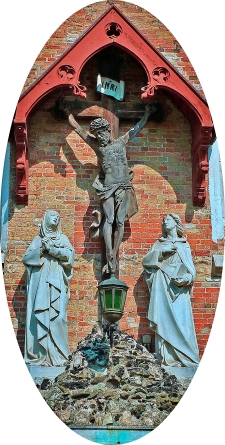
Church of our Lady - Netherlands

In the days leading up to his crucifixion, the people who claimed to love Jesus the most failed him in many ways. We know about Judas—the disciple trusted enough to carry the money bag who betrayed Jesus for thirty pieces of silver. That last night, the deceitful man had the audacity to have his feet washed by the Lord and to drink from His cup! But what of the other disciples? During that same meal, Peter vowed he’d never deny Jesus, even if it meant his death and the rest of the disciples echoed his pledge. Yet, within a matter of hours, those brave disciples would desert Jesus and Peter would deny Him three times. Even though Jesus asked Peter, James, and John to pray and keep watch with him in the Garden of Gethsemane, they fell asleep, not once but twice!

Where were the disciples when the mob shouted for Barabbas to be freed? For that matter, where were all of those people who had been healed or fed by Jesus? Just a few days earlier, a crowd had shouted, “Hosanna! Blessed is he who comes in the name of the Lord!” Where were they? Why were they silent? Instead of calling for Jesus’ freedom, the mob called, “Crucify him! Crucify him!”

The disciples weren’t even there to carry the cross for Jesus; that task fell to Simon, a stranger from Cyrene. Only John, Mary the mother of Jesus, Mary Magdalene, and some other women followers were at the foot of the cross when Jesus was crucified. Disillusioned and fearful for their lives, the other disciples were absent in His dying hours.

Rather than a disciple, it was a dying criminal who attested Jesus’ innocence, showed his faith, and asked the Lord, “Remember me when you come into your Kingdom.” When Jesus took His last breath and died, it was a Roman soldier and not a disciple who declared, “This man truly was the son of God!” The eleven remaining disciples didn’t even help bury their beloved rabbi. That responsibility was taken by Joseph of Arimathea and Nicodemus, members of the Jewish high council and secret followers of Jesus.

The disciples, confused and frightened, failed Jesus both as disciples and as friends. Nevertheless, despite the way they failed Him, Jesus didn’t fail them. Instead, after His resurrection, Jesus greeted them with words of peace and forgiveness. He then opened their minds to understand the Scriptures and charged these men—the same men who once failed Him—with the task of spreading the good news of His resurrection. Jesus knew it is better to be a believer who sometimes fails than not to believe at all.

Be assured, if you walk with Him and look to Him, and expect help from Him, He will never fail you. [George Mueller]

Jesus came and told his disciples, “I have been given all authority in heaven and on earth. Therefore, go and make disciples of all nations, baptizing them in the name of the Father, and the Son and the Holy Spirit. Teach these new disciples to obey all the commands I have given you. And be sure of this: I am with you always, even to the end of the age.” [Matthew 28-18-20 (NLT)]

Copyright ©2024 jsjdevotions. All rights reserved.

STUFF

I had everything a man could desire! … Anything I wanted, I would take. I denied myself no pleasure. I even found great pleasure in hard work, a reward for all my labors. But as I looked at everything I had worked so hard to accomplish, it was all so meaningless—like chasing the wind. There was nothing really worthwhile anywhere. [Ecclesiastes 2:8b-10-11 (NLT)]

squirrelWhen considering Solomon’s excess and riches, I recalled comedian George Carlin’s “Stuff” routine. First performed for Comic Relief in 1986, Carlin made fun of our obsession with having stuff. Along with being the King of Israel, Solomon was the King of Stuff. Denying himself nothing, along with his elaborate throne of gold and ivory, he displayed 500 ornamental gold shields on the walls of his palace. Rather than silver, all the king’s goblets and eating utensils were made of pure gold. He had 40,000 stalls of horses for his chariots, and 12,000 horseman.

Because Solomon controlled the chief trading routes north from the Arabian Peninsula, he collected the equivalent of over $1.2 billion a year in tribute from Arabian kings, merchants, and traders as well as Israel’s governors. It wasn’t just the queen of Sheba who gifted him with precious jewels, spices, and tons of gold. Everyone who visited the king brought him gifts of stuff: silver, gold, spices, weapons, clothing, mules, and horses. Every three years, Solomon collected even more stuff when his fleet of ships returned with additional horses, mules, gold, silver, robes, ivory, apes, and monkeys. The king collected women as readily as he did gold. With 1,000 women in his household, just imagine the amount of stuff the harem held! Nevertheless, despite all his “stuff,” Solomon’s words in Ecclesiastes are not the words of a happy or contented man.

Carlin described our houses as places to keep our stuff while we go out and buy even more of it, but having lots of stuff becomes a burden. We must take care of it, insure it, worry about it, and find a place to put it. Some people have so much stuff, they hire professional organizers to arrange it while others have so much stuff they rent storage units for some of it! With over 50,000 such facilities here, self-storage is one of the fastest growing American industries. It’s easy to imagine what Carlin would make of the over two billion square-feet of space that now are dedicated to storing all our stuff!

You’ll never see a U-Haul following a hearse and Solomon knew that he couldn’t take his riches with him. Nevertheless, he continued to amass stuff and so do we. None of it, however, seemed to satisfy the king any more than our stuff can satisfy us. Denying himself nothing, Solomon claimed to have had everything a man could desire. Nevertheless, contentment eluded him and the king came to hate life and find everything meaningless.

Despite his wisdom, Solomon didn’t understand that wealth and material possessions can’t bring us joy, meaning, fulfillment, or purpose. Exquisite gems, hammered gold shields, golden goblets, and a colossal harem were a poor substitute for a relationship with God. Contentment can’t be found in stuff, no matter how beautiful; it’s found in our confidence in the sufficiency of God. As for those 500 gold shields and the rest of the palace’s treasures of which Solomon was so proud—they were carried off as plunder by Shishak of Egypt just five years after Solomon’s son Rehoboam became king!

You say, “If I had a little more, I should be very satisfied.” You make a mistake. If you are not content with what you have, you would not be satisfied if it were doubled. [Charles Haddon Spurgeon]

We all come to the end of our lives as naked and empty-handed as on the day we were born. We can’t take our riches with us. [Ecclesiastes 5:15 (NLT)]

Yet true godliness with contentment is itself great wealth. After all, we brought nothing with us when we came into the world, and we can’t take anything with us when we leave it. So if we have enough food and clothing, let us be content. [1 Timothy 6:6-8 (NLT)]

Copyright ©2024 jsjdevotions. All rights reserved.