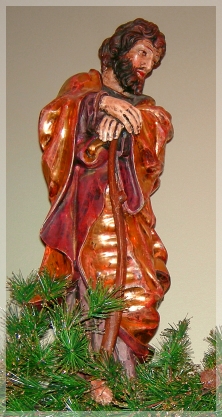
CHRIST THE KING

“My kingdom isn’t the sort that grows in this world,” replied Jesus. “If my kingdom were from this world, my supporters would have fought, to stop me being handed over to the Judaeans. So then, my kingdom is not the sort that comes from here.” [John 18:36 (NTE)]

God’s kingdom, you see, isn’t about food and drink, but about justice, peace, and joy in the holy spirit. [Romans 14:17 (NTE)]

For those of us who attend liturgical churches, yesterday was the last Sunday of the liturgical (or church) year: Christ the King Sunday. A kind of liturgical “New Year’s Eve,” it is the climax and conclusion of the Church’s year.

Starting with Advent, the first half of the church year focuses on the events of Jesus’ life: His incarnation, birth, manifestation, temptation, suffering, death, resurrection, and ascension. The second half of the church year begins on Pentecost (with the outpouring of the Holy Spirit) and, depending on Easter’s date, lasts 23 to 28 Sundays. Sometimes called Ordinary Time, this season focuses on the teachings of Jesus. Next Sunday, we start a new year with the first Sunday in Advent and begin another journey through Scripture to remind us of who we are and to whom we belong.

Like the rest of the liturgical church calendar, Christ the King Sunday is man-made rather than ordained by God. Nevertheless, having attended a liturgical church most of my life, I find comfort in regularly celebrating not just Christmas and Easter but the entire mystery of Jesus—from His incarnation through His death, resurrection, and ascension, to the gifting of the Holy Spirit and the expectation of His glorious return.

When I first saw the words “Christ the King” on the church hymn board years ago, I didn’t know that this observance is a modern addition to the church year. It was instituted in 1925 by Pope Pius XI in response to the growth of communism, fascism, atheism, and secular ultra-nationalism in Europe at that time. Although first observed by the Roman Catholic church, Protestant denominations such as the Lutheran, Anglican, Moravian, Methodist, Nazarene, and Presbyterian churches have joined in observing this day as a reminder that Christ reigns above all earthly rulers.

In the past, cults of personality have formed around leaders like Mussolini, Hitler, Stalin, Mao Zedong, and they continue to form around some world leaders today. Christ the King Sunday is a vivid reminder that our allegiance belongs to our spiritual ruler in heaven as opposed to any earthly political “messiah.” While temporal powers will fade away, Christ’s reign and His kingdom remain eternal. Whether Roman Catholic, Orthodox, or Protestant, observing Christ the King helps to move us from the politics of people to the politics of heaven.

Indeed, Jesus is unlike any other head of state in history. While most leaders are concerned with gaining, increasing, and maintaining power, Jesus gave up His divine power to live as a man among the poor and humble and to die a criminal’s death. While the world’s “kings” strive to amass wealth; King Jesus deliberately left the grandeur of Heaven to be born in a stable and live in a small village as a carpenter’s son. Believing that might makes right, the world’s leaders use economic and military might to enforce their will but Jesus chose to love and forgive his enemies. Jesus’ kingly degrees are unlike those of any earthly ruler: love God, love our neighbors, do unto others as we would have them do to us, pray for our enemies, turn the other cheek, go the extra mile, live in peace with one another, and invite the poor, crippled, lame and blind to our banquets—hardly the typical political platform!

The Kingdom of God is a present reality in our lives and yet, at the same time, the completed Kingdom is yet to come. Theologians describe it as our living in the already—what Christ has done—and the not yet—what He is yet to do when He returns in majesty and glory. Until that day, however, there will be a struggle between the kingdoms of this world and God’s Kingdom. We might want to ask ourselves to which kingdom we owe our allegiance and evaluate whether our actions, attitudes, and words reflect that allegiance. May we always remember that Jesus is our only king; indeed, He is the King of Kings and Lord of Lords!

Then I heard something like the sound of a great crowd, like the sound of many waters, and like the sound of strong thunder, saying, “Alleluia! The Lord our God, the Almighty, has become king! Let us celebrate and rejoice and give him the glory, because the marriage of the lamb has come, and his bride has prepared herself. … On his robe, and on his thigh, is written a name: King of kings, and Lord of lords. [Revelation 19:6-7,19 (NTE)]

Copyright ©2024 jsjdevotions. All rights reserved.

GRIEVING HIM

In all their suffering he also suffered, and he personally rescued them. In his love and mercy he redeemed them. He lifted them up and carried them through all the years. But they rebelled against him and grieved his Holy Spirit. So he became their enemy and fought against them. [Isaiah 63:9-10 (NLT)]

appleMany years ago, my two boys were playing at their grandparents’ house. While Grandpa worked in the garden, the brothers climbed up into the apple tree and started to throw apples at him. A patient man, their grandfather told them to stop and, when more apples came whizzing at him, he offered a sterner warning. After briefly stopping their barrage, the rascals were unable to resist the temptation and chucked more apples at Grandpa. To their surprise, this gentle and loving man turned around, picked up some apples, and returned fire. Having played ball as a boy, Gramps had a strong throwing arm and excellent aim. He didn’t pull any punches as he pitched those apples back at his grandsons. The boys, unable to maneuver easily in the tree, quickly learned the meaning of “as easy as shooting fish in a rain barrel.” When they called, “Stop, Grandpa, it hurts!” he replied, “Yes, I know it does, but you needed to learn that!” It wasn’t until those hard apples hit their bodies that the youngsters understood how much their disobedience hurt their grandfather (both physically and emotionally).
This is one of my boys’ favorite stories about their grandfather. Rather than being angry that he hurled those apples back at them, they’re proud of him. Knowing he loved them enough to discipline them, they learned a variety of lessons that day and not just that being hit by an apple hurts or not to be caught up a tree. They learned to listen to and obey their grandfather, that disobedience brings reckoning, and (after they picked up the apples) that obedience can bring rewards like apple pies. They also learned that their naughtiness grieved their grandfather as much as their punishment hurt them.

We know that Jesus experienced both physical and emotional pain when He walked the earth as a man but what did God the Father experience? As a spirit, without a nervous system, I doubt that He felt physical pain, but what about emotional pain as He saw His son rejected, suffer, and die? Does God have feelings? There are two opposing theological schools of thought about this question (the doctrine of impassibility vs. the passibility of God) and a whole lot of middle ground in-between. Not being a theologian, I’m not addressing doctrine.

Nevertheless, Scripture tells us that God can grieve and the parables of the missing coin, prodigal son, and lost sheep also tell us that God can rejoice. Throughout the Bible, we find examples of God expressing emotions like love, joy, compassion, hate, jealousy, anger and grief. Like any parent, God’s heart is touched by His children; it seems that He can feel our pain and that we can cause Him emotional pain.

Although Scripture tells us that God is compassionate and gracious, slow to anger and abounding in love, like the boys’ grandfather, God eventually will get angry. Moreover, Scripture shows us that our disobedience aggrieves our heavenly Father as much as an apple on the noggin and my boys’ defiance hurt their grandpa. When we disobey God, disgrace His name, doubt His love, forsake our faith, reject His guidance, choose hate over love or callousness over compassion, we bring sorrow, grief, and pain to God. Rather than bringing grief to God, may we always do what pleases Him, for it is in the joy of the Lord that we find strength.

And do not bring sorrow to God’s Holy Spirit by the way you live. … Get rid of all bitterness, rage, anger, harsh words, and slander, as well as all types of evil behavior. Instead, be kind to each other, tenderhearted, forgiving one another, just as God through Christ has forgiven you. … Carefully determine what pleases the Lord. [Ephesians 4:30a, 31-23; 5:10 (NLT)]

Copyright ©2024 jsjdevotions. All rights reserved.

IT’S NOT FAIR

God saved you by his grace when you believed. And you can’t take credit for this; it is a gift from God. Salvation is not a reward for the good things we have done, so none of us can boast about it. [Ephesians 2:8-9 (NLT)]

Many years ago, while my son and his pals were playing baseball in the field next to the Miller house, the ball ended up going through the Miller’s window! When my son returned home, he asked me to call Mrs. Miller and ask for the return of his ball. Once I knew how the ball came to be in her possession, I told him he had to pay for the broken window before getting back his ball. So, for the next few weeks, the boy worked extra chores to pay off his debt.

Some people think of good works like the chores my son did to redeem his baseball. They picture a heavenly bookkeeper with a holy ledger who deposits their good deeds in the credit column and their sins in the debit. Whenever they err, a withdrawal is made from the works side to pay for the sin. It seems like a good plan. After all, my son worked off his debt so why can’t we just work off our sin debt?

If God used a balance scale with good works placed on one tray and sins on the other, how would the weight of good works and sins be determined? Would putting a dollar into the red kettle at Christmas be the same as being a hospice volunteer? Would petty theft weigh the same as grand larceny or adultery as much as mass murder? How many sins would be paid off by a mission trip? What would you need to discharge the sins of deceiving a spouse, gossiping about a neighbor, taking unfair advantage of someone, misappropriating funds, or cheating on your taxes?

Salvation, however, cannot be earned nor is it for sale. That’s good news for me since I know my sins far outweigh my good works and there’s no way I could do enough to purchase my salvation. Moreover, we can’t stock up good turns, kindness, benevolence, generosity, and service to pay for future sins. Thinking our worth comes from our works undervalues God’s gift of grace because good works aren’t what save us from spiritual bankruptcy! Salvation comes from Jesus alone! He paid our sin debt in full with his blood when He died on the cross.

When my son told me about the mishap at the Millers, he insisted he wasn’t the one who hit the ball that broke their window. Claiming his innocence, he protested paying someone else’s debt. It may not have been fair but it was necessary. Someone had to pay the Millers for their busted window and no one else came forward.

As the sinless Lamb of God, Jesus was far more innocent of any wrongdoing than my son. Nevertheless, He paid both my debt and yours! The only one who was absolutely free of sin deliberately chose to take the full weight of God’s justice for sins He didn’t commit! Jesus paid a debt He didn’t owe because mankind owed a debt that couldn’t be paid! It wasn’t fair, but it was necessary.

The Gospel is good news of mercy to the undeserving. The symbol of the religion of Jesus is the cross, not the scales. [John Stott]

For the wages of sin is death, but the free gift of God is eternal life through Christ Jesus our Lord. [Romans 6:23 (NLT)]

He himself is the sacrifice that atones for our sins—and not only our sins but the sins of all the world. [1 John 2:2 (NLT)]

He personally carried our sins in his body on the cross so that we can be dead to sin and live for what is right. By his wounds you are healed. [1 Peter 2 (NLT)]

Copyright ©2024 jsjdevotions. All rights reserved.

IMITATION

Be imitators of me, as I am of Christ. [1 Corinthians 11:1 (ESV)]

mockingbirdHearing the bird’s shrill harsh scream, I looked up expecting to see a blue jay. To my surprise, it was a mockingbird. Of all the beautiful songs it can imitate, I wondered why the mockingbird chose the strident call of the jay. Then, remembering how many blue jays inhabit our neighborhood, I realized their raucous “jaaaaay” is what the mockingbird frequently hears so that has become part of his song.

It’s not just mocking birds and parrots who mimic what they hear and see. Years ago, a retired friend told me about spending Christmas with his son’s young family in Minnesota. By December 26, he grew tired of hearing the three youngsters squabble over their new toys and this grandpa decided to enjoy some peace and quiet while shoveling the snow. When his young grandson insisted on helping, he gave the youngster a small child-sized shovel but the boy complained that he wanted the big one. Telling him it would be too heavy, Grandpa refused and started shoveling. When the child kept whining about using the big shovel, my friend used a few ill-chosen words before letting the boy give it a try. Of course, once he started with it, the child cried that it was too heavy. “$@#!&)%!” said Grandpa, “I told you so!” There were a few more profanities when the boy grew bored and started to toss snowballs. Eventually, however, the shoveling was finished. While taking off their coats in the house, the youngster proudly announced to his parents, “We just shoveled the whole $@#!&)% driveway!” You can’t blame him for the bad language; like the mockingbird, he was imitating what he’d heard!

Children never have been very good at listening to and obeying their elders but they are experts at imitating us. It’s been said that we should live in such a way that we wouldn’t be ashamed to sell our parrot to the town gossip (or have our youngsters answer questions like those asked by Art Linkletter in his 1960s show Kids Say the Darndest Things.)

Children mimic more than our words; they model our behavior, as well. For years, the kids and I watched my husband give two hard shakes to the handle after locking the front door to his business. Although he’d turn toward the car, before taking a step, he’d turn back around and give that door handle at least one more hard shake—just to make sure it was good and locked. When we returned north last May, I chuckled as I watched my son do the identical thing after locking the front door of the same business! Both our words and behavior get recycled to the next generation.

Children will imitate both the positive and negative aspects of our behavior. They can learn to be polite, considerate, positive, helpful, truthful, and modest or they can learn to be rude, selfish, negative, uncooperative, deceitful, and arrogant. Do we model the right kind of behavior—not just for youngsters but also everyone we encounter? As Christ’s followers, we should—regardless of how provoked, aggravated, or tired we may be.

My father-in-law, whose given name was Paul, was called “Bill” for most of his 96 years. When asked why, he explained that everyone called him “Bill” because he walked just like a man named Bill. Whose walk do we imitate? To be worthy of the name of “Christian,” we should be imitators of Christ and walk and speak as would He. Do we?

Whoever says he abides in him ought to walk in the same way in which he walked. [1 John 2:6 (ESV)]

Therefore be imitators of God, as beloved children. And walk in love, as Christ loved us and gave himself up for us, a fragrant offering and sacrifice to God.[Ephesians 5:1-2 (ESV)]

Copyright ©2024 jsjdevotions. All rights reserved.

SUPPORTING ROLES

And what more should I say? For time would fail me to tell of Gideon, Barak, Samson, Jephthah, of David and Samuel and the prophets, who through faith conquered kingdoms, administered justice, obtained promises, shut the mouths of lions, quenched the power of fire, escaped the edge of the sword, were made strong out of weakness, became mighty in war, put foreign armies to flight. [Hebrews 11:32-34 (NTFE)]

pipevine swallowtail butterflyHebrews 11 lists the great examples of faith found in the Hebrew Scriptures. Every story, however, has a supporting cast and, while we may not remember or even know their names, they played an important role in everyone’s story. We know Moses is one of those heroes of faith but what of the midwives Shiphrah and Puah? If they hadn’t defied Pharaoh’s orders to kill newborn Hebrew boys, Moses wouldn’t have lived long enough to be found by Pharaoh’s daughter let alone lead Israel to the Promised Land!

We know the promised Messiah was to come from David’s line but that line nearly became extinct in 841 BC when Judah’s king Ahaziah died and his mother, Athaliah, seized the throne for herself. To secure her position, the queen mother murdered Ahaziah’s children (her grandchildren) and the rest of the royal family! The Davidic line remained only because Athaliah’s sister, Jehosheba, rescued Ahaziah’s infant son Joash. At great risk, she kept the boy hidden for six years until the time was right for him to be named king.

We recall the names of Esther and her uncle Mordecai but probably not that of Hegai, the eunuch in charge of the king’s harem. Without his coaching and assistance, Esther never would have captured the heart of Xerxes, become queen, and been able to save the Hebrew nation from extinction. We revere the name of David but probably don’t know the names of his thirty-seven “mighty men” listed in 2 Samuel 23. We know of Jeremiah but not Ebed-melech, the court official who risked his life to rescue the prophet from the cistern where he had been left to die.

What of those heroes of faith whose names we don’t know—people like the slave girl who told Naaman about the Samarian prophet who could heal him of leprosy? It was her testimony that introduced the Syrian warrior to the one true God of Israel. What of the king’s cup-bearer who told Pharaoh that Joseph could interpret his dream? Without his action, the story of Israel could have ended in Genesis! We only know her as the widow of Zarephath but this nameless woman fed Elijah the last of her oil and bread during a time of famine. We know Gideon but not the names of his 300 valiant men who bravely fought 135,000 Midianites. When outnumbered by 450 to 1, most soldiers would have fled, but those nameless men belong in the “Hall of Faith” along with Gideon!

The New Testament is not without its unnamed heroes of faith—consider the boy who gave his lunch, the widow who gave her two mites, and the four friends so committed to the paralytic’s healing they cut a hole in the roof and lowered him down to the Lord! What of the nameless shepherds and Magi who worshipped the newborn king? We don’t know the names of the woman at the well, the hemorrhaging woman, the Ethiopian eunuch, the repentant thief on the cross, or the Syrophoenician woman who was determined to have Jesus heal her daughter, but they were just as much heroes of faith as were Moses and Abraham.

Every story, play, or movie has both major roles and a supporting cast. While we may have the lead role in our own personal story, we are just supporting actors in the Kingdom’s story. Nevertheless, we are as essential to God’s scenario as were Shiphrah and Puah, Gideon’s 300 and David’s 37, the woman at the well, and those four faithful friends! For the most part, those supporting actors didn’t even know their own importance; nevertheless, acting in faith, they simply followed God’s direction. Let us take the small (but essential) roles God has given us and play them as well as all the unsung heroes of faith did!

There are no small roles, only small actors. [Konstantin Stanislavski]

Therefore, since we are surrounded by so great a cloud of witnesses, let us also lay aside every weight and the sin that clings so closely, and let us run with perseverance the race that is set before us, looking to Jesus, the pioneer and perfecter of faith, who for the sake of the joy that was set before him endured the cross, disregarding its shame, and has taken his seat at the right hand of the throne of God. [Hebrews 12:1-2 (NTFE)]

 Copyright ©2024 jsjdevotions. All rights reserved.

OUTSIDE THE LINES

Don’t copy the behavior and customs of this world, but let God transform you into a new person by changing the way you think. Then you will learn to know God’s will for you, which is good and pleasing and perfect. [Romans 12:2 (NLT)]

Several years ago, I purchased a beautifully drawn coloring book featuring scenes from the Colorado mountain town that had been part of our lives for thirty-five years. Since it was a gift for one of my grands, I asked the artist to sign the book. She added these words to her signature: “Don’t be afraid to color outside the lines!” Was the artist’s advice limited to her book or was it about something more?

“Coloring inside the lines” has come to mean thinking or acting within the generally accepted guidelines. It’s staying within your comfort zone by doing what’s safe—the way it’s always been done. Creating a new and better picture, however, requires coloring outside the lines! Although it can get a little messy, coloring outside the lines means thinking outside the box, seeing new possibilities, stepping out of the norm, using different colors, and drawing new lines. It must be willing to get uncomfortable. Doing God’s work often requires coloring or living outside the lines draw by society!

The unconventional John the Baptist lived outside the lines. A Nazarite from birth, he was an ascetic who practiced self-denial, wore a rough robe of camel’s hair with a leather belt, and ate locusts and honey. Not one to play it safe, he called the Pharisees and Sadducees a “brood of snakes!” and dared to call King Herod and his wife adulterers! Nevertheless, it was by coloring outside the lines that the Baptizer fulfilled God’s purpose to be the voice in the wilderness that prepared the way for Jesus.

Elisha lived outside the lines when he left his prosperous farm and team of oxen to become Elijah’s successor—an odd choice his family and neighbors probably didn’t understand. The young shepherd boy David stepped outside the lines when he dared to take on Goliath—something none of Saul’s seasoned soldiers had attempted. Abigail went outside the lines when she kept David from taking vengeance on her foolish husband as did Rahab when she helped the Israelites. Joseph colored outside the lines when he remained with the pregnant Mary rather than breaking their engagement. Mary of Bethany went outside the lines when she sat with the men rather than help in the kitchen and again when she anointed Jesus with expensive perfume. Peter colored outside the lines when he stepped out of the Jewish code of ritual purity and ate with the Gentile Cornelius as did Paul when he insisted Gentiles didn’t need to become circumcised.

Coloring outside the lines is what we do when we allow God to take control of our lives; it’s leaving your livelihood and tax booth as did Matthew or stepping out of the boat onto the water as did Peter. Staying inside the lines is failing to trust God enough to answer His call and follow His lead. Staying inside the lines is what the Pharisees did. It’s being more concerned about what others think than what God says; it’s being more concerned about how we appear than who we really are.

Coloring outside the lines is refusing to compromise our faith; it is obeying God before man. The artist’s advice to my grand applies to us all: “Don’t be afraid to color outside the lines!” Let’s not be afraid to live outside the lines—honestly, boldly, creatively, faithfully, and joyfully—fulfilling God’s purpose and trusting in His promises.

For God has said, “I will never fail you. I will never abandon you.” So we can say with confidence, “The Lord is my helper, so I will have no fear. What can mere people do to me?” [Hebrews 13:5b-6 (NLT)]

Copyright ©2023 jsjdevotions. All rights reserved.