GOOD INTENTIONS

This is why I remind you to fan into flames the spiritual gift God gave you when I laid my hands on you. For God has not given us a spirit of fear and timidity, but of power, love, and self-discipline. [2 Timothy 1:6-7 (NLT)]

rocky mountain national parkBritish mystery author Ruth Rendell often received letters from would-be authors who wanted to know how to get started. Her response was simple: “I tell them to stop writing to me and get on with it.” Author Jodi Picoult said when she can’t write a good page, she simply revises a bad one while pointing out, “You can’t edit a blank page.” If we want a page filled with words, we’ve got to sit down and write them.

Even when working for God, we need more than good intentions or even prayer. Ten years ago, I was part of a Christian women’s ministry that hosted a web site for twelve writers all of whom believed they’d been called by God to expand His kingdom through their writing. We were a diverse multi-generational group and the website offered links to our individual blogs. We regularly shared our prayer concerns with one another and rarely a week went by without a prayer request for divine inspiration for someone’s writing. Sadly, the ministry disbanded within two years because only a few of the writers ever wrote anything. Apparently, good intentions and even prayer were no substitute for actually sitting down and doing the work!

By simply leaving things up to God and giving Him the entire responsibility for our work, we yield to the temptation not to take any initiative. While God is the one who enables us and deserves the glory, we are His hands and feet here on earth and the ones who are called to do His work! Remember, the Israelites had to take the initiative by stepping into the Jordan River before God stopped its flow and they were the ones who marched around Jericho for seven days before God made its walls come tumbling down! I believe in the power of prayer but prayer alone didn’t get the Israelites across the river or defeat Jericho; the people had to do the walking and the wielding of the swords. In the same way, prayer alone doesn’t provide us with the words for a devotion, sobriety, a job, health, good grades, a thriving business, a successful marriage, a college degree, or a speaking ministry. God gives us the power, guidance, inspiration, and even victory, but we still have to do the work!

When we’re called by God, He will provide us with the talent, tools, situation, time, assistance, and spiritual gifts necessary for that task. The one thing He won’t provide is the finished product. He expects us to do the labor and, as powerful as prayer is, it is no substitute for work. When Jesus spoke of moving mountains and promised us, “You can pray for anything, and if you have faith, you will receive it,” He wasn’t offering us a magic wand to capriciously move mountains into the sea. If God really wants that mountain moved, however, He might just provide the shovel and tell us to start digging!

In Eden, God gave man the gift of work and a sense of purpose. After the fall, however, thistles and thorns appeared and man’s work became difficult. Work was still good; it just wasn’t easy. When faced with a garden full of weeds, we can pray those weeds will disappear and wait for divine intervention or, while praying, we can put on our work gloves and start pulling them out!

I consider it an error to trust and hope in any means or efforts in themselves alone; nor do I consider it a safe path to trust the whole matter to God our Lord without desiring to help myself by what he has given me; so that it seems to me in our Lord that I ought to make use of both parts, desiring in all things his greater praise and glory, and nothing else. [St. Ignatius]

Pay careful attention to your own work, for then you will get the satisfaction of a job well done, and you won’t need to compare yourself to anyone else. For we are each responsible for our own conduct. [Galatians 6:4-5 (NLT)]

Copyright ©2022 jsjdevotions. All rights reserved.


WHY DO WE WATCH? 

I will walk with integrity of heart within my house; I will not set before my eyes anything that is worthless. I hate the work of those who fall away; it shall not cling to me. [Psalm 101:2-3 (ESV)]

rainbowWhile writing about curiosity yesterday, I thought about our insatiable curiosity concerning the lives of others. Some people think nothing of prying into other people’s lives by asking how much it cost, how much you’re paid, what the grade was, and more. The number of followers of the various social media platforms and fans of tell-all books, gossip magazines, tabloids, and reality TV tells me plenty of people want to know all that and more. Whether we know them or not, we seem to have a voracious appetite for the lives of other people, especially the lives of celebrities, former celebrities, one-time-wonders, housewives, bachelors, bachelorettes, the rich and privileged, and just about everyone else. We have talk shows where the more salacious the content the better and people come to blows after revealing sordid betrayals. We have assorted judge shows where in-law problems, unknown paternity, infidelity, and other poor choices reign. Private disagreements, personal relationships, and shocking secrets are openly aired for the curious world.
As much as I struggle to understand why any of us are interested in other people’s private lives, I find it even harder to comprehend why people choose to make public spectacles of themselves. Reality TV, of course, isn’t real and those “real housewives” aren’t really “housewives.” Knowing that circumstances are contrived to guarantee crisis, conflict, and drama, I wonder why people deliberately allow themselves to be manipulated for their five minutes of fame (or infamy). Considering the number of people who have an incredible willingness to freely share the most intimate details of their lives with the world, it appears as if curiosity and braggadocio are two sides of the same coin.

Perhaps it’s conceit, egotism, or a weird sort of arrogance that leads people to think that, no matter how appalling, their every thought, feeling, experience, meal, or intimate moment is worth sharing with the world. People have become so immodest that they will bare their souls and just about everything else to complete strangers. They are like exhibitionists who leave the curtains half open to dance in front of the window and their curious audience is like the voyeur who peeks through those curtains. Sadly, our curiosity has turned people parading their private lives into a lucrative business (apparently the more dysfunctional the better.)

It’s almost malevolent the way people want to see others at the worst. Perhaps we’re drawn into this tabloid culture so we can congratulate ourselves on being nicer, saner, smarter, more moral, and less superficial. Pride puffs us up because we don’t hoard, commit adultery, spend excessively, or keep having needless plastic surgery. Self-righteously, we pat ourselves on the back for not living vicariously through our talented children, exploiting our families, brawling in public, or letting cameras into our bedrooms. We feel superior because we’re better behaved, pay our debts, and know who fathered our children.

Granted, there is a difference between watching chefs contend for top honors, brainiacs compete for money, super athletes vie for a title, or pickers search for rare artifacts and watching people engage in attention-grabbing, immoral, inappropriate, or self-destructive behavior. Nevertheless, there is a fine line between innocent interest and prurient curiosity and crossing that line leads us into sin’s territory of judgment and pride.

To rework Jeff Foxworthy’s quote about going to the state fair: “If you ever start feeling like you have the goofiest, craziest, most dysfunctional family in the world, all you have to do is watch reality TV because pretty soon you’ll be going, ‘You know, we’re alright. We are dang near royalty!’” Perhaps people’s bad behavior, excessive alcohol consumption, emotional outbursts, humiliation, tears, and turmoil became entertainment simply to make us feel like saints in comparison to them. Let’s not fool ourselves; we’re not! Perhaps it’s time to check our curiosity and rethink how we spend our time and with what we fill our minds.

Men compare themselves with men, and readily with the worst, and flatter themselves with that comparative betterness. This is not the way to see spots, to look into the muddy streams of profane men’s lives; but look into the clear fountain of the Word, and there we may both discern and wash them; and consider the infinite holiness of God, and this will humble us to the dust. [Robert Leighton (A Puritan Golden Treasury)]

Finally, brothers, whatever is true, whatever is honorable, whatever is just, whatever is pure, whatever is lovely, whatever is commendable, if there is any excellence, if there is anything worthy of praise, think about these things. [Philippians 4:8 (ESV)]

Since you have been raised to new life with Christ, set your sights on the realities of heaven, where Christ sits in the place of honor at God’s right hand. Think about the things of heaven, not the things of earth. For you died to this life, and your real life is hidden with Christ in God. … Put on your new nature, and be renewed as you learn to know your Creator and become like him. [Colossians 3:1-3,10 (ESV)]

Copyright ©2022 jsjdevotions. All rights reserved.

CURIOSITY

When the Woman saw that the tree looked like good eating and realized what she would get out of it—she’d know everything!—she took and ate the fruit and then gave some to her husband, and he ate. [Genesis 3:6 (MSG)]

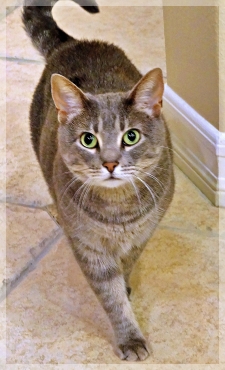
catI often wonder why Eve ate that forbidden fruit and why Adam so foolishly followed suit. Of course, we have the clever, devious and deceitful serpent to blame. Assuring Eve that God lied to her, he said she wouldn’t die if she ate the apple. He promised that she’d be just like God with the knowledge of good and evil. God hadn’t given Adam and Eve any reason to doubt His word, so why did they succumb so easily to Satan’s temptation?

It certainly wasn’t hunger that led them to that forbidden fruit; they lived in Eden where everything was good and all of their needs were met. The two already had the knowledge of all that was good so why were they so interested in learning about evil? The serpent, however, piqued Adam and Eve’s curiosity. Seeing that lovely tree with luscious looking fruit, they got inquisitive. Why did God forbid that fruit? What would happen if they ate it? What did it taste like? Who would know? What was evil? What was death? What would it be like to have that knowledge—to know everything? Curiosity tugged at the two of them and they started yearning for what wasn’t theirs to have.

Curiosity was given to us by God and it is a beautiful gift. It makes us wonder what lies beyond and question what things are made of, how they work, and how they can be used. It causes us to ask, “What would happen if…?” Curiosity moved mankind forward in an amazing and awesome way and, without it, we wouldn’t have things like the wheel, electricity, solar energy, computers, vaccines, telescopes, or space travel. As William Arthur Ward said, “Curiosity is the wick in the candle of learning.”

Along with being that wick in the candle of learning, however, curiosity can be a double-edge sword. While it’s what makes a child explore and ask “Why?” it’s also what makes him stick a fork in an electric socket, swallow button batteries, and bite into detergent pods. Curiosity sent the Magi to Bethlehem and the shepherds to the manger but it also caused Adam and Eve to disobey God. It was curiosity that caused the Ethiopian eunuch to ask Philip to explain Isaiah but it also caused the prodigal son to explore a profligate lifestyle.

Untamed curiosity can make us vulnerable to the enemy’s attacks. It was curiosity that caused David to watch Bathsheba from his rooftop and lust for what wasn’t his to possess and curiosity made the men of Beth Shemesh peek in the Ark at what wasn’t theirs to see. Curiosity asks, “What’s the harm in one taste…one touch…one sip…one try…one time…one look?” Remember, Lot’s wife took just one inquisitive look back at Sodom and it didn’t end well for her.

“Where would we be today if no one got curious?” asked the teacher. “In the Garden of Eden!” answered the little boy. When curiosity leads us to be displeased with the wrongs of the world, it is a blessing. But, when curiosity leads us to be discontented with the blessings we have, as it did with Adam and Eve, it only leads to trouble. Curiosity isn’t a sin but what we do with it can be! Like free will, curiosity is a God-given gift but, like free will, it must be used with caution. The choice is ours.

Curiosity is a kernel of the forbidden fruit which still sticketh in the throat of a natural man, sometimes to the danger of his choking. [Thomas Fuller]

When God, your God, cuts off the nations whose land you are invading, shoves them out of your way so that you displace them and settle in their land, be careful that you don’t get curious about them after they’ve been destroyed before you. Don’t get fascinated with their gods, thinking, “I wonder what it was like for them, worshiping their gods. I’d like to try that myself.” [Deuteronomy 12:29-30 (MSG)]

Copyright ©2022 jsjdevotions. All rights reserved.

SINS OF OMISSION

Remember, it is sin to know what you ought to do and then not do it. [James 4:17 (NLT)]

ALMIGHTY and most merciful Father; We have erred, and strayed from thy ways like lost sheep. We have followed too much the devices and desires of our own hearts. We have offended against thy holy laws. We have left undone those things which we ought to have done; And we have done those things which we ought not to have done; And there is no health in us. [The Book of Common Prayer (1928)]

snowdrop - windflowerA sin of commission is the willful act of doing something that violates God’s commands in Scripture. With a little self-examination, our sins of commission are pretty easy for us to spot because they’re blatant and (more often than not) deliberate. While we may try to rationalize our actions, we know when we’ve lied, cheated, coveted, stolen or worse.
On the other hand, sins of omission are not doing what is right or failing to do as instructed. For example, adultery is a sin of commission but not respecting, honoring or loving our spouse is the more subtle sin of omission! [Ephesians 5:22-33] The things we’ve left undone that should have been done are as much a sin as the things we shouldn’t have done that we did!

Many of Jesus’ parables are as much about people not doing what is right as they are about people doing what is wrong. A priest and a Levite ignored the plight of a fellow Jew lying naked and half-dead in a ditch, the invited guests didn’t come to the great feast, the five bridesmaids didn’t bring enough oil, a servant didn’t invest his master’s money, the Pharisee didn’t humble himself, the son didn’t work in the vineyard, and the forgiven debtor didn’t forgive his fellow servant’s debt. All were sins of omission.

Take a moment to think of the things Scripture commands us to do that we frequently don’t. Chances are we frequently ignore at least one of the commands found in Ephesians—to always “be humble and gentle…patient with each other, making allowance for each other’s faults.” [4:2-3] Furthermore, we are to rid ourselves of “all bitterness, rage, anger, harsh words, and slander” and be “kind to each other, tenderhearted, forgiving one another.” [4:31-32]. For that matter, do we always serve as the “salt of the earth” or the “light of the world”? [Matthew 5:13-14] How are we doing on the loving our enemies and praying for those who persecute us? [Matthew 5:44] Chances are we haven’t erased from our lives “all deceit, hypocrisy, jealousy, and all unkind speech.” [1 Peter 2:1] We frequently pass by people in need [1 John 3:17]. Do we always love the Lord with all our heart, soul, mind and strength and how are we doing on loving that obnoxious neighbor with the dog who poops on our lawn? In the forgiveness department, have we skipped over the adulterous ex-spouse, the friend who betrayed our trust, or the co-worker who maligned us and got the promotion that should have been ours?

When a woman in the crowd called out, “God bless your mother!” Jesus replied, “But even more blessed are all who hear the word of God and put it into practice.” As His followers, we are to be doers of the Word. That’s all of the Word—both the dos and the don’ts and the shalts and shalt nots!

The omission of good is no less reprehensible than the commission of evil. [Plutarch]

If we claim we have no sin, we are only fooling ourselves and not living in the truth. But if we confess our sins to him, he is faithful and just to forgive us our sins and to cleanse us from all wickedness. If we claim we have not sinned, we are calling God a liar and showing that his word has no place in our hearts. [1 John 1:8-10 (NLT)]

Copyright ©2022 jsjdevotions. All rights reserved.

RELUCTANT HEROES

Now go, for I am sending you to Pharaoh. You must lead my people Israel out of Egypt.” But Moses protested to God, “Who am I to appear before Pharaoh? Who am I to lead the people of Israel out of Egypt?” [Exodus 3:10-11 (NLT)]

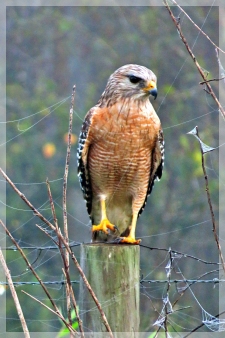
red-shouldered hawkIn the late 1970s, psychologists Suzanna Imes and Pauline Rose Clance developed the concept of what is known as the “imposter syndrome.” Loosely defined as doubting one’s abilities and feeling like a fraud, it is believing that you are not as competent as others perceive you to be. The impostor syndrome manifests in failing to realistically assess our competence and skills, self-denigration, a fear of not living up to expectations, and attributing any of our successes to someone or something else, like luck.

When God called out to Moses from the burning bush, He assigned Moses the task of going to Pharaoh and leading the people of Israel out of Egypt. Moses’ response is a classic example of imposter syndrome. As the princess’ son, he spent forty years as a prince in Pharaoh’s palace, was well-educated, and knew the royal protocol, language, and culture of Egypt and, as a Hebrew, he also knew the language, history, culture, expectations, and God of Israel. Although he was uniquely qualified for the task, Moses belittled his speaking ability and showed his fear of failure with the question, “What if they won’t believe me or listen to me?”

Moses, of course, is not the only one of the Bible’s heroes to suffer from the “imposter syndrome” when called to do God’s work. Isaiah thought he was too sinful, Jeremiah thought he was too young, and then there’s Gideon. When we first meet him, Gideon is hiding in a winepress while threshing wheat, which seems somewhat cowardly. The people of Israel, however, had been oppressed for seven years by marauding nomadic tribes like the Midianites. Their livestock and crops were being pillaged and the people were being starved into submission as they hid in caves. Not about to let his family starve, Gideon had come up with a clever way to conceal his activity and threshing wheat in a wine press may have been wiser than it was cowardly. Nevertheless, when the angel of the Lord called on him to rescue Israel, the man disparaged not just himself but his entire clan of Manasseh. Even though the people had no other leader, Gideon was sure he had neither status nor authority to call up an army.

Convinced that they weren’t capable of doing God’s work, Moses, Isaiah, Jeremiah, and Gideon listed all that they weren’t rather than looking at all of the things God is. They didn’t see what they brought to the table and certainly didn’t understand the power they’d receive from God. It wasn’t eloquence that caused Egypt’s plagues or caused the Israelites to follow Moses nor was it strict adherence to the law or maturity that enabled Isaiah and Jeremiah to prophesy. It certainly wasn’t status and authority that led to Gideon’s victories. It was the power of God!

While there are many competent, experienced, and skilled people in the world, God isn’t interested in whether or not we’re qualified. God is interested in our devotion to Him. If we’re committed to doing His work, God will provide the qualifications! If we’re not devoted to God, however, we’ll remain unqualified regardless of our eloquence, status, authority, talents, wisdom, or expertise. Let us never underestimate our abilities but, more important, let us never underestimate the power of our God!

Many Christians estimate difficulties in the light of their own resources, and thus attempt little and often fail in the little they attempt. All God’s giants have been weak men who did great things for God because they reckoned on His power and presence with them. [James Hudson Taylor]

Then the Spirit of the Lord clothed Gideon with power. He blew a ram’s horn as a call to arms, and the men of the clan of Abiezer came to him. He also sent messengers throughout Manasseh, Asher, Zebulun, and Naphtali, summoning their warriors, and all of them responded. [Judges 6:34-35 (NLT)]

Copyright ©2022 jsjdevotions. All rights reserved.

TAKE THE RISK

Be strong and courageous! … Do not be afraid or discouraged, for the Lord will personally go ahead of you. He will be with you; he will neither fail you nor abandon you. [Deuteronomy 31:6a,8 (NLT)]

Let all who fear the Lord repeat: “His faithful love endures forever.” … The Lord is for me, so I will have no fear. What can mere people do to me? [Psalm 118:4,6 (NLT)]

great egret
Judge Guido Calabresi regularly asks his Yale law students to imagine receiving an offer of an amazing invention that could improve people’s lives in every imaginable way. In exchange for this invention, however, the lives of at least 1,000 randomly selected young people would be taken every year. When asked if they’d accept the deal, his students inevitably conclude they wouldn’t. Calabresi then asks them the difference between that offer and the automobile. The very thing that allows us to travel, see loved ones, easily move products across the country, and do things that couldn’t be done otherwise, kills even more than that! Over 2,600 teens (16-20) accounted for auto accident fatalities in 2019 and, with over 46,000 car fatalities last year, more than 150 people of every age die each day because of a car. Be that as it may, we’re not about to give up driving!

Calebresi uses his example to illustrate how selective we are in our fears. We underestimate and accept chronic risks like riding in a car while overestimating prominent ones like a terrorist attack or plane crash. In actuality, rather than dying from either of those things, we’re more likely to die by choking on food or slipping in the shower or tub but, preferring bathing, eating, and even driving to the alternatives, we decide they’re worth the risk. On the other hand, after assessing the perils involved in things like free solo climbing, running with the bulls, or base jumping, most of us probably decide they’re not worth the risk.

In contrast, any risk we take in obedience to God always is worth it. Regardless of the danger, we must obediently accept the risks in the challenges and tasks He gives us. Think of what Abraham risked by packing up his family and leaving Haran for an unknown destination. Think of the risks taken by the midwives Shiphrah and Puah when they defied Pharaoh by letting boy babies live or the risk Moses took when he returned to Egypt and confronted Pharaoh. It was a huge risk when Gideon and his 300 men took on an army 400 times their size and when David faced Goliath with just a sling and stones. In spite of the risk, Esther approached the king, Daniel defied the law by praying, and the bleeding woman touched Jesus’ robe. Joseph of Arimathea took a risk when he asked Pilate for Jesus’ body and Peter and John risked imprisonment and worse when they defied the Council by continuing to share the gospel. When we search Scripture, we don’t find people who assessed the risks and played it safe. We find God’s version of bungee jumpers and wing-suit flyers—faith-filled and obedient risk takers.

Every God-sent risk comes with a God-sent promise. He will remain faithful to us and be present in the risk. He will protect and empower us and we’ll never need more than what He supplies. As followers of Jesus, we don’t walk by sight. In spite of the risks, we walk by faith because faith means we’re willing to risk anything for God!

Trust is faith that has become absolute, approved, and accomplished. When all is said and done, there is a sort of risk in faith and its exercise. But trust is firm belief; it is faith in full bloom. Trust is a conscious act, a fact of which we are aware. [E.M. Bounds]

Don’t be afraid, for I am with you. Don’t be discouraged, for I am your God. I will strengthen you and help you. I will hold you up with my victorious right hand. [Isaiah 41:20 (NLT)]

…For God has said, “I will never fail you. I will never abandon you.” So we can say with confidence, “The Lord is my helper, so I will have no fear. What can mere people do to me?” [Hebrews 13:5-6 (NLT)]

Copyright ©2022 jsjdevotions. All rights reserved.