TATTOOS – Part 2

Don’t you realize that your body is the temple of the Holy Spirit, who lives in you and was given to you by God? You do not belong to yourself, for God bought you with a high price. So you must honor God with your body. [1 Corinthians 6:19-20 (NLT)]


While the New Testament does not specifically address tattooing, my friend’s question about tattoos got me wondering whether it’s addressed in general terms. Because tattoos apparently originated in things like pagan symbolism, superstition, and idolatry, some maintain they’re prohibited in Scripture. Indeed, the Israelites were prohibited from worshipping the pagans’ gods, following their customs, and participating in “detestable acts” like child sacrifice and the New Testament warns of sorcery and idolatry, but applying those words to tattoos seems a long stretch. The dates of holidays like Christmas (Saturnalia), All Saints’ Day (Samhain), and Valentine’s Day (Lupercalia) have pagan beginnings as do customs like placing flowers on graves, embalming, and celebrating birthdays. Must we abandon those (along with the heart symbol) because of their pagan origins? In that case, we’ll need to ditch our calendars since both the days of the week and the names of the months are founded in astrology and pagan gods (i.e., Saturday/Saturn, Thursday/Thor, March/Mars, and June/Juno)! Where do we draw the line?

Just because pagans did something doesn’t necessarily mean it is sinful. Before condemning every pagan custom, we should remember that even the pagans ate, harvested crops, worshipped, and prayed! In fact, much of the early church’s success was because it adapted to (but didn’t adopt) the pagan culture of its time without compromising the gospel message. “Like the apostle Paul,” said pastor and theologian Dr. E. Glenn Hinson, “they sought to be all things to all people, that Christianity might become the religion of as many as possible.”

The Apostle Paul refers to a Christian’s body as God’s temple and some condemn tattoos with this verse. Likening tattoos to graffiti in the sanctuary of a church, they consider them nothing short of vandalism or defilement. Citing Paul, they maintain that altering our bodies in any way is a sin. Again, where do we draw the line—at make-up, plucking eyebrows, shaving, piercings, coloring hair, Lasix and cataract surgery, corrective and reconstructive plastic surgeries, Botox, or even Spanx? All alter our bodies in one way or another. Since the Apostle was specifically addressing sexual immorality among believers, that’s not what Paul had in mind with his words.

Perhaps the best Scripture to guide us regarding any body embellishment is found in 1 Peter 3. Rather than prohibiting adornments altogether, Peter was emphasizing a proper sense of values. Materialism, boastfulness, conceit, attention seeking, and obsession with sex existed in the 1st century just as they do today. Whether it’s a body entirely covered with tattoos, one enhanced with every sort of plastic surgery, a see-though gown with plunging neckline, heavy gold chains around the neck and gold rings on every finger, or tee shirts with rude or hateful messages on them, none seem to display the Spirit of God or represent the way our humble, gentle, and holy Lord would have appeared.

How we adorn our bodies is one of those grey areas that, to some extent, is a matter of taste and judgment. Remembering that we are created in God’s image and hold His Holy Spirit within us, we must be led by the Spirit, the Word, and common sense. Clearly, any practice that is vulgar, ostentatious, insensitive, or a distraction to one’s Christian influence should be avoided yet, even those guidelines are open to interpretation. When in doubt, I find it best to err on the side of caution and ask, “What would Jesus do?”

Our lifestyle, language, attitudes, and manner of dress reflect on His name. He leads us in paths of righteousness for His name’s sake. Unless you are honestly convinced that the thing in question will bring glory to God, then don’t do it. [Curtis Hutson]

Don’t be concerned about the outward beauty of fancy hairstyles, expensive jewelry, or beautiful clothes. You should clothe yourselves instead with the beauty that comes from within, the unfading beauty of a gentle and quiet spirit, which is so precious to God. [1 Peter 3:3-4 (NLT)]

Copyright ©2023 jsjdevotions. All rights reserved.

TATTOOS – Part 1

Do not cut your bodies for the dead, and do not mark your skin with tattoos. I am the Lord. [Leviticus 19:28 (NLT)]

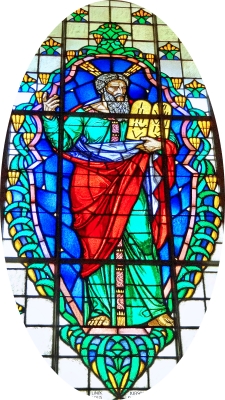
Moses - Meiringen - Michaelskirch
Since Leviticus 19:28 seems to prohibit tattoos, some people mistakenly believe that that it’s a sin for a Christian to be tattooed. My attention was drawn to this specific verse because a friend’s parents had cautioned him throughout his youth that a tattoo would keep him out of God’s kingdom.

Even though the word “tattoo” appears in most Bible translations of this verse, Scripture makes no specific reference to tattoos as we understand them today—a permanent mark or design on one’s body made by depositing pigment beneath the surface of the skin. The original Hebrew word was kethobeth; appearing just this one time, it appears to mean incised writing. Whether this was a scar from cutting (previously mentioned in this verse), a brand, or a mark using dye is unclear. The English word “tattoo” comes from tatau, tatatau, and similar words found in the tribal cultures of Polynesia and didn’t even enter the English language until 1771 when Captain James Cook (and his freshly tattooed sailors) returned from their first South Pacific voyage. Published in 1611, the King James Bible more correctly translates kethobeth as “mark.”  We really don’t know if Leviticus 19:28 was a blanket prohibition of all body markings or just certain types nor do we know if it applied to all circumstances or just specific ones like mourning, idolatry, or blasphemy.

Nevertheless, we’re curious about the various prohibitions in the Mosaic law and often wonder about God’s reasoning behind them. Many laws that seem quite arbitrary, like that in Leviticus 19:28, may well have been to distinguish the Israelites from the pagan customs they left in Egypt and would encounter in Canaan. Archeology indicates that ritualistic cutting was common in the Canaanite, Hittite, and Mesopotamian cultures when mourning the dead or honoring their gods. In their false belief that drawing blood called the attention of the gods, 1 Kings 18 tells us the prophets of Baal, “following their normal custom,” cut themselves with knives and swords “until the blood gushed out!” after they failed to call down fire from heaven.

Since we can’t understand God any better than an ant can understand us, trying to determine His reasoning behind many of the Torah’s laws is an exercise in futility. Moreover, obedience to God’s word isn’t dependent upon our understanding; His laws are to be obeyed simply because He is God and we are not. If the Israelites were presumptuous enough to ask God’s justification for the 613 mitzvot (commandments) in the Torah, His answer would have been the same one our parents gave us when we whined about curfews, TV time, proper attire, and being nice to our annoying little brother: “Because I said so!” God doesn’t need to justify His reasoning to His children any more than did our parents to us!

Heeding his parents’ caution about tattoos, my friend never got one but his grandchildren have! I assured him that their body ink has no bearing on their final destination. While many of the Old Testament laws are guidelines for knowing how to love God and our neighbor, they are not the standard by which Christians measure their conduct. We wear garments made of two or more kinds of fabric, trim our beards and side burns, consume dairy and meat in the same meal, and eat things like bacon, shrimp, and shellfish—all of which defy the Torah’s laws, yet no one claims any of those things will keep us out of the Kingdom and neither will tattoos!

When Jesus died on the cross, He put an end to the Old Testament law (even the one about body markings). As Christians the only law we are under is that of Christ: to love God with our heart, soul, and mind and to love our neighbors as ourselves!

Before the way of faith in Christ was available to us, we were placed under guard by the law. We were kept in protective custody, so to speak, until the way of faith was revealed. … The law was our guardian until Christ came; it protected us until we could be made right with God through faith. And now that the way of faith has come, we no longer need the law as our guardian. [Ephesians 3:23, 24-25 (NLT)]

Copyright ©2023 jsjdevotions. All rights reserved.
HANUKKAH (2) – FEAST OF DEDICATION

Look at my servant, whom I strengthen. He is my chosen one, who pleases me. I have put my Spirit upon him. He will bring justice to the nations. [Isaiah 42:1 (NLT)]

In the same way, let your light shine before others, that they may see your good deeds and glorify your Father in heaven. [Matthew 5:16 (NLT)]
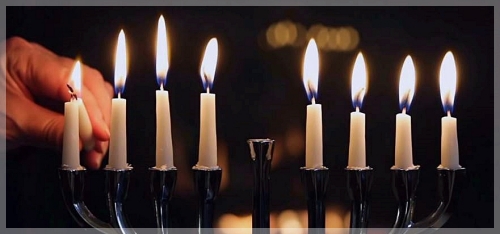
menorah

Most of us associate Hanukkah with Judaism’s menorah. Although the books of the Maccabees mention the relighting of the Temple’s lampstand/menorah, they make no mention of a miracle of oil. However, the Talmud (a collection of discussion and commentary on Jewish history, customs, law and culture) does. It claims that, while only one small flask of consecrated oil was found to light the menorah that first day, the lamp remained lit the entire eight days of celebration until new oil could be consecrated.

Although the Temple’s menorah had seven branches with wicks that burned fresh olive oil, Hanukkah’s menorah usually has nine branches with nine candles. Eight of those candles represent each day of the feast. The ninth candle, often placed in the center and slightly higher than the rest, is called the shamash, meaning servant. Rather than lighting each candle with a match, only the shamash is lit. It is this “servant” candle’s flame that is used to ignite the rest. Upon learning this, I couldn’t help but think of the Messianic prophecies of a suffering servant found in Isaiah 53. That servant was Jesus—He was the shamash who brought God’s light into the world and, like the shamash candle, He gave His light to our lives. By trusting in Him, Jesus said we become  “children of the light,” and, as His children, we are His servants. The Great Commission tells us that we are to be the shamash candles who continue to bring His light into our troubled world.

Thinking of Hanukkah merely as a festival of lights, however, misses the heart of this story—the rededication of the Temple. When a ragtag group of Jewish rebels retook the Temple from the powerful Seleucid army, the Temple had been desecrated and profaned. Before resuming worship there, the Temple had to be cleaned, the idols removed, the pagan altar dismantled, and a new altar consecrated. Only after they made it a fitting place for Jehovah to live did they re-dedicate the Temple to God.

For the people of Judah, the Temple was where God resided. For the people of Jesus, however, it is our bodies—our hearts, minds, and souls—that serve as a temple for God’s Holy Spirit. As believers, we are God’s temple individually and, as the body or church of Christ, we are His temple collectively. As His temple, we should be as holy and pure as were the Temple’s menorah and altar. Nevertheless, it’s difficult to walk through this sinful world and not have some of its filth contaminate us. Things like hate, anger, prejudice, envy, pride, deception, and greed defile us as much as that pig’s blood and idol of Zeus defiled Jerusalem’s Temple. Worse, as the collective temple of God, we’ve seen His church desecrated with things like corruption, exploitation, abuse, hypocrisy, bigotry, and shoddy, distorted and false doctrine. Like the Maccabees, do we need to do some cleaning of His holy temple?

The season of Hanukkah reminds us that Jesus is the servant whose light overcame the darkness of the world. My prayer for this Christmas season is that we allow Hanukkah’s story and traditions to inspire us so that we rid our lives of all that defiles His temple. Let us rededicate ourselves to the Lord and, as His servants, may we glorify Him in all we do.

He that chooses God, devotes himself to God as the vessels of the sanctuary were consecrated and set apart from common to holy uses, so he that has chosen God to be his God, has dedicated himself to God, and will no more be devoted to profane uses. [Thomas Watson]

Don’t you realize that your body is the temple of the Holy Spirit, who lives in you and was given to you by God? You do not belong to yourself, for God bought you with a high price. So you must honor God with your body. [1 Corinthians 6:19-20 (NLT)]

Copyright ©2022 jsjdevotions. All rights reserved.

WHITE LIES

You shall not steal; you shall not deal falsely; you shall not lie to one another. [Leviticus 19:11 (ESV)]

A faithful witness does not lie, but a false witness breathes out lies. … A false witness will not go unpunished, and he who breathes out lies will perish. [Proverbs 14:5,19:9 (ESV)]

squirrel
In the movie Liar Liar, comedian Jim Carrey portrayed a glib lawyer who plays fast and loose with the truth. After his son wishes his father would tell the truth, the insincere and conniving man finds it impossible to lie and immediately gets himself into hot water. Many of his problems, however, don’t come from telling the truth as much as they do from his callousness and insensitivity when he does. The self-centered man doesn’t know the difference between brutal honesty and truthful tact, crudeness and candor, vulgarity and restraint, or rudeness and civility. Among other things, the comedy illustrates that lying, while wrong, is often far easier than telling the truth.

At one time or another (probably more if we sell used cars), we’ve all told what we think of as “white lies.” Deception of any kind didn’t exist until Satan, the father of all lies, brought it into the garden. The deceit continued as both Abraham and Isaac lied about their wives, Sarah lied to God about laughing, Jacob and Rebecca tricked Isaac, Laban and Leah hoodwinked Jacob, Joseph’s brothers lied to Jacob, and Potiphar’s wife lied about Joseph. The lies continued as Israel’s midwives lied to Pharaoh, Pharaoh lied to Moses, Rahab lied to the king’s men, Samson lied to Delilah, Saul lied to David, both Michal and Jonathon lied to Saul, David lied to Ahimelech, Gehazi lied to Naaman, Elisha misled the Syrian army, Peter lied about following Jesus, and Ananias and Sapphira lied to Peter!

Some of those liars were good people and others were not. They all lied for different reasons and some of their falsehoods were less treacherous than others. Is there such a thing as an innocent white lie and, if so, when does it become a guilty gray? Since Rahab’s lie protected Israel’s spies, is there such as thing as a righteous lie? Can we lie to protect ourselves or someone else, to prevent needless worry, or to spare feelings? If all lying is wrong, can deception be less wrong in some situations?

Scripture, however, doesn’t appear to split hairs when it comes to lies. The Israelites were commanded to be truthful in all things and lying is condemned throughout Scripture. Jesus said he was the way and the truth and truth isn’t relative. Regardless of its size or intent, any lie is a deception and the Bible seems pretty clear about deceit; God doesn’t like it! The end never justifies the means if the means involves sin.

For the most part, a white lie is just the lazy way out of a sticky situation. It’s easier to spin off a lie than to find a way to be honest, tactful, and considerate. Nevertheless, when we tell people the dress isn’t too tight when it is, the check is in the mail when it isn’t, the procedure won’t hurt when it will, or we’re busy when we aren’t, we’ve done more than lie; we’ve given false witness and stolen the truth. Moreover, when people look in the mirror, see the postmark, feel the pain, or discover the duplicity, we’ve lost our credibility both as a friend and a Christian. While it may not be easy, it is possible to be loving and honest at the same time.

On the flip side, perhaps we also should be more willing to hear the truth. When we ask if the pants make our butt look big, do we look tired, were we wrong, or did the family enjoy the tofu casserole, we better not take offense when we get an honest answer.

Hang this question up in your homes – “What would Jesus do?” and then think of another – “How would Jesus do it?” For what Jesus would do, and how He would do it, may always stand as the best guide to us. [Charles Spurgeon]

Rather, speaking the truth in love, we are to grow up in every way into him who is the head, into Christ… Therefore, having put away falsehood, let each one of you speak the truth with his neighbor, for we are members one of another. [Ephesians 4:15,25 (ESV)]

Copyright ©2022 jsjdevotions. All rights reserved.

LOST

“If you look for me wholeheartedly, you will find me. I will be found by you,” says the Lord. [Jeremiah 29:13-14a (NLT)]

Trapp family chapel - Vermont
As devout Jews, every year Joseph, Mary, and their family made the seventy-mile trek from Nazareth to Jerusalem to celebrate Passover and the Festival of Unleavened Bread. After spending the week in Jerusalem, they gathered with others to make the three-day journey back to Nazareth. It wasn’t until making camp that first night that they discovered Jesus was missing. At first, Joseph and Mary appear to be neglectful and careless parents and little better than the absent-minded McCallisters (of Home Alone) who misplaced their son Kevin not once but twice! After God entrusted His only son to their care, can you imagine Mary and Joseph trying to explain to the Lord how they managed to lose Him?

Mary and Joseph’s error, however, is understandable. Jerusalem normally had a population estimated at 80,000 but, during the Passover, it would have swelled to around 400,000 as people crowded into the city for the festival. Entire villages often travelled together. Traditionally, the women and children would have been in the front of the caravan while the men followed in the rear. Being twelve, Jesus was neither a young child nor a grown man and could have been in either group. As the people gathered for their return trip to Nazareth, each parent probably assumed Jesus was with the other one. Once they discovered His absence, Mary and Joseph returned to Jerusalem the next morning to search for the missing boy and eventually found Him.

While at a mall some 45 years ago, we lost our youngest child in the same way—I thought he was with his father while he thought the boy was with me! Once he and I reconnected and discovered that our child was with neither of us, we spent a frantic ten minutes until we found him enjoying a lollipop at mall security. I can’t imagine waiting days before he was found! No wonder Mary’s anxiety and fear turned into a little scolding when Jesus was discovered!

Bible scholars disagree on how long Jesus actually was missing. Some say it was a total of three days: one day to discover His absence, another day to return to Jerusalem, and the third day to find Him. Other scholars, however, interpret Luke’s words to mean that after the two days of travel, Joseph and Mary searched Jerusalem for three days. Whether three days or five, it appears that the temple was not the first place Mary and Joseph looked. Knowing Jesus as His parents did, shouldn’t it have been the first place they looked? When they finally found Him there, Jesus was surprised by their frantic search. We now understand Jesus’ rather impertinent words to his parents: “‘Why did you need to search?’ he said. ‘Didn’t you know that I must be in my Father’s house?’” [2:49]

Like Joseph and Mary, do we make incorrect assumptions about Jesus’ presence in our lives? Do we expect Him to follow us or us to follow Him? Do we make the Pharisees’ mistake of assuming that being religious is the same as being righteous? Do we assume pardon without any penitence or forgiveness when we won’t forgive? Do we assume we’re saved without having been transformed? Do we assume He’ll answer our prayers without our answering His call? Do we assume we’re living for Him without first having died with Him? Do we take Jesus’ presence for granted? Do we expect him to take our journey or are we taking His? It’s never Jesus who is lost but, without Him, we surely are!

As Joseph and Mary learned, if we discover Jesus is missing, a good place to start looking for Him is in His Father’s house.

Search for the Lord and for his strength; continually seek him. [1 Chronicles 16:11 (NLT)]

Copyright ©2022 jsjdevotions. All rights reserved.

WOMEN IN THE CHURCH

And I ask you, my true partner, to help these two women, for they worked hard with me in telling others the Good News. They worked along with Clement and the rest of my co-workers, whose names are written in the Book of Life. [Philippians 4:3 (NLT)]

pale purple coneflower
From the beginning of His ministry, women were among the earliest followers of Jesus. Mary Magdalene, Joanna, and Susanna accompanied and financially supported Him and Martha and Mary offered their hospitality in Bethany. Women were witnesses to His death, burial, and the empty tomb and Mary Magdalene was the first to view the resurrected Christ! Because women get little mention in the New Testament, however, we tend to overlook the role they played in the early church.

Yesterday, when I wrote about the feud between Euodia and Syntyche, I didn’t mention Paul’s commendation of these same two women for diligently working beside Paul, Clement, and others in spreading the gospel. That Paul was troubled enough by their disagreement to ask a ministry colleague to intervene implies these women had influence in the Philippian church. What role did they and other women play in the early church?

Although Philippi was a Roman colony, Euodia and Syntyche are Greek names. It’s a possibility that, like Lydia (a Greek merchant of purple cloth), they were merchants originally from Greece. The two may have been some of the women who met with Lydia at the riverbank for prayer. [Acts 16] Although Lydia merits just a few sentences in Scripture, the Philippian church began with her baptism and the baptisms of the rest of her household! That Lydia was the only Philippian named by Luke indicates she played an important role in the early church. Paul, Silas, Timothy, and Luke stayed at her home while in Philippi.

Along with Lydia, a number of other women served as leaders of the house churches that sprang up in the cities throughout the Roman Empire: among them were Priscilla, Chloe, Apphia, Nympha, Mary (the mother of John Mark), and possibly the woman John addressed as “the chosen lady” in his second epistle. While it is speculation, Euodia and Syntyche, like Lydia, may have led house churches. We know that Priscilla and her husband Aquila travelled with Paul to Ephesus and founded the church there. Both men and women could serve as deacons and Phoebe was a deacon in the church in Cenchrea. In Acts, we learn that Philip’s four daughters were prophetesses.

Paul even entrusted his epistles to be delivered by women and it was Phoebe who carried his letter to the Romans. In Romans 16, Paul specifically greeted Mary “who has worked so hard for your benefit” and a woman name Junia who, along with Andronicus, had been imprisoned for the faith. Among the 29 people he mentioned in this chapter, nine were women. Many of those mentioned, like Priscilla, traveled as missionaries with their husbands or brothers. Whenever Paul referred to someone as a fellow co-worker, he used the same word, synergos, for both women and men!

There is extra-Biblical support of the important role women played in the early church, as well. In the 2nd century, Clement of Alexandria wrote that women accompanied the apostles on their missionary journeys as colleagues. Acting as equals, not subordinates, Clement said they served as “fellow ministers in dealing with housewives…that the Lord’s teaching penetrated also the women’s quarters without any scandal being aroused.” When writing about the “crime” of Christianity, Pliny the Younger mentioned torturing two slave women he called ministrae (or deacons) in the Christian community.

Understanding the important role played by women in the early church, it’s easier to understand Paul’s deep concern about the rift between Euodia and Syntyche. Moreover, it tells me that both the early church and Paul (who has unfairly been accused of misogyny by some) truly lived by the words found in Galatians that, in Christ’s family, previous distinctions like nationality, race, status, and sex no longer exist. In Christ’s body, we truly are one!

For you are all children of God through faith in Christ Jesus. And all who have been united with Christ in baptism have put on Christ, like putting on new clothes. There is no longer Jew or Gentile, slave or free, male and female. For you are all one in Christ Jesus. And now that you belong to Christ, you are the true children of Abraham. You are his heirs, and God’s promise to Abraham belongs to you. [Galatians 3:26-29 (NLT)]

Copyright ©2022 jsjdevotions. All rights reserved.