
When I heard this, I sat down and wept. In fact, for days I mourned, fasted, and prayed to the God of heaven. Then I said, “O Lord, God of heaven, the great and awesome God who keeps his covenant of unfailing love with those who love him and obey his commands, listen to my prayer!” [Nehemiah 1:4-5 (NLT)]
 The books of Ezra and Nehemiah tell of the reconstruction of Jerusalem. Nearly fifty years after Jerusalem was destroyed, the first of the exiled Jews returned to the ruined city. Although his brother Hanani returned to Judah, Nehemiah, who served Persia’s King Artaxerxes as cup-bearer, didn’t. While his job included ensuring the safety of the king’s food and drink, Nehemiah was more bodyguard than waiter. In constant contact with the king, he served as both confidant and companion to Artaxerxes. He carried the king’s signet ring and possibly served as his chief financial officer.
When Hanani returned from Jerusalem to visit, Nehemiah casually asked how the exiles were doing in the city. When his brother replied that Jerusalem’s walls still were in shambles and without any gates, Nehemiah was distraught. Without its walls, Jerusalem’s residents (and the Temple’s treasures) were vulnerable to attack by gangs, bandits, and wild animals. Worse, having remained in ruins for over 140 years, Jerusalem’s broken walls signaled a defeated and weak people. After hearing his brother’s distressing report, Nehemiah spent days mourning, fasting, and praying.
Nehemiah’s prayer is beautiful in its simplicity. Reminding God of His unfailing love for His people, the cupbearer humbly asked God to hear his prayer. After confessing both the sins of Israel as well as those of his family and himself, he repeated God’s promise to Moses that He’d restore the people when they returned to Him. [Deut.1-4] Nehemiah asked God to hear his prayer and the prayer of those “who delight in honoring you” and closed by asking the Lord to grant him the king’s favor. What Nehemiah didn’t do was tell God how Jerusalem’s problem should be solved. He simply laid his burden on God, claimed God’s promises, and let God get to work!
It was three months later that Nehemiah’s downcast demeanor caused the king to ask what was troubling him. Although terrified to answer, the cupbearer told the king he was sad because Jerusalem’s walls remained in ruins. Nehemiah was frightened for good reason. A sorrowful expression in the king’s presence was considered an insult to him and, several years earlier, Artaxerxes ordered Jerusalem’s reconstruction to stop. [Ezra 4:21] The king’s response, however, was to ask what he could do. After praying again, Nehemiah responded that he’d like to go to Judah and rebuild the city’s walls. When his request was granted, Nehemiah went all in and requested the king’s financial, political, and military support in Jerusalem’s rebuilding.
Without a doubt, Nehemiah was a man of action. Once in Jerusalem, he rebuilt the city’s walls in 52 days (when it took 22 years for the Temple’s restoration). Nevertheless, he waited three months before speaking to the king. Although Scripture doesn’t tell us what Nehemiah did during that time, I imagine he spent it in prayer while patiently waiting for the God-appointed time to take action.
By working on God’s timeline rather than his own, Nehemiah had a well formulated plan, knew how much time was needed, and what materials and help he needed. If he’d impetuously spoken to the king immediately upon hearing about the city walls, things wouldn’t have gone so well. Without God having softened the king’s heart, the cupbearer might have been punished for his disrespect in daring to look sad, his insubordination in expecting the king to reverse a previous decree, and his impudence in asking the king to fund the project!
Although Nehemiah’s prayer tells us he knew the king’s favor was essential to any solution, I suspect he didn’t know that he’d be the one to lead the rebuilding effort when he first prayed. Nehemiah saw Jerusalem’s need but, rather than devise his own plan, he relied on “the gracious hand of God” to fulfill that need. Moreover, when the time came, he willingly accepted God’s call to leave a cushy job in the king’s palace to serve as a construction foreman in a land he’d never seen! If we want God’s will to be done on earth, like Nehemiah, we must let Him devise the plan and be available for His use!
 In a classic Peanuts comic (drawn by Charles Schulz), the meek Linus asked his bossy big sister Lucy, “Why are you always so anxious to criticize me?” She answered, “I just think I have a knack for seeing other peoples’ faults.” When Linus queried, “What about your own faults?” Lucy replied, “I have a knack for overlooking them.” Along with her over-sized ego, Lucy has what psychologists call “fundamental attribution error.”
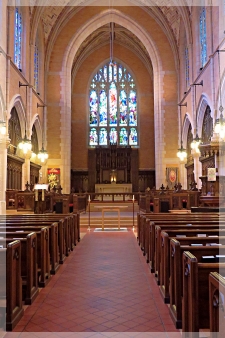 Since we both attended liturgical churches as girls, my friend and I were trying to recall the terms for the various parts of a traditional church building. We knew the foyer is called the narthex and the congregation sits the church’s nave. We also knew the altar rail usually separated the nave from the chancel in the front. It’s from the chancel that the service is conducted and where the altar, pulpit, and lectern are located. We even recalled that the sacristy was the room holding Communion supplies and linens. Since we were worshipping in a park that morning, my friend asked the location of our sanctuary. In historic usage, sanctuary and chancel were synonymous but, in modern usage, a sanctuary consists of the entire worship space of a church. With no building, we had no narthex, nave, or chancel but we did have a worship space; our sanctuary was a gazebo in a county park.
 While baking banana bread, I decided to add in the last of the walnuts I found in the refrigerator. After pouring the dough into the prepared pans, I spotted a few walnut pieces that hadn’t made the mixing bowl and popped them in my mouth. One taste told me they were rancid! Not only are rancid nuts horrid tasting but, if enough are consumed, they can make you sick! Just as there’s no way to get a little bit of yeast out of a lump of dough, there was no way to get every last bit of nut nastiness out of the bread. A mere cup of nuts managed to turn more than eight cups of what should have been sweet and delicious into something bitter and sour. As I emptied the pans into the garbage, I recalled a sermon illustration about a thirteen-year-old girl.
 For a single-cell microorganism member of the fungus family, yeast is mighty powerful. When added to water and flour, it starts to grow and multiply as it ferments the sugars in the flour, releases carbon dioxide, and causes the dough to rise. Moreover, once added to something, yeast can’t be removed. When a small amount of old fermented dough called a starter or seor is kneaded into flour and water, it permeates the dough and makes it rise. Some of the newly leavened dough can be saved to become the starter for the next batch of bread and so on.
 Devotions of the Heart