But you will receive power when the Holy Spirit comes upon you. And you will be my witnesses, telling people about me everywhere—in Jerusalem, throughout Judea, in Samaria, and to the ends of the earth. [Acts 1:8 (NLT)]
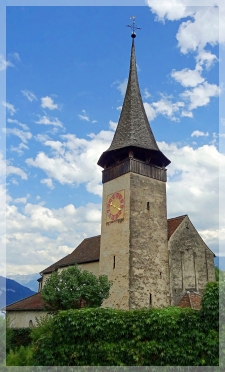
“We will do anything short of sin to reach those who don’t know Christ,” was frequently said by the pastor of the mountain church at which we worshiped during our Colorado winters. His passionate words reflect the sort of zeal that mountain church has for reaching the unreached.
In Mark’s gospel, we find four men willing to do anything (short of sin) to bring someone to Christ. Jesus was in Capernaum where he previously healed the sick and demon-possessed. Upon hearing the news that Jesus had returned, these four men placed their paralyzed friend on a mat and carried him to the house where the Lord was preaching. Unfortunately, but the house was so mobbed that they couldn’t even get in the door! Unwilling to let a crowd of people keep their sick friend from Jesus, the men carried him up to the roof. While they didn’t sin, I’m not so sure they didn’t break the law when they dug up the thatch and dry mud, removed the tiles, and made a hole in the roof through which they lowered their paralyzed friend to Jesus’ feet.
Timothy certainly went “the extra mile” when the young man underwent circumcision just to become a more effective evangelist to the Jews. In obedience to the Spirit’s direction to go south to the Gaza road, Philip actually walked an extra 42 miles before even getting to that desert road and finally meeting the Ethiopian! His miles, however, pale in comparison to Paul’s! New Testament scholar Dr. Eckhard Schnabel estimates that Paul logged over 15,500 evangelism miles before arriving in Rome in 60 AD. 6,800 of those miles were by sea and another 8,700 were on land (presumably done on foot). Along with the blisters and callouses resulting from all that walking, Paul endured things like imprisonment, shipwrecks, being adrift at sea, whippings, beatings, imprisonment, and being stoned along with bandits, hunger, thirst, bad weather, and attacks from Jews, Gentiles, and false believers. Nevertheless, even when imprisoned, the Apostle relentlessly continued to spread the gospel of Christ in his letters.
Even after Herod ordered James’ death “by sword,” the first believers never stopped doing all they could to bring people to Christ. When Stephen was called before the high council, he knew his words would provoke them. Nevertheless, he courageously witnessed for Jesus until his last breath. Although Peter and John were beaten, imprisoned, and told to stop preaching, they continued to lead people to Jesus. The early church was determined to bring people to the Lord.
Jesus gave us a “great” commission (not a small one) when he told us to go into the world and preach the good news of God’s grace and love. Rather than a suggestion, that was an order and meant to be obeyed! When fulfilling His command, we’re not likely to endure things like circumcision, beatings, imprisonment, bandits, shipwreck, breaking through rooftops, or martyrdom. We don’t have to log over 15,000 travel miles or even walk 42 miles out of the way. Philip didn’t go far to bring Nathanael to the Lord and the woman at the well just ran back into town to bring people to Jesus!
The first believers were willing to do whatever it took to bring people to the Lord. Are today’s believers willing to do the same? Are we willing to leave our own personal comfort zone to bring light into darkness? Great things happened when Andrew invited his brother (Simon Peter) to meet Jesus. Are we even willing to ask our neighbors to church?
Evangelism is not a professional job for a few trained men, but is instead the unrelenting responsibility of every person who belongs to the company of Jesus. [D. Elton Trueblood]
 While baking banana bread, I decided to add in the last of the walnuts I found in the refrigerator. After pouring the dough into the prepared pans, I spotted a few walnut pieces that hadn’t made the mixing bowl and popped them in my mouth. One taste told me they were rancid! Not only are rancid nuts horrid tasting but, if enough are consumed, they can make you sick! Just as there’s no way to get a little bit of yeast out of a lump of dough, there was no way to get every last bit of nut nastiness out of the bread. A mere cup of nuts managed to turn more than eight cups of what should have been sweet and delicious into something bitter and sour. As I emptied the pans into the garbage, I recalled a sermon illustration about a thirteen-year-old girl.
 For a single-cell microorganism member of the fungus family, yeast is mighty powerful. When added to water and flour, it starts to grow and multiply as it ferments the sugars in the flour, releases carbon dioxide, and causes the dough to rise. Moreover, once added to something, yeast can’t be removed. When a small amount of old fermented dough called a starter or seor is kneaded into flour and water, it permeates the dough and makes it rise. Some of the newly leavened dough can be saved to become the starter for the next batch of bread and so on.
 Last week, after singing we’d come in the opening hymn, we promised to go in the closing one: I the Lord of Sea and Sky. Originally written for a Roman Catholic ordination mass in 1981, it has found its way into many Protestant hymnals. As I sang the refrain, “Here I am, Lord. Is it I, Lord?” I thought of Samuel and Isaiah, both of whom were called by God and both of whom responded by saying, “Here I am.” I wonder if I would have responded as positively as did they. Like Moses, would I have protested or, like Jeremiah, say my age disqualified me? Would I simply have run away as did Jonah? Although Moses, Jeremiah, and even Jonah eventually answered God’s call, I’m not so sure I would have (although three days in the belly of a fish might have convinced me)!
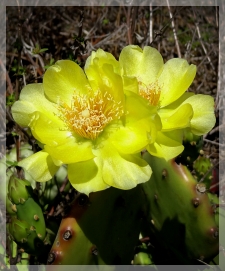 I enjoy stopping for a short stroll on the boardwalk of a local nature preserve that is home to well over 100 gopher tortoises (a protected species) and a wide assortment of native plants. The boardwalk is low to the ground and has no railing because it’s not there to protect people from the alligators and snakes of the swamp; it’s there to protect the animals and their dry scrub habitat from people! Several signs are posted about not stepping off it onto the fragile landscape. When I spotted an absolutely beautiful prickly pear cactus in full bloom, I was disappointed it was out of decent photo range. Since mine had been the only car in the parking lot, I was tempted to disobey the posted signs. “I really want that photo! Who’d know? What harm could I do?” I asked myself. If I’d seen someone else stepping off the boardwalk, however, I would have admonished them for their lack of environmental concern! Recognizing sin’s whisper in my ear, I stayed put. Nevertheless, I realized how tempting it is to think my desires are more important than anything or anyone else.