
CLAIMING PROMISES

Tao New MexicoThe Lord said to Abram after Lot had parted from him, “Look around from where you are, to the north and south, to the east and west. All the land that you see I will give to you and your offspring forever. [Genesis 13:14-15 (NIV)]

We were visiting an area church when the pastor referred to the above verse from Genesis in which God tells Abram (Abraham) he can have all that he sees. As the sermon continued, the pastor recited a litany of God’s promises and he seemed to be preaching a “name it and claim it” theology only, in this case, it was more like a “see it and have it” one. Granted, it was the first sermon of the year and the pastor clearly wanted to start 2018 on a high note. Nevertheless, claiming God’s promises and thinking they mean He’ll give me everything I visualize isn’t Bible-based.

Our faith and thoughts do not create our reality. If they did, among other things, I would be two inches taller, a whole lot shapelier, and without a wrinkle or any arthritis. Our faith doesn’t promise to give us what we want; our faith allows us to trust in a loving God who will give us what we need.

It is God, not us, who chooses when and how to bless us or, as in the case of Job, afflict us with trials. Job didn’t suffer for lack of faith; the man was filled with faith and yet he endured the loss of everything but his life. As baffled as Job was by his troubles, he knew that blessings and misfortune are not a measure of faith; the faithful can suffer and the wicked can prosper.

Not every promise made by God in the Bible is a wholesale across-the-board promise to us. That promise to Abram was a specific promise about a particular piece of land. God said nothing about seeing and having boyfriends, better jobs, new businesses, babies, healing, bigger paychecks, larger houses, or freedom from debt. Jesus came to save us from our sins and not from bankruptcy, infertility, illness, bad marriages, poor choices, difficult in-laws, unemployment, demanding bosses, or a host of other life challenges. Moreover, He calls us to sacrifice and deny rather than want and get.

Although God wants our love, worship, faith and obedience, He doesn’t need any of those to operate the universe. As Christians, we believe in the power of faith and prayer but we must remember the real power lies in God and His plan. We’re not God’s customers who can order what they see; we’re His children who thankfully accept what He gives us. Much of what we envision never will be ours simply because it’s not in God’s plan. When we become so intent on seeing what we want, we may miss seeing the blessings we’ve been given or different ones waiting in another direction.

I will continue to have faith and claim God’s promises—the promises of His presence, unfailing love, strength, wisdom, comfort, forgiveness, salvation, eternal life, the power of Holy Spirit, and the peace of God. What He hasn’t promised me is that if I see it, believe it or name it, it will be mine.

 Faith is not the belief that God will do what you want. It is the belief that God will do what is right. [Max Lucado]

Do not be anxious about anything, but in every situation, by prayer and petition, with thanksgiving, present your requests to God. And the peace of God, which transcends all understanding, will guard your hearts and your minds in Christ Jesus. [Philippians 4:6-7 (NIV)]

Copyright ©2018 jsjdevotions. All rights reserved.

ARMLOADS OF GIFTS

O Israel, hope in the Lord; for he is loving and kind and comes to us with armloads of salvation. [Psalm 130:7 (TLB)]

dahliaMy arms were filled with precariously piled packages as I trudged through the mall parking lot. Thinking it was the perfect time to test the easy tailgate feature on our new SUV, I kicked my foot forward under the car’s rear bumper expecting it to magically open. Perhaps it was the trailer hitch or that my legs are too short, but the sensor didn’t work and the trunk lid remained closed. After trying several more times, it became clear that, in spite of the car’s promise, I was not going to open the tailgate while holding armloads of anything! It was when I tried to find the keys in my purse that my pile of holiday gifts tumbled every which way. On the plus side, my arms were finally free to lift the tailgate!

As God would have it, that morning’s Bible reading had taken me to Psalm 130 in the Living Bible translation: “He…comes to us with armloads of salvation.” While gathering up assorted packages in the parking lot and muttering a few bahs and humbugs, I wondered how God, with his armloads of salvation, would do with my tailgate. Then I pictured another, far nicer, scenario. It’s Christmas and someone’s at the door. As the host opens the door, he welcomes his visitor inside. The guest’s arms are overflowing with beautifully wrapped packages piled so high that you can’t even see his face. Everyone eagerly gathers around him with open hands to receive their gifts. The boxes, however, aren’t filled with shirts, purses, perfume, toys, books, and the latest electronics; they are filled with a never-ending supply of salvation, redemption, wisdom, forgiveness, joy, peace, faith and love. It may be His birthday, but it is Jesus who brought us armloads of gifts!

Since the Lord’s arms are filled with His gifts, we must open the door for Him. I couldn’t open the tailgate when my arms were filled with packages and we can’t open the door to our hearts if our arms are filled with the stuff and nonsense of this world. Although attachment to wealth and actual possessions can fill our arms, things like unforgiveness, fear, doubt, pride, anger, ingratitude, shame, and guilt also can leave us too encumbered to open the door or accept His gifts. God’s got an armload of good things for us but our arms must be free and our hands empty if we ever hope to get them.

Faith is two empty hands held open to receive all of the Lord. [Alan Redpath]

Look! I have been standing at the door, and I am constantly knocking. If anyone hears me calling him and opens the door, I will come in and fellowship with him and he with me. [Revelation 3:20 (TLB)]

Copyright ©2017 jsjdevotions. All rights reserved.

POWER

But Jesus called them together and said, “You know that the rulers in this world lord it over their people, and officials flaunt their authority over those under them. But among you it will be different. Whoever wants to be a leader among you must be your servant, and whoever wants to be first among you must become your slave.  [Matthew 20:25-27 (NLT)]

red-shoudered hawkRecently, the news has been filled with stories about powerful men who have misused their influence to prey on others. Unfortunately, abuse of power is nothing new. Consider our Biblical hero King David. While strolling on his roof late one afternoon, he looked down on the city below and spotted a beautiful woman taking her ritual bath. Even though he knew she was married, David sent for her. With at least six wives already, he wasn’t lacking for female companionship. Nevertheless, he wanted the beautiful Bathsheba. The Bible tells us the two had sex, she got pregnant, and David killed her husband to conceal their adultery. The Bible, however, tells us nothing of Bathsheba. We know she didn’t ask David to invade her privacy and, obedient to her king, she went to his palace. How could she refuse and to whom could she complain? Whether David managed to seduce her with his charm or forced himself on her doesn’t matter. He was her king and she had no choice. He wrongly took advantage of his power when he sent his men to get her, had sex with her, and manipulated events so that her husband was killed in battle.
This is not a male-bashing devotion; it is a reminder to us all that power and authority of any kind is a privilege. We are told to be good stewards of our wealth and use it wisely. When we are blessed with positions of authority or power, we should use that wisely, as well. If we’re not millionaires, CEOs, politicians, producers, or celebrities, we might think we have little or no power, but we do. We have the power to make someone else’s day good or bad and we have the power to affect their future. We can badger or intimidate co-workers, baby sitters, interns, clerks, sales people, bus drivers, assistants, neighbors, care givers, maintenance people, spouses and even children. It’s not just sexual abuse; there are many other ways to abuse, demean, mistreat, manipulate, or exploit people. Bullies aren’t found just on the playground; I’ve seen them berate wait staff, receptionists, and students. Threats aren’t made just by bosses; I’ve seen them made by irate customers. Politicians aren’t the only ones with clout; many of us have the ability to put in a good (or bad) word that can change someone’s future. We can make or break someone’s reputation with a few keystrokes. Having the upper hand never gives us the right to hit with it and having the power to do something doesn’t necessarily mean we should.

Abuse of power has consequences; conceived in adultery, David and Bathsheba’s child died and we’ve recently seen numerous successful careers crash. We may not make the tabloids when we shortchange the sitter, take out our anger on the secretary, or threaten someone out of spite. Nevertheless, there will be consequences for us as well—if not in this world, then in the next. In the parable of the talents, Jesus tells us that we’ll be held accountable for the way we use our gifts. We tend to think of those gifts as money, time and skills. They also include knowledge, relationships, privilege, power and authority and we should use all of them with love and compassion. Moreover, when we use our influence or authority to mistreat those less powerful, let us remember that we are mistreating the most powerful one of all!

And the King will say, “I tell you the truth, when you did it to one of the least of these my brothers and sisters, you were doing it to me!” [Matthew 25:40 (NLT)]

Copyright ©2017 jsjdevotions. All rights reserved.

FOOD INSECURITY

The crowds asked, “What should we do?” John replied, “If you have two shirts, give one to the poor. If you have food, share it with those who are hungry.” [Luke 3:10-11 (NLT)]

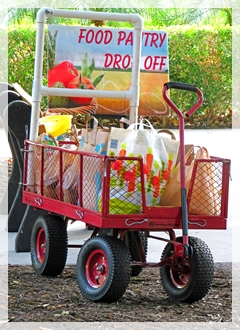
food pantry - feed the hungryYesterday, our nation celebrated Thanksgiving, a holiday that revolves around food and unites our nation across lines of culture, race, religion, and politics in a way little else can. Regardless of what football team they support, where they live or from where they came, whether liberal, conservative or somewhere in between, my Muslim, Hindu, Jewish, Christian, and unbelieving friends all celebrated around tables heavy laden with food. The menu and traditions varied—some had naan and others enjoyed cornbread or Parker House rolls. Some plates had ham alongside the turkey while others tofurkey and lentils or some of Grandma’s lasagna. Some cooks put pork sausage in their dressing and others kept kosher. There may have been glazed sweet potatoes and green beans at one house and mashed whites with gravy and corn casserole at another but, whatever was served, no one went away hungry and there were plenty of leftovers. Unfortunately, not everyone’s plate was piled with food and not everyone complained of feeling stuffed.

When I grew up, I was told there were starving children in Armenia so I should clean my plate. I once gave the smart-aleck retort that what I didn’t eat couldn’t be sent to those kids so what difference did it make! That was, of course, the wrong response and, most definitely, the wrong attitude. It wasn’t so much about cleaning my plate; my parents were trying to teach me appreciation and gratitude for the bounty at our table. They wanted me to understand that not everyone was so blessed. Unlike me, many children knew the real meaning of hunger.

The UN defines “food security” as always having physical, social and economic access to enough safe and nutritious food to meet one’s dietary needs for a productive and healthy life. Although there is more than enough food in the world to feed everyone, they estimate that some 815 million people in our world are “food insecure.” In our nation alone, some 41 million people (13 million of whom are children) are considered food insecure. It’s not just the Armenians or whoever else our parents mentioned that are hungry; it’s our neighbors!No one anywhere should go hungry but it’s disgraceful that anyone in our wealthy nation should be without reliable access to a sufficient quantity of affordable and nutritious food.

As Christians, we must respond to food insecurity with compassion and action—prayer, advocacy, volunteering, and donating. When we pray, “Give us this day our daily bread,” let’s remember the bread with which we are blessed is meant to be shared. When Jesus shared a few loaves and fish, He managed to feed thousands; consider how many we could feed if we shared our resources! As you write up your Christmas gift list, perhaps you will include a Christian relief organization and help combat poverty and hunger. If you’re wondering what to get your pastor or child’s teacher, rather than a tie or mug, what about a flock of chicks, geese or ducks (only $20) from someplace like Heifer International? Your donation will provide both food and a source of income for a hungry family. These next few weeks, you’ll be making several trips to the grocery store. Every time you shop, consider taking advantage of the BOGO specials and giving that free item (better yet both of them) to the local food pantry. There are more than enough resources in our world so that everyone can eat well but we each must do our part.

Yesterday, we looked at our bountiful Thanksgiving feast and asked ourselves, “What will I eat?” Please remember that someone not that far from you may have said, “Is there anything for me to eat?”

For I was hungry, and you fed me. I was thirsty, and you gave me a drink. I was a stranger, and you invited me into your home. I was naked, and you gave me clothing. I was sick, and you cared for me. I was in prison, and you visited me. … I tell you the truth, when you did it to one of the least of these my brothers and sisters, you were doing it to me! [Matthew 25:35-36,40 (NLT)]

Copyright ©2017 jsjdevotions. All rights reserved.

GOD’S BANKERS

wild geraniumThere are always going to be poor and needy people among you. So I command you: Always be generous, open purse and hands, give to your neighbors in trouble, your poor and hurting neighbors. [Deuteronomy 15:11 (MSG)]
The Hebrew word for what we call “charity” is tzedakah; its nature, however, is far different than acts of benevolence or generosity. Rather than being a magnanimous act by someone more fortunate, tzedakah is considered an act of justice and righteousness. It is remedying a wrong, doing what is right and just, and fulfilling a duty; in short, it is giving the poor what they deserve.

In writing about charity, Rabbi Yanki Tauber tells of a wealthy man who often supported his rabbi’s charitable activities. One day a letter requesting a large sum for a good cause arrived. At the time, money was a little tight and making a donation was inconvenient so the rich man ignored the request. Shortly after that, his businesses began to fail and the wealthy entrepreneur lost his entire fortune.

The distraught fellow went to the synagogue and berated the holy man for not warning him that he’d suffer if he ignored the rabbi’s plea. “I would have given you the money had I known what punishment I would suffer!” he said. The rabbi calmly responded that the loss of money wasn’t a punishment. “Nothing that was yours has been taken from you,” he explained, adding that God had allotted a certain amount of resources to the rabbi in his work. Since the time he spent in prayer, studying, teaching, counseling and helping others left him no time to manage finances or property, the rabbi’s resources had been placed in the trust of several people who acted as “bankers” for that wealth. In turn, those bankers recognized the value of the rabbi’s work and supported it. When the once rich man failed to carry out his banking duty, the money was simply transferred to another, more responsible, “banker.”

God loves all of His children but that does not mean that He allots equal portions of blessings or sorrows to each of them. Some are healthier, wealthier, smarter, more talented or more attractive than others. Some people seem to escape misfortune while others seem to encounter storms at every turn. Because of an accident of birth, we may live comfortable lives in a wealthy nation or suffer in poverty in a corrupt or war-torn land. Some people have power and are easily heard while others are powerless and often ignored. That we are not given equal portions, however, does not mean that we are not equally deserving. If we have been blessed with wealth, education, influence or opportunities, we should think of ourselves as God’s bankers. We’re just holding on to other people’s resources and it is our job to distribute those resources to their rightful owners. Like our Jewish brothers and sisters, Christians should be dispensers of tzedakah. Unlike them, however, we don’t do it to buy our way into heaven (which it won’t). We do it because God tells us it is the right thing to do!

God does not need your good works, but our neighbor does. [Martin Luther]

This is how we’ve come to understand and experience love: Christ sacrificed his life for us. This is why we ought to live sacrificially for our fellow believers, and not just be out for ourselves. If you see some brother or sister in need and have the means to do something about it but turn a cold shoulder and do nothing, what happens to God’s love? It disappears. And you made it disappear. [1 John 3:16-17 (MSG)]

Then the King will say, “I’m telling the solemn truth: Whenever you did one of these things to someone overlooked or ignored, that was me—you did it to me.” [Matthew 25:40 (MSG)]

Copyright ©2017 jsjdevotions. All rights reserved.

WHAT LEGACY?

But God said to him, “You fool! You will die this very night. Then who will get everything you worked for?” Yes, a person is a fool to store up earthly wealth but not have a rich relationship with God. [Luke 12: 20-21 (NLT)]

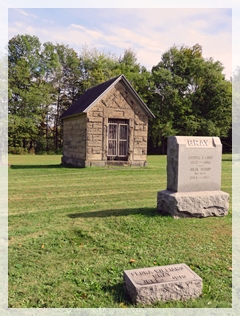
Trumbull Cemetery - OhioWhen touring a nearby resort town, a beautiful old mansion was pointed out. It was once owned by a man who made so much money on his invention of the sanitary milk bottle cap that he retired at the age of 26. For 93 years, the Chicago White Sox played at a ball field named for the team’s founder. In 2003, the field was renamed US Cellular Park and then, in 2016, it became the Guaranteed Rate Field. When I went to Northwestern University, the football venue was named for a former Evanston mayor. In 1997, the stadium was renamed to honor the family of a generous donor to the school’s athletic facilities. A friend’s daughter is attending a school named for a German immigrant who opened a Chicago butcher shop in 1883. Who were these men?

If you’ve not been on a Lake Geneva boat tour, you’ve never heard O.N. Tevander. Although one can still find pictures of his bottle capping machine, he doesn’t even rate a mention in Wikipedia. Do today’s baseball fans know that Charles Comiskey was a key person in the formation of the American League and founder of the Chicago White Sox? Do the Northwestern Wildcats know anything of William Dyche, class of 1882, and that his name was to remain on any NU stadium for perpetuity? In another twenty years, will they have any idea that Patrick Ryan founded Aon Corporation and once served on the university’s Board of Trustees? By then, it’s possible that another large check will have been written and the stadium will have yet another name. When you hear the name Oscar Mayer, do you think of an immigrant butcher from Bavaria or of a large corporation (now owned by Kraft), hot dogs and the wiener song?

Even if we amass great wealth, make generous donations, or achieve some modicum of fame, chances are that most of us will be forgotten in a few generations. Our last name might remain on a corporate letterhead or, if wealthy enough, we could have a building or stadium named after us (at least for a while). Our headstone may rest in a cemetery, we might be listed in a genealogy chart, or an old letter or picture of us may reside in a box of memorabilia stored in someone’s attic. Nevertheless, we will be long gone and, for the most part, forgotten. For William Dyche, perpetuity lasted only 71 years! How long will it last for us? Even if a great grandchild has our china, a piece of our jewelry or carries our name, our essence will have vanished. We will be little more than a short family story or a faceless name.

Jesus told a parable about the rich man whose land was so productive that he ran out of room to store his crops. Rather than share his excess, he just built bigger barns so he could relax and enjoy his wealth for years to come. Unfortunately for him, he died that very night. A simple parable, it points out the temporal nature of life.

Financial planners often ask their clients, “What will be your legacy?” The rich man in the parable left a legacy of filled barns for someone else to enjoy. Sadly, he forgot the most important thing—his soul. Sometimes we’re so busy thinking about our legacy here on earth that, like the man in the parable, we also forget about our souls. Whether or not we are remembered in this world isn’t really important. The real question is whether or not God will welcome us into His kingdom in the next.

Don’t store up treasures here on earth, where moths eat them and rust destroys them, and where thieves break in and steal. Store your treasures in heaven, where moths and rust cannot destroy, and thieves do not break in and steal. Wherever your treasure is, there the desires of your heart will also be. [Matthew 6:19-21 (NLT)]

Copyright ©2017 jsjdevotions. All rights reserved.