THE GATEWAY SIN

You must not covet your neighbor’s wife. You must not covet your neighbor’s house or land, male or female servant, ox or donkey, or anything else that belongs to your neighbor. [Deuteronomy 5:21 (NLT)]

roseIn spite of many states having legalized its use, countless studies suggest that marijuana is a “gateway drug” meaning that it may lead to the use of other stronger more addictive drugs. I’m not going to enter into that argument but I’d like to use the word “gateway” as it regards to sin. Just like marijuana (when compared to heroin or cocaine) seems innocuous, coveting (when compared to murder or stealing) seems like an insignificant sin. After all, who does it harm? No sin, however, is insignificant and every sin is an offense to God

While desiring God, wisdom, right living, and faith is good, the tenth commandment’s coveting is desiring what God doesn’t want us to have or what rightfully belongs to another. Masquerading as envy, jealousy, resentfulness, lust, longing, selfishness, greed, materialism, desire, craving, bitterness, and even wishful thinking, it is one of the easiest commandments to break. Just as a rose by any other name is still a rose, coveting (no matter what you call it) is still coveting and easily can lead to more sin. Coveting is a “gateway” sin because it can lead us deeper into the enemy’s darkness.

Consider Achan who disobeyed God’s direct command to take none of Jericho’s plunder for himself. Coveting the spoils of war, he stole a beautiful robe, 200 silver coins and more than a pound of gold. His coveting led not just to stealing but also to murder when 36 of his countrymen died in battle and his family was killed in punishment for his sin. David coveted his neighbor’s wife and then committed both adultery and murder to have her. Coveting Esau’s rightful blessing, Jacob stole it from his brother and failed to honor his father. King Ahab coveted the field of Naboth; when Naboth refused to sell it, Ahab’s covetous heart made him so sullen and angry that he refused to eat. His wife Jezebel then hatched a scheme in which two of her minions falsely accused Naboth of cursing both God and king; the man was stoned to death and Ahab claimed his field. Ahab’s coveting led to breaking the commandments about false witness, murder and misusing the name of the Lord. It would seem that when we want something that isn’t ours to have, we’re likely to break several other commandments to get it!

Indeed, coveting is a gateway sin!

Yet true godliness with contentment is itself great wealth. After all, we brought nothing with us when we came into the world, and we can’t take anything with us when we leave it. So if we have enough food and clothing, let us be content. [1 Timothy 6:6 (NLT)]

Copyright ©2018 jsjdevotions. All rights reserved.

SACRIFICES

I want you to show love, not offer sacrifices. I want you to know me more than I want burnt offerings. [Hosea 6:6 (NLT)]

And the King will say, “I tell you the truth, when you did it to one of the least of these my brothers and sisters, you were doing it to me!” [Matthew 25:40 (NLT)]

little blue heronA 2013 United Healthcare Group study found that volunteering is linked to better physical, mental and emotional health. Apparently it reduces stress, brings people together, promotes personal growth and self-esteem, strengthens our sense of community, and helps us learn new skills. Something their study did not mention is that volunteering is an act of worship and sacrifice. A sacrifice is an offering to God and every time we sacrifice time, talents, or resources by doing for His Kingdom, we are worshipping Him.
Because Jesus was the perfect and final sacrifice when He died for our sins, we no longer bring pigeons or sheep to God’s altar. Rather than dead animal sacrifices, we offer ourselves as living sacrifices, not to atone for sins but to worship our Lord. When we drop that envelope in the offering plate, give a dollar to a street person, write a check to a charity, or bring groceries to the food pantry, we’re really not giving to the church, homeless, Red Cross, or the hungry; we’re giving to God. When we lift a hammer at a Habitat home, sort clothes at the charity resale shop, pack lunches for the migrant workers, give someone a ride to church, visit the ill or assist at Sunday school, we are worshipping God with our service. Our sacrifice of resources, time, and talent is as much an act of worship as singing hymns or offering prayers of praise and thanksgiving.

The Old Testament often spoke of God being pleased with the aroma of a sacrifice. While our New Testament sacrifices are not burned on an altar and have no aroma, I think God finds them just as pleasing to His senses. When those ancient sacrifices were not the first and best or were accompanied by a bad attitude, God found a stench to them. It would seem to follow that when our Christian sacrifices are offered begrudgingly or we fail to give the best we can, our hypocrisy will cause them to stink, as well.

Let us worship the Lord with our hearts and hands as well as our voices! Let us joyfully worship Him with service as well as with song!

And so, dear brothers and sisters, I plead with you to give your bodies to God because of all he has done for you. Let them be a living and holy sacrifice—the kind he will find acceptable. This is truly the way to worship him. [Romans 12:1 (NLT)]

Therefore, let us offer through Jesus a continual sacrifice of praise to God, proclaiming our allegiance to his name. And don’t forget to do good and to share with those in need. These are the sacrifices that please God. [Hebrews 13:15-16 (NLT)]

Copyright ©2018 jsjdevotions. All rights reserved.

THE TITHE

One-tenth of the produce of the land, whether grain from the fields or fruit from the trees, belongs to the Lord and must be set apart to him as holy. [Leviticus 27:30 (NLT)]

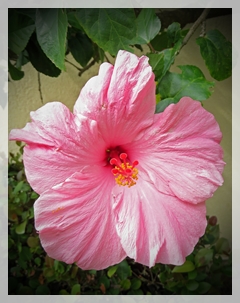
HibiscusTithe means ten percent and the Jews were required to give ten percent of all they earned or grew as part of their worship. Because there were three required tithes, the actual percentage given was more like 23%. One tithe went to the Levites, another was for the use of the temple and religious festivals, and a third one, required every third year, was for the poor. Although no tithes were collected from the land on the seventh (Sabbath) and 50th (Jubilee) years or when there was drought or famine, tithing was mandatory at any other time and the Israelites got in trouble with God when they didn’t fulfill this obligation.

With His sacrifice on the cross, Jesus fulfilled all of the requirements of the old law. As Christians, we’re no longer obliged to visit Jerusalem for the festivals of Passover, Shavuot, or Sukkot nor do we observe Yom Kippur. We don’t keep the Jewish dietary and butchering regulations, light Shabbat candles, refrain from work on the Sabbath, or require circumcision. Like tithing, those are the laws of the Old Covenant and Jesus brought us a New Covenant. Nevertheless, there are some Christian pastors who think that one specific Old Testament law remains: tithing.

In effect, the Old Testament tithe was an involuntary tax and no one I know cheerfully pays his or her taxes. Searching for every loophole, they may even employ some “creative accounting” to lessen their payment. When we think “tithe,” we can easily start nit picking and hair splitting like the Pharisees. Are we talking before or after income taxes? Can we take off tuition for a Christian school, medical expenses, property taxes or business expenditures? What about mileage to and from church? Is the tithe for our parish or the church at large? What about faith-based causes like World Vision, the Gideons or Samaritan’s Purse—are they part of the tithe? Can good causes that aren’t faith based, like the local food pantry or homeless shelter, qualify? Perhaps the greatest problem with tithing is that we begin to think that only 10% of our money is God’s when, in fact, it all belongs to Him! Moreover, He also owns our time and talents and how do we measure ten percent of those? The tithe can become what Randy Alcorn calls the “finish line” instead of the “starting block” for our giving.

If we don’t tithe, how do we decide how much to give? A pastor friend gives the perfect answer: we pray! We simply ask God exactly how much He wants us to give and how and where He wants us to give it. In obedience to Him, we then commit our resources—our finances, time, and talent—as He directs. What we don’t do is base our giving on feelings, recognition we may be given, or the entertainment value of the pastor’s sermons. Offering our first fruits rather than our leftovers, we don’t give thoughtlessly, randomly, or grudgingly. We base our giving on God’s principles of stewardship and use His gifts wisely to expand His kingdom. Whatever He tells us to give, we give joyfully and with thanks—remember, it’s all His!

You must each decide in your heart how much to give. And don’t give reluctantly or in response to pressure. “For God loves a person who gives cheerfully.” [2 Corinthians 9:7 (NLT)]

Wherever your treasure is, there the desires of your heart will also be. [Matthew 6:21 (NLT)]

Copyright ©2018 jsjdevotions. All rights reserved.

SACRED TRUST

He said to them, “The Scriptures declare, ‘My Temple will be called a house of prayer for all nations,’ but you have turned it into a den of thieves.” [Mark 11:17 (NLT)]

great egret - corkscrew swampSeasoned travelers know the worst place to exchange their money is at the airport. With no easy option to get local currency, the unsuspecting tourist gets the worst exchange rates at the highest fees. Seasoned travelers also don’t buy suntan lotion or Dramamine onboard the cruise ship or a face mask and goggles at the ski shop on top of the mountain. Knowing their customers are desperate for their products, those shops tend to gouge them with inflated prices.

That’s what was happening in the Temple when Jesus cleared it of money changers and merchants. Jerusalem was filled with pilgrims who’d traveled long distances to worship, offer sacrifices, and pay their annual temple tax. With the Tyrian half-shekel the only coin acceptable for the tax, people had to exchange their foreign currency. Because traveling with animals was problematic for the pilgrims, they had to buy their sacrificial offerings in Jerusalem. The priests solved the problem, not out of the goodness of their hearts but as a way to fatten their wallets.

They rented out spaces in the Court of the Gentiles to money changers who charged excessive fees for their services and to merchants who sold sheep, lambs, goats, doves, pigeons, grain, and anything else necessary for a sacrifice at exorbitant prices. Since sacrificial animals were to be unblemished, the priests had to approve them. They charged an additional fee for the inspection and, if an animal wasn’t purchased at the Temple, chances are that it wouldn’t be approved. What should have been a service to the pilgrims had become a scheme to swindle them. The priests who looked for flaws in offerings were blind to the flaws in their own behavior.

With the commotion of the animals and vendors competing for business, the courtyard was no longer a place of worship. The inevitable animal odor and excrement was considered defilement of a sacred place; people weren’t even supposed to pray, recite blessings or study the Torah if urine or feces were visible within a range of six feet. That the sanctity of the Temple was profaned by this filth and exploitation or that the worship of Gentiles was disturbed in the mayhem of this stockyard and marketplace didn’t seem to bother the priests. It bothered Jesus enough so that He chased the offenders out of the Temple.

Today’s equivalent of that first century corruption can be found in those churches that don’t operate with financial oversight or fiscal responsibility. Whether out of ignorance, irresponsibility, or dishonesty, they use smoke and mirrors with vague budgets and no accountability or audits. The church has been given a sacred trust both to raise and spend money with integrity. Let us never forget that people’s tithes and offerings come at a cost to them. By the time the money exchanger took his cut, the half shekel Temple tax represented four days wages and the widow who put her two small coins in the Temple treasury gave all that she had. The church must recognize the sacrifice that comes with every dollar and take their duty to be good stewards seriously. As congregations, we must demand fiscal responsibility and transparency; we have an obligation to keep God’s house from becoming a den of thieves.

So guard yourselves and God’s people. Feed and shepherd God’s flock—his church, purchased with his own blood—over which the Holy Spirit has appointed you as leaders. [Acts 20:28 NLT

No one can serve two masters. For you will hate one and love the other; you will be devoted to one and despise the other. You cannot serve God and be enslaved to money. [Matthew 6:24 (NLT)]

Copyright ©2018 jsjdevotions. All rights reserved.

LIVING WATER

Medicine LakeJesus replied, “If you only knew the gift God has for you and who you are speaking to, you would ask me, and I would give you living water. … But those who drink the water I give will never be thirsty again. It becomes a fresh, bubbling spring within them, giving them eternal life.” [John 4:10,14 (NLT)]
When in Canada last summer, we came across a strange body of water called Medicine Lake; although it looks like a lake, it really isn’t. It’s where the Maligne River backs up before disappearing into several underground pipelines. The cave system draining this river is one of the most extensive in the world. Every spring, the runoff from melting glaciers and snow fills the river with water much faster than it can drain and, as the water backs up, the river becomes a lake. As the summer progresses, the inflow slows and the water level gradually lowers until, in autumn, it once again looks like a river. The disappearing water resurfaces far away in lakes and rivers throughout the Canadian Rockies and eventually ends up in the Pacific Ocean. Medicine Lake is like a bathtub without a stopper that is being filled faster than it can drain; once the faucet’s flow slows down, the tub’s water level lowers but it never quite empties.

On the other hand, the bogs near our northern home are more like bathtubs with drains so gunked up from hair, soap and other yucky stuff that the water can’t empty. Typically, rain and snow are the only source of a bog’s water. Formed when a lake fills with debris, a bog has little or no drainage and the water that enters it stays there. Without movement, the bog’s water becomes stagnant, gets a foul odor, and can become a breeding ground for insects, bacteria, parasites and disease. Thinking of these two bodies of water, I wondered if I’m like Medicine Lake or a bog. Like the lake, do I spread God’s blessings or, like the bog, do I keep them all to myself? The water that feeds both starts clear and fresh, but only water that flows (as it does in the lake) remains that way.

Jesus said He gives us living water, the Holy Spirit, so that we’ll never thirst again. For the water to remain fresh and sweet, however, we can’t allow it to become stagnant; it must flow in and through us and, like the water from Medicine Lake, spread far and wide. Like those underground streams, we must be His pipelines, not just of our blessings, but of the fruit of the Holy Spirit. Only when Jesus’ living water pours through us can we bring life to the world. Are we stagnant cisterns or flowing pipelines with rivers of living water flowing from our hearts?

Jesus stood and shouted to the crowds, “Anyone who is thirsty may come to me! Anyone who believes in me may come and drink! For the Scriptures declare, ‘Rivers of living water will flow from his heart.’” (When he said “living water,” he was speaking of the Spirit, who would be given to everyone believing in him. [John 7:37-39a (NLT)]

The Lord will guide you continually, giving you water when you are dry and restoring your strength. You will be like a well-watered garden, like an ever-flowing spring. [Isaiah 58:11 (NLT)]

Copyright ©2018 jsjdevotions. All rights reserved.

WHY JOIN?

The community continually committed themselves to learning what the apostles taught them, gathering for fellowship, breaking bread, and praying. Everyone felt a sense of awe because the apostles were doing many signs and wonders among them. There was an intense sense of togetherness among all who believed; they shared all their material possessions in trust. [Acts 2:42-44 (VOICE)]

Locarno-Madonna del SassoWe’ve left our old church and have been house-of-worship hunting. At first, it was like trying various hotels once a week to discover one of good quality with the right character, location and features for us. Having found a good prospect, we returned several times, signed up for a community service opportunity, and joined a Bible study. Now, it’s more like we’re renting a house; we’re meeting the neighbors, becoming familiar with the community and getting an idea of what a long-term stay would be like. Nevertheless, we’re still just temporary residents and have no ties. As we settle into this new church, however, our prayer is that it will feel enough like home that we’ll want to join it, which is a commitment somewhat like buying a house (but without the mortgage and closing costs.)

Why should we bother to join a church? Couldn’t we continue as Christians-at-large and just visit churches? There are over 85 Christian churches in our town alone, so we’d have plenty from which to choose. Why not remain a renter and just drop our tithe into whatever basket is passed that morning?

There’s a big difference, however, between renting something and living in a home we own. In a nightly rental, we really don’t care about the mud we’ve tracked into the room, the burnt out light bulb, the coffee stain on the rug, or the people in the next room. Even when renting a house, as long as everything works, we aren’t concerned about the aging appliances, the armadillo digging under the deck, or the grubs in the grass; we can always move on elsewhere. It’s only when we buy the house that we become committed to it, our neighbors, and the well-being of our community. Because the house’s future is tied to ours, we invest our time, love and money; we look not just to today but also to tomorrow.

Church membership, like owning a house, is a commitment and one that means far more than maintaining a building. It’s a commitment to worship regularly, serve one another, spread God’s word, study, fellowship, pray for each other, uphold doctrine, be held accountable, and ensure its future for the next generation. Commitment is what keeps us caring for the homes we own and it’s what keeps a church functioning.

When we buy a house, we get a building but, when we join a church, we get much more than that. We get a ready-made family—a group of people who share the same foundation and love of Christ. And that, more than anything else, is why we’ll join the church that’s right for us once it’s found.

Why should you join a church? Because by committing yourself in that way you will help to fulfill your purpose as a Christian. It seems pretty obvious from biblical metaphors of building stones and body parts that the Christian life was not meant to be lived alone. You, as a Christian, were designed and created by God, not for a life of individuality and self-will, but to fill a niche in the spiritual building called the church. [Jim Elliff]

They were unified as they worshiped at the temple day after day. In homes, they broke bread and shared meals with glad and generous hearts. The new disciples praised God, and they enjoyed the goodwill of all the people of the city. Day after day the Lord added to their number everyone who was experiencing liberation. [Acts 2:46-47 (VOICE)]

Copyright ©2018 jsjdevotions. All rights reserved.