
I am a pure-blooded citizen of Israel and a member of the tribe of Benjamin—a real Hebrew if there ever was one! I was a member of the Pharisees, who demand the strictest obedience to the Jewish law. I was so zealous that I harshly persecuted the church. And as for righteousness, I obeyed the law without fault. [Philippians 3:5-6 (NLT)]
 In writing about change yesterday, I couldn’t help but think of the Apostle Paul. He knew firsthand of God’s transforming power. When we first meet Paul, he’s going by his Hebrew name of Saul and looking on as Stephen (the first of Christ’s followers to give his life for the gospel) is stoned to death.
The slaying of Stephen led to a wave of persecution and Saul relentlessly went from house to house in search of Jesus’s followers so he could drag them off to prison. Full of religious zeal and eager to kill those who followed the Way, Saul asked the high priest for permission to go to Damascus so he could arrest Christ’s followers and drag them back to Jerusalem in chains. In short, Saul was brutal and violent and little more than a religious terrorist! It is on the road to Damascus, however, that Saul meets the risen Christ and has his amazing conversion [Acts 9]. Meeting Jesus face-to-face, being struck blind for three days, having Ananias lay hands on him, scales falling from his eyes, and Saul’s baptism make for a powerful story of redemption and truly testify that no person is beyond the saving grace of the Lord.
Nevertheless, old habits die hard and, as I wrote yesterday’s devotion, I wondered if Saul struggled as this once fanatical persecutor of Christians transformed into the great Christian evangelist. As a second-generation Pharisee, he thought of himself as a member of an elite group and anything foreign would have been detested. Wanting to keep himself free of any impurity, the old Saul would never associate with Gentiles or even any Jews who interpreted the law differently. Yet, the man who abhorred anyone different from him preached all over the Roman Empire, stressed unity between Jewish and Gentile believers, and became known as the Apostle to the Gentiles!
As a Pharisee, Saul had been meticulous to the point of obsession about obedience to both the written and oral Law. Yet, in an about face, he maintained that Jewish Christians no longer had to abide by those same regulations and that Gentile converts didn’t have to become Jews before becoming Christians. Understanding that it was the Holy Spirit rather than the Law that empowered holy living, Saul changed from thinking that strict obedience to the Law would make us right with God to knowing that we are only made right by grace through faith in Jesus.
Nevertheless, until meeting Jesus on the way to Damascus, Saul’s life had been wrapped around strict adherence to the Law. Did he have difficulty letting go of Pharisaic traditions like their elaborate hand washing ritual before meals, the conspicuous wearing of phylacteries and tassels, or fasting twice a week? Did the Jew who’d grown up loathing Gentiles cringe when he first sat down to eat with them? Until now, I hadn’t considered how difficult it had to have been for the Pharisee to become the Apostle. The man who wrote that “anyone who belongs to Christ has become a new person” [2 Corinthians 5:17] knew firsthand the truth of his statement. It is in his transformation that we see the power of Jesus to revolutionize a life! Through the power of the Holy Spirit, the persecutor of Christians became a preacher for Christ!
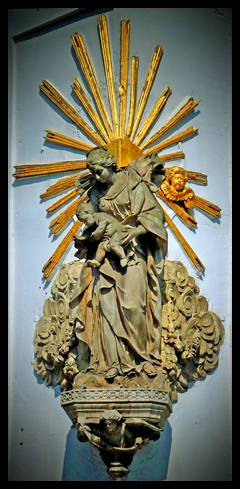
 The early church encountered difficulty in trying to reconcile the humanity and divinity of Jesus. In the 5th century, one group, from Alexandria, referred to the Virgin Mary as Theotokos, the one who gave birth to God, while the group from Antioch insisted that she was merely Anthropotokos, the one who gave birth to the human nature. Trying to bring about a compromise but pleasing no one, the bishop Nestorius suggested that the term Christotokos, the one who gave birth to Christ. The controversy, however, wasn’t about Mary; it was about the nature of Jesus. Did Mary give birth to a man who also was God or did Mary give birth to a man who later became God? The debate continued until 451 when the Chalcedonian Creed was adopted which confirmed the two natures of Christ (human and divine) in one person.
 Sorting through cabinets, I came across a video of Raiders of the Lost Ark. As I recall, archaeologist/adventurer Indiana Jones was authorized by the government to find the Ark of the Covenant before Hitler’s Nazis could obtain its supernatural powers and dominate the world. Indiana was told that the Bible speaks of the Ark’s power to level mountains, lay waste to entire regions, and that any army carrying the Ark is invincible.
 After driving out an evil spirit from a man in Capernaum, Jesus went to the home of Andrew and Peter. When He learned that Peter’s mother-in-law was sick with a fever, Jesus went to her bedside, took her hand, helped her up, and the fever was gone. Having shown his authority over both demon possession and physical disease that day, reports of His ability circulated throughout town. That evening, a crowd gathered wanting to be healed by Jesus.
 Her neighbors probably thought she’d lost her mind when she sent her boys out to ask for empty containers. Shutting the door certainly kept out the creditors, naysayers, and doubters along with any talk of unbelief that could hinder the widow’s faith. That closed door shut out interruptions, distractions, anxieties, and whatever else that might have kept the widow from focusing on God. Because that shut door even kept out Elisha, there was no mistaking who was responsible for the flowing oil: God!
 Remembering that Elisha burned both plow and oxen to become an itinerate prophet for the Lord, let’s rethink the way he may have said “What can I do to help you?” With no home or money and possessing only what he could carry, how does the widow expect him to help? In the very next sentence, however, Elisha tells her to take stock of what she already has. Although she expected Elisha to solve her problem, he showed her how to solve it herself (with God’s help, of course). As it turned out, with a little work on her part and God’s intervention, the little she had was more than enough; she didn’t just pay her debts, she had money left over.
 Devotions of the Heart