THE CRÈCHE AND THE CROSS

For this is how God loved the world: He gave his one and only Son, so that everyone who believes in him will not perish but have eternal life. God sent his Son into the world not to judge the world, but to save the world through him. [John 3 16-17 (NLT)]
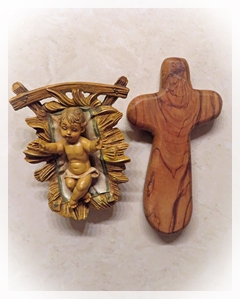
creche and crossPew Research reports that while 90% of Americans celebrate Christmas, more than half of them celebrate it only as a cultural holiday! While they’ll decorate their house with lights and wreaths, trim a tree, send cards, and exchange gifts, Christmas is just an excuse for good food, parties, family gatherings, and presents. While they’re not indifferent to Santa, gifts, merriment, or decorations, like the people of 1st century Palestine, they are indifferent to the Christ child. The shepherds saw the star and sought the babe in the manger and a caravan from the East brought Him gifts, but we don’t read of any townspeople visiting Joseph and Mary. What of the priests and scribes who told Herod where the Messiah would be born? They knew the prophecies but didn’t join the Magi in their quest to find the One who would fulfill those prophecies. Lowly shepherds and men from a faraway land recognized Jesus as the Messiah but most of God’s chosen people ignored the greatest event in all of history.

Some people react to Christmas with antipathy; like Herod, they hate its message. Rather than join the magi and seek the newborn King of the Jews, the enraged Herod slaughtered all of the male babies around Bethlehem in an attempt to kill the king! The “bah humbuggers” are like the atheist who erected a 10-foot 300-pound pentagram just 20-feet from a nativity scene in a Boca Raton park in 2016. Non-believers don’t want a King who might knock them off their pedestals any more than Herod wanted one who could knock him off his throne. They’re uncomfortable with the concepts of sin, salvation, love, sacrifice, obedience and forgiveness that surround Christmas. Then again, maybe they dislike this day simply because Christmas reminds them of the emptiness of their lives.

Some people respond to Christmas as did the angels, shepherds, magi, Simeon, and Anna: with worship. Tonight and tomorrow, people around the world will raise their voices in praise and thanksgiving, light candles, sing carols, kneel in prayer, lift their hands in worship, and share bread and wine at communion. Some will come and adore Him tonight but won’t return to church until next Christmas. But others will ponder the events of this night, as did Mary. They will allow the Christ child to enter into their hearts and lives and affect their every thought, word, and action for the rest of their lives. After extinguishing the Christmas Eve candles, they will continue to let their lights shine all year long. They are the ones who know that God came as a baby and lay in a manger so that He could suffer, die on the cross as a common criminal, and pay the penalty for mankind’s sins. They know that the crèche is meaningless without the cross!

Let us behold, the Lamb of God who takes away the sin of the world!

But Mary kept all these things in her heart and thought about them often. The shepherds went back to their flocks, glorifying and praising God for all they had heard and seen. It was just as the angel had told them. [Luke 2:19b-20 (NLT)]

Copyright ©2019 jsjdevotions. All rights reserved.

THE FORERUNNER

God sent a man, John the Baptist, to tell about the light so that everyone might believe because of his testimony. John himself was not the light; he was simply a witness to tell about the light. The one who is the true light, who gives light to everyone, was coming into the world. [John 1:6-9 (NLT)]

Steamboat Ski“I didn’t know Van was racing,” I said as he skied through the gates and sped across the finish line. “He isn’t,” explained his wife. “He’s just a forerunner.” While the focus is on the racers at a ski race, there wouldn’t be any race without the forerunners. Before the race begins, forerunners ski the course, set the line, allow the officials to test their systems, and assess course conditions. While proficient enough to race the course well, they are not in the competition. Although it’s an honor to be a forerunner, forerunners don’t get a number, nobody knows their names, and only the judges care about their times. It’s the races’ winners who get the accolades. Understanding that the race is not theirs to run, forerunners are happy just to prepare the way!

After 400 years of silence from God’s prophets, John the Baptist appeared as the forerunner for Jesus. Like prophets before him, he called for the people to repent and turn back to God. Linking the Old Testament and the New, John also prepared the way for the coming Messiah. Denying that he was the Messiah, John quoted the words of Isaiah 40:3 saying, “I am a voice shouting in the wilderness, ‘Clear the way for the Lord’s coming!’” John knew his qualifications were to prepare the way, not to be the Way. When he saw the Holy Spirit descend upon Jesus after His baptism, John knew whose way he’d been preparing and testified that Jesus was “the chosen One of God.” [John 1:34]

After acting as forerunner, John condemned Herod for marrying his brother’s wife which resulted in his imprisonment. Having heard about all that Jesus was doing, John sent his disciples to openly ask if He were the Messiah. Had John started to doubt? Let’s not forget the expectations people (even John) had of the Messiah: a political and military prince who would slay Israel’s enemies, not a Prince of Peace. Having prophesied that the Messiah would inflict punishment upon the wicked, did John wonder why, if Jesus were the Messiah, he’d done nothing to punish the Romans or free him from Herod’s prison?

At first glance, Jesus’ answer to John’s disciples seems evasive: “Tell them what you have seen—the blind see, the lame walk, the lepers are cured, the deaf hear, the dead are raised to life, and the Good News is being preached to the poor.” [Matthew 11:4-5] But, to anyone as familiar with Isaiah’s prophecies as John would have been, it was a straightforward answer in the affirmative. Isaiah had prophesied that the Messiah would do those very things [Isaiah 35:5-6,61:1-2] and Jesus had done them all. I have no doubt that, upon hearing that answer, John no longer questioned the identity of Jesus. Having prepared the way for the one true Messiah, His task as forerunner was over; it was up to Jesus to complete the race!

Listen! It’s the voice of someone shouting, “Clear the way through the wilderness for the Lord! Make a straight highway through the wasteland for our God! Fill in the valleys, and level the mountains and hills. Straighten the curves, and smooth out the rough places. Then the glory of the Lord will be revealed, and all people will see it together. The Lord has spoken!” [Is. 40:3-5 (NLT)]

Copyright ©2019 jsjdevotions. All rights reserved.

THE SNOW GLOBE

Steamboat SkiAnd we are confident that he hears us whenever we ask for anything that pleases him. And since we know he hears us when we make our requests, we also know that he will give us what we ask for. [1 John 5:14-15 (NLT)]
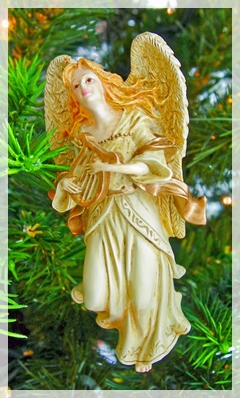
Along with the typical things you’d expect to find on my desk is an odd collection of other items. A small resin figure of the Holy Family reminds me that God deliberately chose to be born of a woman and to live as a man while the small olive wood cross tells me how He chose to end that life. When I see the three-inch square-cut nail, a souvenir from a Good Friday service, I remember how He suffered for mankind while on the cross and a small candle reminds me to let my light shine. My wooden “God box” holds some long-term prayers, Niebuhr’s “Serenity Prayer,” and my promise “to face life, not with doubt and pessimism, but with hope.” In the desk’s corner is a small African carving of two people facing one another with arms connected. Made of just one piece of stone, it continues to remind me that, in marriage, two become one and we must never turn away from one another.

Something new has just been added to my quirky collection: a small snow globe. Probably designed to be a baby gift, in it is a pink-cheeked little girl gently touching a lamb and printed on its base are the words “Jesus loves me.” This bit of nursery décor seems rather strange for a woman my age but, along with telling me that Jesus loves me, it reminds me that God answers prayers in unexpected ways!

When filling in for our pastor recently, my message was about God’s grace, the faith necessary for salvation, and the discipleship that comes from that faith. While preparing it, I’d asked God to help me bring it all together with one final example. The following day, I came across the story of Izabella McMillon. Years before she started working for Samaritan’s Purse, she lived in Romania and was the recipient of one of their gift-filled shoe boxes. Having already been introduced to Christianity, 13-year old Izabella had asked God to prove His existence by giving her snow but, after three months of waiting, the girl was ready to give up. The prayer for faith is one God always answers and inside Izabella’s shoe box was a snow globe! As she watched the snow fall through the water, she was assured of God’s presence in her life; it was then that Izabella decided to carry Jesus into the world as His disciple!

God answered my prayer with one woman’s witness about salvation, grace, faith and discipleship! He answered hers with an inexpensive snow globe! That our church was packing 75 shoeboxes for Samaritan’s Purse was just God’s way of putting frosting on the cake for me! That Izabella received other gifts in that box, gifts that told her not just of God’s presence but also of the love and compassion found in His disciples, was the frosting on hers!

God answers prayers in unexpected ways. When the Israelites complained of hunger and God promised them bread from heaven, I’m pretty sure they weren’t expecting manna—something like coriander seeds that tasted like honey and was found on the ground. When God promised a Messiah who would deliver His people, Israel expected a political savior who would free them from Rome rather than a spiritual savior to deliver them from sin. Although the Israelites accepted manna as God’s provision, most didn’t recognize God’s answer to their prayers for a Messiah. Had Izabella insisted on cold wet snow falling from the sky, she would have missed God’s glorious answer to her prayer, as well. While my new snow globe says that Jesus loves me, it also reminds me to expect the unexpected!

And may you have the power to understand, as all God’s people should, how wide, how long, how high, and how deep his love is. May you experience the love of Christ, though it is too great to understand fully. Then you will be made complete with all the fullness of life and power that comes from God. [Ephesians 3:18-19 (NLT)]

Copyright ©2019 jsjdevotions. All rights reserved.

WOULD YOU?

“Don’t be afraid, Mary,” the angel told her, “for you have found favor with God! You will conceive and give birth to a son, and you will name him Jesus.” … Mary asked the angel, “But how can this happen? I am a virgin.” Luke 1:30-31,34 (NLT)]

It’s no wonder that the angel Gabriel told Mary not to be afraid. Angels were not an everyday occurrence and, when they arrived, lives were changed. As God’s messengers, angels sometimes brought good news, offered protection, or comforted people, but they also brought warnings and executed God’s judgment. Although angels rescued Lot, they also warned of Sodom’s destruction! Balaam received a stern warning from a sword-bearing angel, David wrote of destroying angels, and 2 Samuel tells of an angel nearly destroying Jerusalem. Mary’s initial confusion and concern at seeing an angel is understandable. When reassuring the girl, Gabriel tells her she is “highly favored” by God; he’s not brought bad news, but good. Nevertheless, she knows her life is going to change; she just doesn’t know how!

Gabriel then tells Mary in what way she’s found favor—by giving birth to a child named Jesus who will fulfill the promises of Scripture. I don’t think Mary fully understood the ramification of Gabriel’s words simply because she was stuck on the “How?” of his words. When the angel told Zechariah of Elizabeth’s pregnancy, the priest questioned out of disbelief saying that he and Elizabeth were too old. Mary, however, didn’t question whether God could do such a thing; she just asked how He would do it. That it would be a miracle through the Holy Spirit was all she needed to know! Calling herself the Lord’s servant, she immediately acquiesced to His will.

Mary’s answer is one of amazing faith. Unlike Moses, she didn’t list her weaknesses or the problems facing her and unlike Jonah, she didn’t run in the opposite direction. Although the angel encouraged Mary by telling her of Elizabeth’s pregnancy, Mary never asked for proof as did Gideon. Mary’s faithful response is that of highest obedience to God.

We know the rest of the story; Mary did not. She didn’t know how Joseph or her parents would react, where God’s plan would lead, or what would be demanded of her in the future. Trusting that the Lord would work out the details, she simply walked forward in faith. When God gives us a task, are we as obedient as Mary? We should be!

There’s some task which the God of all the universe, the great Creator, your redeemer in Jesus Christ has for you to do, and which will remain undone and incomplete until by faith and obedience you step into the will of God. [Alan Redpath]

Mary responded, “I am the Lord’s servant. May everything you have said about me come true.” And then the angel left her. [Luke 1:38 (NLT)]

Copyright ©2019 jsjdevotions. All rights reserved.

STANDING ON HIS PROMISES

Then Jesus took the loaves, gave thanks to God, and distributed them to the people. Afterward he did the same with the fish. And they all ate as much as they wanted. [John 6:11 (NLT)]

queen butterflyThe feeding of the five thousand is one of the more impressive of Jesus’s miracles. The gospels’ writers surely thought it important; other than the resurrection, this is the only miracle recorded in all four accounts. While small details vary, they all agree that Jesus had only five loaves and two fish when He said a blessing over the food. Although a typical Jewish blessing would have been something like, “Blessed are you, Lord our God, king of the universe, who brings forth bread from the earth,” I think Jesus said something quite different. I don’t think He thanked God for five loaves and two fish and I don’t think He asked God for more provisions. In spite of not having sufficient food to feed even fifteen let alone more than five thousand, I think Jesus thanked our more-than-enough God for the more-than-enough food that would feed that multitude. I think the One who promised, “If you believe that you’ve received it, it will be yours,” thanked His Father in Heaven for His abundant provision before that food ever appeared!

We don’t know exactly how this miracle transpired but none of the gospels’ writers describe anything impressive like fish and bread falling from heaven, Jesus staggering from the weight of the food that appeared in His arms, or needing extra baskets to distribute it (although twelve baskets were needed for the leftovers)! This extraordinary miracle occurred without drama or fanfare; as the food was distributed, it never seemed to diminish and, even though everyone ate until full, food remained.

Giving thanks in advance really isn’t so odd. Back in August, when we celebrated our anniversary, our children gave us play tickets and a night’s lodging in a nearby town. Our reservations, however, weren’t until October. Nevertheless, we didn’t wait two months to thank them. Even though we’d not checked into the hotel, enjoyed dinner and a comedy, or been assured at check-out that all expenses were paid, we thanked them in advance because we knew them to be good to their word.

A pastor recently shared his own story of giving thanks in advance. When he accepted a new job, he knew there had been some financial irregularities and questionable practices under his predecessor. Nevertheless, he was shocked to discover the church was so far behind in mortgage payments that the bank was considering foreclosure. He then learned that the church also was in debt to several church members. Sure it couldn’t get any worse than an insolvent church, the pastor received a notice from the city that, unless their gravel parking lot was paved within thirty days, services could no longer be held. That Sunday, as he delivered the disturbing news to the congregation, the pastor made one request. He asked everyone to say a prayer as they walked to their cars and felt the gravel’s stones beneath their shoes. They were to thank God for the smooth new asphalt under their feet and to praise Him for His timely provision of a parking lot! That was faith! Together, pastor and church stood on God’s promises of provision and, within thirty days, that parking lot was paved (and paid for). Eventually, through faith, prayer, good stewardship, and God’s provision, all of their debts were paid and the church got back on solid financial ground.

After the pastor told his story, I recalled the chorus to an old hymn, “Standing, standing, standing on the promises of God my Savior…I’m standing on the promises of God.” I wondered if I only thank God after His provision, which is gratitude, or if I stand on His promises and thank Him in advance, which is faith. If I have enough faith in my children to thank them before receiving their gifts, I should be able to trust God enough to thank Him for blessings not yet received. Do I stand on the promises of God? Do you?

Then Jesus said to the disciples, “Have faith in God. I tell you the truth, you can say to this mountain, ‘May you be lifted up and thrown into the sea,’ and it will happen. But you must really believe it will happen and have no doubt in your heart. I tell you, you can pray for anything, and if you believe that you’ve received it, it will be yours.” [Mark 11:22-24 (NLT)]

Copyright ©2019 jsjdevotions. All rights reserved.

UNLIMITED

expect a miracleBut Jesus said, “You feed them.” “With what?” they asked. [Luke 9:13a (NLT)]

After the crowd followed Jesus to the far side of the Sea of Galilee, He sat on the top of a hill, taught them about the Kingdom of God, and healed the sick. The gospels specify there were five thousand men but, considering that women and children probably accompanied them, there may have been as many as fifteen thousand or more. Late in the afternoon, the disciples asked Jesus to send the people away so they could go purchase food. Rather than dismiss them, Jesus said to feed them, but the disciples responded there wasn’t money enough to feed them all. When Andrew mentioned a boy with five loaves and two small fish, he added, “But what good is that?” Seeing neither money nor food enough, the disciples had missed the point; they were seeking a human solution for a God-sized problem.

Looking more like naan or pita than a modern loaf of bread, the boy’s loaves probably were about 7-inches in diameter and no more than an inch thick. As for the fish, with no refrigeration (or mention of cooking), they probably were dried or pickled and something like sardines. Did the boy even think his lunch would make a difference to that enormous crowd? The disciples certainly didn’t. Although the boy didn’t know what Jesus could do with his meager offering, he gave what little he had to Him. One boy shared his food with thousands and, instead of having less, everyone had more!

While the people’s problem had been lack of food, the disciple’s problem was graver: lack of faith! As first-hand witnesses to Jesus’s miracles, they’d seen Him turn water into wine, heal the sick, restore sight to the blind, give hearing to the deaf, free the demon-possessed, cure lepers, make the lame walk, and return a dead girl to life. When Jesus asked His disciples what they had to feed the people, not one of them said, “You, Lord! You can feed them!” Having seen His power, they didn’t see that their greatest asset was standing right in front of them. With his offering, this unnamed boy showed more faith in the Lord than did His own disciples!

How easily we forget that, while man’s resources are limited, God’s are unlimited. “It’s impossible!” is never heard in Heaven and shouldn’t be heard among His believers here on earth. When we offer what little we have to God, He can do more with our gifts than we can imagine! He will take our meager offerings and turn them into an abundance of blessings. Instead of worrying about how it can be done, we must have faith that it can be done! When we provide God with our fish and loaves, He will provide the miracle!

It is true that we have but our five coarse barley loaves and two small fishes; in themselves they are useless. Well, then, let us give them to Christ. He can multiply them, and can make them more than enough to feed the five thousand. [Archdeacon Frederic Farrar]

Jesus looked at them intently and said, “Humanly speaking, it is impossible. But with God everything is possible.” [Matthew 19:26 (NLT)]

Copyright ©2019 jsjdevotions. All rights reserved.