
Wives, submit yourselves to your own husbands as you do to the Lord. [Ephesians 5:22 (NIV)]
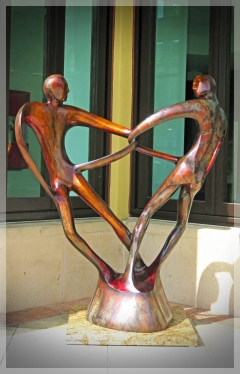 I’m not quite ready to put to rest Paul’s use of the word “submit.” With one in three women having experienced some form of domestic violence, the word “submit” makes us bristle as we think of passivity in the face of abuse. Throughout the ages, women have been mistreated, exploited, demeaned, and discounted. We’ve had the vote for just a century and it wasn’t that long ago when our career choices were pretty much limited to teaching or nursing. Today, women continue to earn only about 80% of what men make and professional women still bump their heads on the glass ceiling. Wanting independence and empowerment, submitting sounds too much like surrendering whatever power we have, buckling under to unfairness, and servitude.
Paul’s words regarding submission, however, deserve more than a quick dismissal as being outdated or politically incorrect. In actuality, we voluntarily submit to people all the time simply because submission is a vital part of living in a community. We yield at intersections, move to the side so someone can pass, hold a door, wait our turn in line, yield the floor so someone else can speak, remain silent during a concert, or let the kids pick the night’s movie. We submit to one another because we’re in this crazy world together and surviving it takes a cooperative effort.
Submission isn’t the same as obedience. Obedience responds to rules and is imposed but submission responds to reason and is freely given. Obedience doesn’t require a relationship; submission does. When we, as Christians, bear one another’s burdens, we are submitting. When we don’t dominate, we are submitting. When we are humble, we submit. When we respond to one another’s needs, we submit. Submission is a sign of strength, not weakness. It doesn’t elevate one person above the other or cancel their equality. Moreover, it has nothing to do with allowing abuse of any kind.
Submission is what happens when there is a collaborative effort and any relationship worth having is worth making that kind of effort. I regularly submit to my husband out of respect, affection, or persuasion (but I usually don’t call it submitting). In the same way, he often defers (or submits) to me. That’s how we’ve lasted 53 years! While we recognize one another’s rights, we also recognize our obligation to put aside our own personal agenda to serve one another.
 Because we heard the fan running, we didn’t realize the AC wasn’t working until we returned home after being gone most of the day. By then, the inside temperature of 86 told us we were in trouble. A check outside told us the AC compressor wasn’t operating and the blackened grass near it told us why: a lightning strike during the previous night’s storm! Although the fan could still operate, without the power of the compressor, all it did was blow hot air!
 Jesus criticized the Pharisees for their meticulous tithing of herbs and spices while missing the more important aspects of the law. While both gnats and camels were forbidden food, in a wonderfully graphic hyperbole, He compared the way they poured their wine through a strainer to avoid accidentally swallowing a gnat (the smallest of prohibited “unclean” animals) while actually swallowing a camel (the largest)! Feeling self-righteous over their adherence to minor details, the Pharisees entirely missed the foundational principles of the Law: loving God and loving others.
 Yesterday I told about a friend who was reading her Bible in a coffee shop when a young Jewish man belittled her belief in God. Admitting that he once believed, he explained he no longer did because the Torah had too many laws. My friend was pleased when the Holy Spirit provided her with this simple response: “Try the New Testament; there are only two laws in it!”
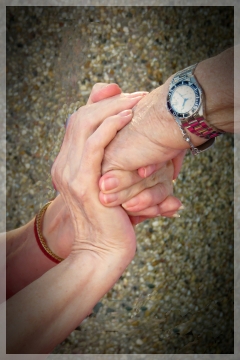 While social distancing has put an end to breaking bread with friends and holding hands while sharing a table blessing, I recall a dinner several years ago when I held the hand of our pastor’s wife during grace. For a small woman, her hands were larger and stronger than I expected. After grace, I looked at them and, comparing her youthful hands with mine, admit to feeling a twinge of envy. Like her, I played the piano but, unlike her, I could barely span an octave. Her sturdy hands had incredible reach and, unhampered by arthritis, there was power in her touch on the keyboard. I was overwhelmed by the strength of her hands and the beautiful way she uses them to praise the Lord as the worship leader at our mountain church.
 It was obvious we had ceiling fans in all three bathrooms but, because all their bulbs were burned out when we moved here, we didn’t know they also had lights. Never having seen how bright the bathrooms could be with working fan lights, we didn’t notice their absence. It was only when we had some electrical work done that we discovered the dead bulbs. Now that we’ve put in new LEDs, we’ll be sure to notice if any stop working in the future!
 Devotions of the Heart