
 The Word gave life to everything that was created, and his life brought light to everyone. The light shines in the darkness, and the darkness can never extinguish it. [John 1:4-5 (NLT)
It only takes a spark to get a fire going,
And soon all those around can warm up in its glowing;
That’s how it is with God’s Love,
Once you’ve experienced it,
Your spread the love to everyone
You want to pass it on. [Kurt Kaiser]
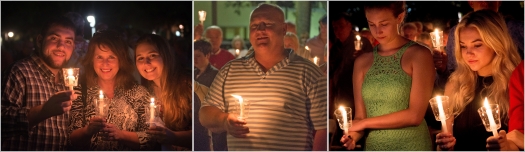
Last year, our entire family celebrated Christmas in the Keys and we were able to worship together Christmas Eve. Typical of most Christmas Eve services, everyone received a small candle when entering the church. At the end of the service, the lights were dimmed and the first person’s candle was lit from an altar candle. As we sang Silent Night, the flame from that first candle was passed to the next person and continued to be passed from person to person until everyone’s candles were burning brightly. It was a tiny church with about one hundred worshippers. Nevertheless, even though each individual candle gave off only a little light, by the time the song was finished, the sanctuary was 100 times brighter than when we’d started.
While listening to praise music today, I heard an old favorite from my Girl Scout days: Pass It On by Kurt Kaiser. The words, “It only takes a spark to get a fire going,” got me thinking about those candles. When we light a candle, we can pass along the flame without our own light diminishing. In fact, as the light gets passed along, it only gets brighter! Just as the flame of a candle doesn’t weaken as it is spread around, neither does love—it simply grows larger and stronger. While having more children may lessen the amount of money we can spend on each child, it certainly doesn’t lessen the love we have each one of them. In fact, our love increases so that we still can love each child as if he or she were our only one. That’s how it is with our Heavenly Father’s love; His love is limitless and He loves each and every one of us as if we were his only child.
This year, my family was separated by thousands of miles and we only saw one another on Zoom. Instead of going to a church Christmas Eve, we attended church on our computers. No flames were passed from person to person and no candles illuminated a darkened church as we sang Silent Night. Nevertheless, it only takes a spark to get the fire going and we don’t need a candle’s flame to spread the blessings of God’s grace and love. Let us remember these words attributed to St. Francis of Assisi: “All the darkness in the world cannot extinguish the light of a single candle.” It can’t extinguish God’s love, either!
The candlelight from last year’s Christmas Eve service was limited by the number of people in the church but there is no limit to the brightness that can be brought into this dark world by Christ’s church. What if every one of us took the light of God’s love with us and passed it on to all who cross our path? Remember, “It only takes a spark to get a fire going!”
I wish for you my friend This happiness that I’ve found;
You can depend on God It matters not where you’re bound.
I’ll shout it from the mountain top;
I want the world to know
The Lord of love has come to me
I want to pass it on. [Kurt Kaiser]
 John 21 records Jesus telling Peter to feed His flock three times. The word translated as “feed” in verse 16 is poimaino which refers to the entire process of tending the sheep: feeding, leading, guarding, doctoring, and bringing them into the sheep fold. Although the food of which Jesus is speaking appears to be the word of God, in verses 15 and 17 the word translated as “feed” is bosko, which exclusively meant to feed. Jesus gave Peter these instructions immediately after He’d fed the disciples a breakfast of grilled fish and bread. Could He also have been speaking of providing actual food?
 Becoming a Christian is the most important step we will ever take in our lives and has longer reaching consequences that our choice of career or spouse. Fortunately, it is relatively easy: admit our sinfulness and turn away from sin, believe that Jesus died on the cross to save us from sin and to give us eternal life, and declare our faith in Jesus Christ. Repenting, accepting and confessing one’s faith—that’s the easy part.
 Devotions of the Heart