
I will be your God throughout your lifetime—until your hair is white with age. I made you, and I will care for you. I will carry you along and save you. [Isaiah 46:4 (NLT)]
If I’d known I was going to live so long, I’d have taken better care of myself. [Anonymous]
Several years ago, a friend’s spry 94-year old mother emailed the family about having forgotten her elbow brace on the way to the exercise room in her senior residence. After returning to her apartment and donning the brace, the woman took an inventory of the other pieces of hardware she needed to get through each day. Along with the elbow brace, she wore bi-focal glasses, two hearing aids, a knee brace, two sets of dentures, two orthopedic shoe inserts, and one doe-skin support for three toes. Even without inventorying the number of medications that were part of her daily regimen, she observed that “it’s not a simple management situation” to keep track of it all. Feeling blessed that she didn’t need a cane and walker as did many her age, she closed her message by reminding the younger family members to take care of themselves. She continued her optimistic outlook and daily exercise routine until she went home to the Lord just a few months before her 100th birthday. Her light-hearted email remains a serious reminder that time takes a toll on our bodies.
Within my circle, many have reached the age when God has started to recall some of their parts. A few are nearly bionic with their titanium plates, pacemakers, implanted cardioverter defibrillators, replacement heart valves, intraocular lenses, artificial hips and knees, or portable oxygen concentrators. As my mother-in-law observed in her 102nd year, “Old age is not for sissies!” Indeed, it presents a fair number of challenges. Nevertheless, as long as we’re still breathing, we should be in good spirits and thankful. Old age is a gift from God and one denied to far too many of our friends and family. It is a privilege not a punishment, an opportunity rather than a misfortune, and a blessing not a curse.
Even though we slow down and start wearing out as the years progress, God (who is older than time itself) remains the same and is constant in His care for us. He doesn’t stop working in our lives because parts of our bodies have ceased to function properly. He doesn’t put us out to pasture because we can no longer carry a load, consign us to the trash heap because we have some broken parts, or scrap us because we’re out of date. In God’s eyes, no matter how old or run-down His children are, no one is considered unusable or obsolete! He is as close to us now as when we took our first breath and He’ll be right beside us when we take our last one. God carried us as children and He will continue to carry us until He recalls our worn out bodies and takes us on our final trip home.
Before we take that last journey, however, there is still work to be done in God’s earthly kingdom. As long as we are breathing (even if we need an oxygen concentrator to do it), there is someone somewhere with whom we can share God’s love and good news. Just don’t forget your elbow brace or cane on the way out the door!
But the godly will flourish like palm trees and grow strong like the cedars of Lebanon. For they are transplanted to the Lord’s own house. They flourish in the courts of our God. Even in old age they will still produce fruit; they will remain vital and green. They will declare, “The Lord is just! He is my rock! There is no evil in him!” [Psalm 92:12-15 (NLT)]
That is why we never give up. Though our bodies are dying, our spirits are being renewed every day. [2 Corinthians 4:16 (NLT)]
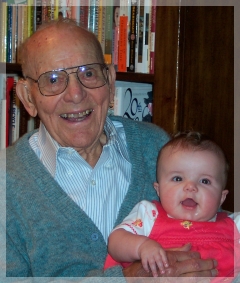
Today’s picture is of my father-in-law—a man who never grew obsolete. Even though his physical strength waned, his spiritual strength never did and he continued to bear fruit until he went home at age 96.
 John 21 records Jesus telling Peter to feed His flock three times. The word translated as “feed” in verse 16 is poimaino which refers to the entire process of tending the sheep: feeding, leading, guarding, doctoring, and bringing them into the sheep fold. Although the food of which Jesus is speaking appears to be the word of God, in verses 15 and 17 the word translated as “feed” is bosko, which exclusively meant to feed. Jesus gave Peter these instructions immediately after He’d fed the disciples a breakfast of grilled fish and bread. Could He also have been speaking of providing actual food?
 Becoming a Christian is the most important step we will ever take in our lives and has longer reaching consequences that our choice of career or spouse. Fortunately, it is relatively easy: admit our sinfulness and turn away from sin, believe that Jesus died on the cross to save us from sin and to give us eternal life, and declare our faith in Jesus Christ. Repenting, accepting and confessing one’s faith—that’s the easy part.
 I’m not quite ready to put to rest Paul’s use of the word “submit.” With one in three women having experienced some form of domestic violence, the word “submit” makes us bristle as we think of passivity in the face of abuse. Throughout the ages, women have been mistreated, exploited, demeaned, and discounted. We’ve had the vote for just a century and it wasn’t that long ago when our career choices were pretty much limited to teaching or nursing. Today, women continue to earn only about 80% of what men make and professional women still bump their heads on the glass ceiling. Wanting independence and empowerment, submitting sounds too much like surrendering whatever power we have, buckling under to unfairness, and servitude.
 Devotions of the Heart