OUR VOWS

For your Creator will be your husband; the Lord of Heaven’s Armies is his name! He is your Redeemer, the Holy One of Israel, the God of all the earth. [Isaiah 54:5 (NLT)]

But you have been unfaithful to me, you people of Israel! You have been like a faithless wife who leaves her husband. I, the Lord, have spoken. [Jeremiah 3:20 (NLT)]


Throughout the Bible, marriage is often used as a metaphor for man’s relationship with God. His covenant with Israel is seen as a form of marriage, their unfaithfulness as adultery, and their alienation from God as divorce. The book of Hosea is a story of a prophet with an unfaithful wife that parallels God’s relationship with his unfaithful people. Some scholars say the entire Song of Songs is an allegory of God’s love for Israel or the church. In the New Testament, John the Baptist describes the Messiah as a bridegroom and Jesus refers to himself as the groom in wedding parables. Marriage was ordained by God and the marital bond illustrates God’s relationship with His people.

55 years ago, I promised to love, comfort, and honor my husband and to forsake all others, keeping myself only for him as long as I lived. I took him for better or worse, for richer or poorer, in sickness and health, and to love and cherish until we were parted by death. In light of the many Biblical references to our spiritual marriage, I started to evaluate how I’ve done keeping those same vows with God.

Although I’ve done a pretty good job of doing all that I promised to my husband, I’ve not done as well with God. In times of health, wealth and contentment, I often forgot who made those good times possible. Moreover, I often was doubtful, distant, or angry with God in the times of sickness, scarcity, and sorrow. Since I frequently followed my peers, took the easy rather than right route, and listened to the enemy when I should have listened to Him, I’m not sure I even forsook all others for the Lord. Like a mistress or prostitute, I seemed to love Him for his gifts and often came to Him only because I wanted something more. While I can’t comfort our Almighty God, I’ve probably caused Him a fair amount of discomfort and grief. Fortunately, there was nothing about obedience in my wedding vows because obedience certainly hasn’t been my strong suit with the Lord. While I haven’t failed completely as a spiritual wife, I certainly haven’t kept our covenant relationship as well as I should have done.

On God’s part, like the perfect husband, He has been faithful and loved me in all circumstances. In spite of seeing me at my worst and knowing my every fault, God continued to love me. When I stopped believing in Him, He never stopped believing in me and, when I rejected him, He never rejected me. No matter how unfaithful I have been, God has remained faithful to me. He’s been loving and true to me at my sickest, poorest, and most contemptible. He gave me unconditional love when my love for Him seemed to depend on circumstances. Just as God told Hosea to redeem and love his adulterous wife, God has redeemed and loved me! The gift of His only Son to save my sorry soul is evidence of that.

At landmark anniversaries, people often remake their wedding vows. Our vows to God need to be retaken not just every ten years but every day. Merciful God, thank you for your unconditional and lavish love. Forgive us for being less than you deserve and thank you for giving us more than we could ever desire. In all circumstances, may we love, honor, cherish, and obey you, now and forever.

Never again will you be called “The Forsaken City” or “The Desolate Land.” Your new name will be “The City of God’s Delight” and “The Bride of God,” for the Lord delights in you and will claim you as his bride. Your children will commit themselves to you, O Jerusalem, just as a young man commits himself to his bride. Then God will rejoice over you as a bridegroom rejoices over his bride. [Isaiah 62:4-5 (NLT)]

Copyright ©2022 jsjdevotions. All rights reserved.

BUTTERFLY KISSES – Part 2

Give thanks to the Lord, for he is good! His faithful love endures forever. [Psalm 107:1 (NLT)]

For I know the plans I have for you,” says the Lord. “They are plans for good and not for disaster, to give you a future and a hope.” [Jeremiah 29:11 (NLT)]

red-spotted purple admiral butterflyAs I began looking for, listing, and thanking God for the little blessings hidden in each day (His “butterfly kisses”), I couldn’t help but wonder about the rest of the day. In a fallen world that all but guarantees loss, pain, misery, and trouble, does God just scatter these special moments of grace willy-nilly? Does He randomly send things like encouraging emails, the perfect worship song at just the right time, the aroma of gardenias wafting through the air, a hummingbird flitting through the garden, a shooting star, or doves nesting outside the window? What about the rest of our moments—the ones when we’re struggling with colicky babies, chronic pain, a severely disabled child, stage-4 cancer, betrayal, or abuse? As I look at my prayer list, I see prodigal children, financial woes, severe depression, food insecurity, parents who’ve lost two infants in less than two years, families dealing with Alzheimer’s, and a newly-wed who, less than an hour after sending her husband off to work with a kiss, learned that he died of an aortic aneurysm while on the train. Hearing children’s laughter while frolicking in the pool, a popsicle on a hot summer day, a rainbow, or seeing the elusive green flash at sunset only go so far in alleviating their anguish or sorrow. Where is God’s grace the rest of the time?


But wait! What do we know of God? Throughout Scripture, we are told that He is good and that He loves us as a parent loves a child. We know we have a loving God who gives us good gifts because, in Matthew 7, Jesus compared God’s provision to that of a loving father who wouldn’t deceive his children by giving them an inedible stone or a poisonous snake instead of bread or fish. Scripture also tells us that this good and loving God has a plan for us. So, if we believe that we are loved by a good God and that this good and loving God has set our lives in motion according to His plan, does it not follow that His entire plan is for our good (even when it includes sleepless nights, loss, hurt, pain, and tears)?

While we grab with gusto all that seems good to us, we’d prefer escaping the rest. While we find joy in the gifts we like, we feel cheated when it’s not the gift we wanted or expected. Nevertheless, every moment, even the ones that seem to break our hearts, are as much a part of God’s grace as are the little blessings of the day. Perhaps, God’s butterfly kisses are simply His way of reminding us of His loving presence in everything and serve as a way for us to see His hand in all things. It is in thanking Him for the little insignificant gifts of our day that we eventually find the ability to gives thanks in all circumstances!

Be filled with the Holy Spirit, singing psalms and hymns and spiritual songs among yourselves, and making music to the Lord in your hearts. And give thanks for everything to God the Father in the name of our Lord Jesus Christ. [Ephesians 5:18b-20 (NLT)]

Copyright ©2022 jsjdevotions. All rights reserved.


WHICH CAME FIRST?

Then God said, “Let there be light,” and there was light. … Then the Lord God formed the man from the dust of the ground. He breathed the breath of life into the man’s nostrils, and the man became a living person. [Genesis 1:3. 2:7 (NLT)]

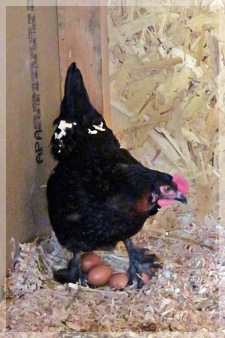
hen and eggs

Years ago, The Jerusalem Post published a joke about human arrogance. After considering all of humanity’s scientific progress, a group of scientists decided that God no longer was necessary. The chief scientist explained to God that man’s ability to clone people, manipulate atoms, build molecules, fly through space, create body parts with 3-D printers, and perform other miraculous feats meant God was unneeded and could be replaced by man. After patiently listening to the scientist, God suggested a human-making contest with only one rule: “We have to do it just like I did in the Bible.” Saying that was easy, the arrogant scientist bent over to pick up a handful of dust. “Put that down!” said God, while adding, “To do it my way, you have to make your own dust!”

Our vacation home in Idaho came complete with chickens and hen house. Every morning, the littlest grands would trek out to the hen house, check for eggs, and return with the makings of an omelet. I was relieved they never asked the age-old unanswerable question of “Which came first, the chicken or the egg?” We need a chicken (actually two) to have a fertilized egg but we need a fertilized egg to make a chicken. This seemingly futile question has been discussed for thousands of years. The Greek philosopher Aristotle considered it but evaded the answer by saying that both egg and chicken went infinitely backwards and always existed. The oldest fossilized eggs are 190 million years old and the oldest fossilized birds are only 150 million years old so paleontologists might say the egg came first. A strict reading of Genesis, however, would lead us to conclude that the chicken came first because animals appeared on the 5th day of creation. It’s a silly question but people ask it because they want to understand how something can come from nothing.

When making the children’s omelets, we still needed the raw ingredients. Along with the eggs that came from chickens (that came from eggs), we needed butter and cheese from cows, salt from the sea, pepper from the drupe of a pepper plant (Piper nigrum}, and green peppers and onions that came from seeds sown by a farmer, as well as a frying pan, whisk, spatula, and gas stove. Although my seamstress friend creates stunning clothing, she needs the silk from the silkworm (that came from an egg) or the cotton from the cotton bush (that came from a seed) to do so. My wood-working friend creates beautiful furniture but he can’t do it without the wood that comes from an oak tree that comes from an acorn that originally came from the oak! This begs the question, “Which came first, the oak or the acorn?” As the arrogant scientist learned, mankind can’t create something from nothing!

God, however, created everything from nothing. He had no eggs for the chickens, acorns for the oaks, seeds for the apple trees, or pollen for the flowers. He had no hydrogen or oxygen for water and no sodium or chloride to add to the water for the sea! Simply put, God spoke all creation into existence. That’s a rather unsatisfactory answer for those who want a technical explanation but the Bible is a book of theology that tells us the who and not a book of science that tells us how. We’re not about to get any more details as to how chaos turned to order, a void came to be filled, and nothing became something. Whether it was the chicken or its egg that came first will always be a conundrum.

The Lord merely spoke, and the heavens were created. He breathed the word, and all the stars were born. He assigned the sea its boundaries and locked the oceans in vast reservoirs. Let the whole world fear the Lord, and let everyone stand in awe of him. For when he spoke, the world began! It appeared at his command. [Psalm 33:6-9 (NLT)]

Copyright ©2022 jsjdevotions. All rights reserved.

KNOWING HE’S THERE

And the believers were filled with joy and with the Holy Spirit. [Acts 13:52 (NLT)]

zebra longwing butterfly
Zebra Longwing butterflies (Heliconius charithonia) live in hammocks and damp forests. Unless they are resting on a plant, however, they are often difficult to spot. Unlike most butterflies, they don’t stay in the sunlight for long. I may see their shadows on the boardwalk but, when I look up, they quickly vanish into the shade they prefer. With their yellow and black colors, shallow wingbeats and languid flight, they float through the woods and often seem to be little more than flickering sunlight glimmering through the trees.

Oddly, I think of the Holy Spirit whenever I get a glimpse of these beautiful creatures. Just as I’ll probably never hold one in my hand, I have difficulty grasping the concept of the Holy Spirit. Nevertheless, I know they both exist and bring me joy. There are times it’s difficult to catch sight of the winged zebras and, unfortunately, there are times I have difficulty detecting the Spirit. Nevertheless, just as I know the butterflies are in the woods, I know that He is present. Some days are better than others when it comes to spotting the Longwings and some days are better than others when it comes to sensing the Holy Spirit’s presence. If I’m jogging down a trail, I’ll never spot the butterflies and, if I’m rushing through life, it’s just as easy to overlook the Holy Spirit.

While I can blame the season, weather, light, or location for not seeing a butterfly, I have only myself to blame when I fail to perceive the Spirit. The times I feel devoid of His presence are when I neglect Scripture and prayer—the times I become so busy with the “me” and “my” of life that I don’t leave room for Him. They are the times I refuse to accept God’s control of my circumstances, ignore His direction, or don’t want to hear His conviction of my unacceptable behavior. Most often, however, I can’t feel the Holy Spirit because I’ve done something that grieves Him. Things like anger, resentment, jealousy, guilt and pride serve as barriers to feeling His presence. Fortunately, unlike the butterflies that disappear as they float through the woods, the Spirit will never leave me, even when I’ve disappointed Him.

In perfect unity with God the Father and God the Son, the Holy Spirit is the power of God that dwells within every believer in Jesus Christ. Just as it’s likely that I’ll catch a glimpse of Zebra Longwings on a certain boardwalk through the mangroves, I’m sure to feel the Spirit’s presence when I walk in His ways throughout the day.

You might as well try to see without eyes, hear without ears, or breathe without lungs, as to try to live the Christian life without the Holy Spirit. [D.L. Moody]

But when the Father sends the Advocate as my representative—that is, the Holy Spirit—he will teach you everything and will remind you of everything I have told you. [John 14:26 (NLT)]

Copyright ©2022 jsjdevotions. All rights reserved.

GOD THE SON

The virgin will conceive a child! She will give birth to a son and will call him Immanuel (which means ‘God is with us’). [Isaiah 7:14 (NLT)]

So the Word became human and made his home among us. He was full of unfailing love and faithfulness. And we have seen his glory, the glory of the Father’s one and only Son. [John 1:14 (NLT)]

It was the whole Trinity, which at the beginning of creation said, “Let us make man.” It was the whole Trinity again, which at the beginning of the Gospel seemed to say, “Let us save man.” [J.C. Ryle]

African iris
When reciting either the Apostle’s or Nicene Creeds, we express our belief in God, the Father Almighty, who created heaven and earth, and in His Son, Jesus Christ. When thinking of God as the Father and Jesus as His son, however, it’s easy to think of Jesus as sort of a God, Jr. As the son, He’s a smaller, younger, novice, or apprentice version of God the Father—sort of like the son who’s learning the business so He can take over when His father retires. Nothing could be further from the truth.

When we read the first chapter of Genesis, God refers to “us” and “our image,” so the plural nature of God didn’t just happen two thousand years ago in Bethlehem. The Apostle John tells us that Jesus (the Word) existed with God in the very beginning. Our triune God (the Father, Son, and Holy Spirit) exists beyond time—He always has been and always will be. Having no beginning, He will have no end. Although it was thousands of years between creation and Jesus’ birth, God the Son always existed. In the same way, the Holy Spirit wasn’t born on Pentecost; like the Father and the Son, He always has been!

That night in Bethlehem, Jesus didn’t come as an assistant God or as a lesser version of God the Father. Look at His names: Wonderful Counselor, Mighty God, Everlasting Father, Prince of Peace and Immanuel. Those are powerful names given to a baby boy but that baby boy was God Himself. He didn’t come as a god who looked like a man nor did He come as a man who looked like God. Both fully God and fully man, He was co-equal and co-eternal with God the Father and God the Holy Spirit—they were one in nature, power, action, and will. Rather than God, Jr., Jesus was wholly God—only He was in clothed in flesh and chose to live as a man.

Let us never forget that it was God who came to be born as a man that night in Bethlehem. It was God who was baptized by John and called “the Lamb of God.” It was God who preached the Sermon on the Mount, threw the money changers out of the temple, and called Himself “the bread of life” and the “good shepherd.” It was God who spoke with the woman at the well, healed the lepers, gave sight to the blind, and raised Lazarus from the dead. It was God who was tempted by Satan in the wilderness and it was God who lived a sinless life as a man in a sin-filled world. It was God who was betrayed by Judas, denied by Peter, sweat blood in Gethsemane, and condemned to die between two thieves. Mocked, whipped, and nailed to a cross, that was God who suffered and died a criminal’s death. And it was God who rose from the dead and ascended into heaven. It was God, in the form of a man called Jesus, who did it all just for us!

Our triune God is one in essence and yet three distinct persons. Understanding how each personage of the Trinity can be fully God while there is only one God is beyond my pay grade. Then again, I can’t understand things like quantum physics, the theory of relativity, string theory, or black holes. I can’t even fathom how I can be body, soul, and spirit in one person, so I shouldn’t be surprised at my limited understanding of the Trinity. As John Wesley aptly said, “Bring me a worm that can comprehend a man, and then I will show you a man that can comprehend the Triune God.”

I believe in one God, the Father Almighty, Maker of heaven and earth, and of all things visible and invisible. And in one Lord Jesus Christ, the only-begotten Son of God, begotten of the Father before all worlds; God of God, Light of Light, very God of very God; begotten, not made, being of one substance with the Father, by whom all things were made. [Nicene Creed]

Jesus said to them, “For sure, I tell you, before Abraham was born, I was and am and always will be!” [John 8:58 (NLV)]

Copyright ©2022 jsjdevotions. All rights reserved.

YOU WOULDN’T UNDERSTAND

“My thoughts are nothing like your thoughts,” says the Lord. “And my ways are far beyond anything you could imagine. For just as the heavens are higher than the earth, so my ways are higher than your ways and my thoughts higher than your thoughts.” [Isaiah 55:8-9 (NLT)]
spiderwort

During our summer travels, we were seated with a young couple during breakfast at a rural B&B. Upon discovering they were PhD candidates at the University of Chicago, we asked for an explanation of their research. Our eyes glazed over as the man used words like photons, leptons, mesons, baryons, and hadronic interactions. By the time his wife explained her materials research and mentioned macromolecular interactions, microstructures, interface dynamics, nanoparticles and stress variations, I think we would have preferred a flippant, “We’d tell you but then we’d have to kill you!” response to the ones we got. As patient as they were and as dumbed-down as they made their explanations, we barely knew more about their studies at the end of our conversation than we did at the beginning.

Perhaps a better answer to our questions would have been, “You wouldn’t understand even if we told you!” Nevertheless, if they’d said that, even though they were right, we would have been offended by their answer and insisted we could figure it out. Their world, however, is so far removed from ours and their vocabulary so specific that it would have taken them hours (more likely days) of explanation before we could have a vague understanding of what they did and why they did it. Nevertheless, we managed to find common ground in our fondness for Chicago, the charm of the B&B, and the delicious breakfast we were enjoying.

Even though the Bible clearly explains that God’s thoughts and ways are not ours, Scripture’s answer is neither satisfying nor comforting in the face of tragedy. Naturally, we want an explanation but God is strangely silent. Perhaps that’s just His way of saying, “Trust me, child, you really wouldn’t understand even if I explained it all to you!” While it’s not found in the Bible, the old maxim, “God works in mysterious ways,” is true. If the world of physics and materials science is beyond my limited understanding, I know I’m incapable of ever understanding what makes God run the universe the way He does. I’m still having trouble understanding a love so great that He gave His son as propitiation for our sins! I can’t fully grasp an all-powerful God who has always existed and always will—an all-knowing God, unconstrained by time or space, who can be everywhere at once—a God who can see yesterday, today and all the variations of tomorrow at one time. If I can’t fully comprehend God’s traits, what makes me think I could ever comprehend His reasoning?

We mortals want a detailed explanation of our lives from God but, even if He offered us one, we’d never understand it. Moreover, I’m not so sure I really want to know—the weight of such divine knowledge would be overwhelming. As we did with those grad students, however, we can find common ground—in God’s case, that would be His love for us and our love for Him. For now, that will have to suffice.

Oh, how great are God’s riches and wisdom and knowledge! How impossible it is for us to understand his decisions and his ways! [Romans 11:33 (NLT)]

The teaching of your word gives light, so even the simple can understand. [Psalm119:130 (NLT)]

God moves in a mysterious way His wonders to perform;
He plants His footsteps in the sea And rides upon the storm.
Deep in unfathomable mines Of never failing skill
He treasures up His bright designs And works His sov’reign will.
Ye fearful saints, fresh courage take; The clouds ye so much dread
Are big with mercy and shall break In blessings on your head.
Judge not the Lord by feeble sense, But trust Him for His grace;
Behind a frowning providence He hides a smiling face.
His purposes will ripen fast, Unfolding every hour;
The bud may have a bitter taste, But sweet will be the flow’r.
Blind unbelief is sure to err And scan His work in vain;
God is His own interpreter, And He will make it plain.
[William Cowper]

Copyright ©2022 jsjdevotions. All rights reserved.