PERFECTLY MADE

For it was you who created my inward parts; you knit me together in my mother’s womb. I will praise you because I have been remarkably and wondrously made. Your works are wondrous, and I know this very well. [Psalm 139:13-14 (CSB)]

Today’s socks tell me, “I am perfectly made” and remind me of Psalm 139’s affirmation that, “I have been remarkably and wondrously made.” All of my low-cut athletic socks have pithy affirmations woven into the toes. Depending on what pair I choose, I’m reminded that I have hope or that I’m loved, brave, strong, grateful, kind, powerful, blessed, or thankful. My favorite pair, however, tell me, “I am with you always!” It may seem silly, but there are times, especially during difficult days, when I recall the day’s affirmation on my feet and I stand a little more assuredly.

What we say to others matters, but what we say to ourselves matters even more! The way we speak to ourselves determines how we relate to everything and everyone else! Affirmations replace the negative talk we hear from others as well as the trash talk we say to ourselves! Shifting our minds toward the positive can change the direction we’re taking and lead us to a better destination!

I thought of my socks during church last week when the soloist sang Megan Woods’ lovely song, “The Truth.” The song opened with the sad words, “How many times can you hear the same lie before you start to believe it? The enemy keeps whisperin’ to me… Lord, I don’t wanna listen to the lies anymore.” The negative words we hear our heads are gifts from the enemy—Satan, the Father of lies. He might say that we’re not pretty enough, capable enough, or good enough. He’ll whisper that we’re too young, too old, too fat, too skinny, too tall, or too short. His words tell us we can’t when we can and we shouldn’t when we should. When we pray, he murmurs that God’s not there. Telling us we’re worthless sinners, he claims our past defines us, we don’t deserve happiness, and that we’re unworthy, unlovable, and unforgiveable! The enemy with his lies is camping out rent-free in our heads and his scorn, disparagement, and belittling can make quite a ruckus in there.

Our best defense against the enemy’s lies is keeping God’s truth in our hearts! While my affirmation socks can be found on Amazon, the God’s truth is found in the pages of our Bibles! It is filled with affirmations of who we are in Christ. Instead of socks telling us we are loved or have hope, we have Jeremiah 31:3 telling us that God loves us with an everlasting love and Psalm 62:5 telling us our hope comes from God! While my socks may say I’m strong, Romans 8:37 tells us we’re more than conquerors through Christ! When the enemy tries to take up residence in our minds, let’s remember that Scripture tells us we can stand against his schemes because we’re clothed in the armor of God (Eph 6:11). Our socks don’t need to say, “I am with you always,” because God promised He will never leave nor abandon us (Deut 31:6). God’s word reassures us that we have the peace of God guarding our hearts and minds. (Phil 4:7)

The Bible tells us truth—we are God’s beloved children! He lived and died for us! Never forget that we are God’s workmanship and God doesn’t make junk! Indeed, we are “remarkably and wondrously made.”

The truth is I am my Father’s child
I make Him proud and I make Him smile
I was made in the image of a perfect King
He looks at me and wouldn’t change a thing
The truth is I am truly loved
By a God who’s good when I’m not good enough
I don’t belong to the lies, I belong to You
And that’s the truth!
[Jeff Pardo/Matthew West/Megan Woods]
For we are his workmanship, created in Christ Jesus for good works, which God prepared ahead of time for us to do. [Ephesians 2:10 (CSB)]

Copyright ©2025 jsjdevotions. All rights reserved.

EASTER ISN’T OVER

Christ died for our sins, just as the Scriptures said. He was buried, and he was raised from the dead on the third day, just as the Scriptures said. He was seen by Peter and then by the Twelve. After that, he was seen by more than 500 of his followers at one time, most of whom are still alive, though some have died. Then he was seen by James and later by all the apostles. Last of all, as though I had been born at the wrong time, I also saw him. [1 Corinthians 15:3-8 (NLT)]

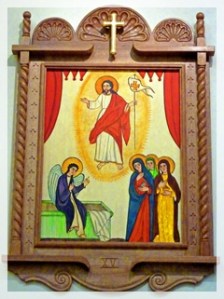
Station XVFound in almost every Roman Catholic church (and some Protestant and Orthodox ones), are the Stations of the Cross—a series of fourteen icons or carvings on the walls—each of which depict a moment in the Passion of Christ. Created to help people contemplate the events leading up to Christ’s crucifixion, they start with His death sentence from Pilate and end with His dead and battered body being laid in the tomb. Because Good Friday and Jesus’ death aren’t the end of the story, some churches have begun adding the resurrected Christ as a 15th station.

More recently, the idea of “Stations of the Resurrection” has taken hold in both Roman Catholic and Protestant traditions. While the Stations of the Cross depict just one day in the life of Christ, the Stations of the Resurrection illustrate the 50 days of Eastertide. There is no official list of “stations” but they usually begin with the angel speaking to the women at the empty tomb. They continue through the days Jesus remained on earth showing events like Jesus on the road to Emmaus and His appearance to the disciples on Easter, as well as His appearances to Thomas, the disciples on the shore, and the 500 mentioned by Paul. After portraying Jesus’ Ascension on the 40th day, the “stations” conclude either with the Holy Spirit’s descent on the 50th day (Pentecost) or Jesus’ appearance to Paul on the road to Damascus.

Having spent the season of Lent spiritually preparing for Good Friday and Easter Sunday, we shouldn’t need the Stations of the Cross or those of the Resurrection to help us remember Christ’s suffering, death, and rising from the dead. Nevertheless, once we put away the Easter baskets, we may not give Easter another thought until the following year. Easter, however, is more than one day; it is a liturgical season called Eastertide. Lasting for seven weeks, it concludes with Pentecost. Why not spend these weeks reading about and meditating on those 50 days in the gospels and Acts. Imagine the shock of finding an empty tomb. What was it like for Cleopas when he realized the stranger with whom he’d walked, talked, and broken bread was the resurrected Messiah? If you’d been one of His frightened followers hiding in a locked room, how would you react to seeing Jesus miraculously appear? Visualize seeing the scars on His hands and feet. What was it like to have breakfast with Him on the beach and to walk with Him, hear His voice, and witness His miracles once again? Can you imagine watching Jesus ascend into Heaven? Picture what it was like that 50th day on Pentecost when the disciples were filled with the power of the Holy Spirit. Consider how Peter, the one who denied Christ three times, became the one who boldly proclaimed Him “Lord and Messiah.” The Easter story doesn’t end at Easter, or even at Pentecost; it continues to unfold today!

Christ’s resurrection is the most powerful world-shaping event in history. It is why we are freed from our sins and live in hope not fear! The good news of Easter is so good that we should continue to celebrate Christ’s resurrection long after the rest of the world (having eaten the last of the Peeps and chocolate rabbits) is thinking about the next holiday. Remembering Easter and the events that followed should be an important part of our spiritual lives—not just for the 50 days of Eastertide—but all year long. As Augustine of Hippo said, “We are an Easter people and Alleluia is our hymn of praise!” Let us be Easter people all year long. Alleluia!

 God raised Jesus from the dead, and we are all witnesses of this. Now he is exalted to the place of highest honor in heaven, at God’s right hand. And the Father, as he had promised, gave him the Holy Spirit to pour out upon us, just as you see and hear today. … So let everyone in Israel know for certain that God has made this Jesus, whom you crucified, to be both Lord and Messiah! [Acts 2:32-33, 36 (NLT)]

Copyright ©2025 jsjdevotions. All rights reserved.

FASTING ALLELUIA

Hallelujah! Give thanks to the Lord, for he is good; his faithful love endures forever. [Psalm 106:1 (CSB)]

Hallelujah! Give praise, servants of the Lord; praise the name of the Lord. [Psalm 113:1 (CSB)]

low bindweed“Alleluia” (or “Hallelujah”), like “Amen,” is a word familiar throughout Christendom. Meaning “Praise the Lord,” it is the transliteration of the Hebrew hallel, meaning to shine, be boastful, praise, or rejoice and Yah, an abbreviated form of the name of the Lord: YHWH (Yahweh/Jehovah). Although two distinct words, they were consistently written as one (halleluyah).  In the Old Testament, this extraordinary word occurs only in Psalms. Usually found at the beginning, halleluyah was an imperative call to praise or boast in the Lord—a call to shine a light upon Him! Whether we spell this beautiful word the Latin way as “alleluia” or the Greek way as “hallelujah,” the meaning is the same. Many modern translations simply translate it as “Praise the Lord!”

On the Sunday prior to Ash Wednesday, the pastor at our liturgical church selected “All Creatures of our God and King” for the opening hymn at worship. As we sang its many alleluias, I knew we wouldn’t be singing any more of them until Easter. When our pastor was a girl, on the Sunday before Lent, the church’s children would process into the sanctuary carrying a banner with the word “Alleluia” on it. After being folded and placed in a box under the cross, that word and banner wouldn’t reappear until Easter morning. Although we don’t physically put away or “bury” any alleluias at our church, she continues the ancient tradition by eliminating them during Lent.

As a way of highlighting the solemnity of Lent, the “putting away” or depositio (meaning burial) of the alleluia goes back to medieval times. Choir boys would process into church with crosses, candles, and holy water while carrying a casket containing an “Alleluia” banner. The coffin was then buried in the garden until it was unearthed during the Easter vigil. In Paris, a straw figure bearing an “Alleluia” of gold letters was carried out and burned in the churchyard. After the Reformation, many Protestants continued the tradition of eliminating alleluias during the somber penitential season of Lent.

One modern writer compared putting away our alleluias during Lent to putting away all our Christmas decorations in January. If we had the tree, nativities, and wreaths out all year long, they’d lose their significance. Commonplace rather than special, they’d be ignored and unappreciated. Because we put them away in January, they’re treasured when we bring them out again in Advent! Without any alleluias during Lent, we appreciate them even more on Easter morning as we praise the Lord with every “Alleluia” in “Christ the Lord is Risen Today.”

While many hymns include “alleluia” or “hallelujah,” it occurs in only four New Testament verses, all in Revelation 19, when a heavenly chorus sings “Hallelujah!” at the marriage supper of the Lamb. While Lent is a time to focus on recognizing our sin and need for salvation, fasting from alleluias for seven weeks reminds us that our story is not yet complete. The day will come when Christ returns and God’s victory is completed. When that happens, we will be part of that heavenly chorus and praise the Lord while singing “Hallelujah!”

The greatest adventure in life—knowing God—begins at the Cross of Christ and ends with a “Hallelujah!” [David Jeremiah]

Then I heard something like the voice of a vast multitude, like the sound of cascading waters, and like the rumbling of loud thunder, saying, Hallelujah, because our Lord God, the Almighty, reigns! [Revelation 19:6 (CSB)]

Copyright ©2025 jsjdevotions. All rights reserved.

THE BRILLIANT THINGS

This is the day that the Lord has made; let us rejoice and be glad in it. [Psalm 118:24 (ESV)]

What would you do if you were six and your father said that your mom is in the hospital because she finds it hard to be happy and “did something stupid”? That question is answered in Duncan Macmillan and Jonny Donahoe’s one-act play, Every Brilliant Thing. In their play, that boy, now a grown man, tells the audience that he made of list of everything that was “brilliant” about the world—everything worth living for—and left it on his mother’s pillow. Reflecting a six-year old’s priorities, the list included ice cream, Kung-Fu movies, laughing so hard you shoot milk out your nose, burning things, construction cranes, and “me.” Although she returns the list with its spelling corrected, the boy’s mother never comments on it. Nevertheless, he keeps adding to his list. Although his mother eventually takes her life, the narrator tells how his list took on a life of its own and eventually saved him from his own depression and suicidal thoughts.
Throughout the play, the audience learns of additions to the list—everything from peanut butter, water fights, and sunlight to peeing in the sea with nobody knowing, someone lending you a book, cycling downhill, and completing a task. Sort of a theatrical and secular version of Ann Voskamp’s One Thousand Gifts, Every Brilliant Thing is a poignant reminder of the importance of noticing and naming the little “brilliant” things in our lives—to step out of ourselves to take in the small blessings with which God blesses us every day—to pause and feel God’s love in a stranger’s smile, a nurses’ gentle touch, the sound of children’s laughter, the smell of lemon zest, the taste of a fresh-baked warm chocolate chip cookie, a mockingbird’s serenade, a compliment, or the smell of a campfire! No one’s list is the same nor should they be.

Nearly three years ago, Voskamp’s book inspired me to start my own list of “gifts” (what Macmillan and Donahoe called “brilliant” things). But, like the play’s narrator, I put it aside after a while. Although there were moments I thought, “That’s one for the list,” I rarely added them and they were forgotten. It wasn’t until my most recent bout with depression and pain that I resumed adding to it. Of course, I couldn’t add to the list without making a point of opening my eyes to God’s presence in the ordinary stuff of life. Some were big things like taking Communion or learning that my girls are visiting in a few weeks. Most things, however, are pretty mundane—the aroma of night-blooming jasmine, the two standard poodles that sit regally beside their person as he chauffeurs them around the community in his golfcart, Savannah Guthrie’s  book Mostly What God Does, whipped cream on a cup of hot cocoa, and monarch butterflies. There’s nothing extraordinary about these “brilliant” things; nevertheless, they bring a smile to my face and remind me of God’s presence in all things.

Although our cups overflow with God’s blessings, it’s been said that joy comes in sips rather than gulps. May we always remember that it wasn’t in the storm that Elijah heard God—it was in His whisper. Indeed, God whispers to us in the seemingly insignificant but “brilliant” things of life. Let us take note of each and every one!

There is not one little blade of grass, there is no color in this world that is not intended to make men rejoice. [John Calvin]

You serve me a six-course dinner right in front of my enemies. You revive my drooping head; my cup brims with blessing. Your beauty and love chase after me every day of my life. I’m back home in the house of God for the rest of my life. [Psalm 23:5-6 (MSG)]

Copyright ©2025 jsjdevotions. All rights reserved.

“HALLELUJAH” RATHER THAN “HUMBUG”

The Spirit of the Sovereign Lord is upon me, for the Lord has anointed me to bring good news to the poor. He has sent me to comfort the brokenhearted and to proclaim that captives will be released and prisoners will be freed. He has sent me to tell those who mourn that the time of the Lord’s favor has come, and with it, the day of God’s anger against their enemies. [Isaiah 61:1-2 (NLT)]


Unfortunately, much of our Advent season is not spent joyfully looking forward to celebrating the birth of the Christ child. In hope of finding the perfect gift for everyone on our list, we pore over catalogues and search for sales and coupons. Either we fight for parking spots at the mall and spend hours standing in line or spend those hours sitting at the computer while shopping on line! We then fret and fuss over wrapping those gifts, mailing packages and Christmas cards, hosting and attending parties, baking cookies, making travel arrangements, decorating the house, preparing holiday dinners, and paying the ever-mounting bills. When we say, “Merry Christmas!” we might find ourselves mumbling a Scrooge-like “Bah! Humbug” under our breath! Instead of looking forward to Christmas with anticipation, there are times we can’t wait until it’s all over and done.

Dr. Seuss’ Grinch eventually realized Christmas really has nothing to do with all those trappings; I wonder why we have so much trouble remembering that same thing. Christmas isn’t about gifts, parties, cards, peppermint bark, decorations, or the “roast beast feast.” Jesus with His message of love, redemption, forgiveness, and salvation is the only reason for the season! Mary didn’t send out 100 birth announcements or bake dozens of cookies and the stable that housed the Holy Family wasn’t decorated with wreaths, ribbons, holly, or tinsel. God took care of the only decoration with a bright star and a heavenly chorus announced the birth. Shepherds were the first holiday guests and they didn’t expect gingerbread cookies or care about the stable’s decor or cleanliness. The Magi’s Christmas presents were odd gifts for an infant and probably arrived two years late.

Today, consider pausing from all your preparations to re-read Zechariah’s prophecy of a Savior who would redeem His people and the beautiful story of His birth in Luke 1 and 2. Tonight, take a drive and look at the Christmas lights festooned around your town; let them remind you of Isaiah’s promise; “The people who walk in darkness will see a great light … For a child is born to us.” Then let us joyfully raise our voices in a “Hallelujah!” instead of “Humbug!”

And the Grinch, with his Grinch-feet ice cold in the snow, stood puzzling and puzzling, how could it be so? It came without ribbons. It came without tags. It came without packages, boxes or bags. And he puzzled and puzzled ’till his puzzler was sore. Then the Grinch thought of something he hadn’t before. What if Christmas, he thought, doesn’t come from a store. What if Christmas, perhaps, means a little bit more. [From “How the Grinch Stole Christmas” by Dr. Seuss]

The people who walk in darkness will see a great light. For those who live in a land of deep darkness, a light will shine … For a child is born to us, a son is given to us. The government will rest on his shoulders. And he will be called: Wonderful Counselor, Mighty God, Everlasting Father, Prince of Peace. [Isaiah 9:2,6 (NLT)]

Copyright ©2024 jsjdevotions. All rights reserved.


GRACE NOTES

Let the heavens be glad, and the earth rejoice! Let the sea and everything in it shout his praise! Let the fields and their crops burst out with joy! Let the trees of the forest sing for joy. [Psalm 96:11-12 (NLT)]

clouded sulphur butterfly - asterIn Letters to Malcom, C. S. Lewis wrote, “We, or at least I, shall not be able to adore God on the highest occasions if we have learned no habit of doing so on the lowest. … Any patch of sunlight in a wood will show you something about the sun which you could never get from reading books on astronomy. These pure and spontaneous pleasures are ‘patches of Godlight’ in the woods of our experience.”

What Lewis called “patches of Godlight,” I think of as God’s grace notes. In music, a grace note is played with a light quick motion that immediately leads to the principle and stressed note. Unnecessary for the melody and so brief they don’t alter the tempo, grace notes merely enrich the music by adding a small embellishment. Like the musical grace note and Lewis’s “patches of Godlight,” God’s grace notes aren’t necessary; nevertheless, they enhance our lives. They’re subtle reminders that God is present and loves us enough to embellish the day with a little something extra.

Unlike Kodak moments, Godlight and grace notes are not meant to be saved. They’re rarely repeated and we can’t predict when a “patch of Godlight” will shine into our lives or a grace note will play. While waiting at a red light, I glanced at the grassy median to my left where small yellow flowers appeared to be dancing in the air. Although hundreds of dainty Sulphur butterflies were flitting to and fro just a few inches above the yellow wireweed in the grass, it looked like the flowers’ petals had escaped from their stems and the field was bursting with joy! Did God arrange that revelry in yellow just for me? Probably not, but it felt like He did and my day changed for the better because of it.

After noticing that others at that light seemed oblivious to the butterfly frolic, I wondered how many of God’s grace notes I’ve missed because I wasn’t looking or listening. As the prophet Elijah learned, God doesn’t necessarily reveal Himself in spectacular displays of things like lightning, wind, thunder, and fire. Our infinitely creative God whispers through the ordinary as well—with things as mundane as yellow butterflies, a child’s laughter, the aroma of jasmine, a finch on the windowsill, a song on the radio, seeing a young couple caress or an old couple walk hand in hand, a shooting star, a stranger’s smile, or a patch of sunlight while walking through the woods. Although God personalizes His grace notes for each one of us, we need to slow down and be mindful enough to recognize and appreciate them.

There is an old Hindi poem, translated by Ravindra Kumar Karnani, in which a child asks God to reveal Himself. God responds with a meadowlark’s song, then the roar of thunder, followed by a star, and the birth of a baby. In her ignorance, however, the child doesn’t recognize any of God’s answers. Finally, in desperation, she cries, “Touch me God, and let me know you are here!” But, when God touches the child, she brushes off the butterfly and walks away disappointed. It occurs to me that we are not much different from her. May we never thoughtlessly brush away one of God’s gentle kisses, fail to notice His grace notes, or miss appreciating a small patch of Godlight!

Are we paying attention to the everyday moments of our lives and seeing God in them, or are we living in such a chaotic frenzy that we hope we’ll have time to look for the presence and mystery of God later, when we have more time – say, when the degree is finished, the kids have moved out, this project is completed, or we retire? [Dean Nelson]

For ever since the world was created, people have seen the earth and sky. Through everything God made, they can clearly see his invisible qualities—his eternal power and divine nature. [Romans 1:20 (NLT)]

Copyright ©2024 jsjdevotions. All rights reserved.