SAFETY FEATURES

Do not stifle the Holy Spirit. [1 Thessalonians 5:19 (NLT)]

painted lady butterflySince my 18-year-old grand is a new driver, I was surprised when her parents purchased a new car for her. Remembering the many dings, scrapes, and dents our teens left on their cars, I asked why they’d replaced the 15-year-old car on which she learned to drive with a new one; “safety features” was their simple and logical explanation. This new car offers things like forward collision warning, automatic emergency braking, adaptive cruise control, blind spot monitoring, lane departure warnings, lane-keeping assist, backup cameras, active park assist, rear cross traffic alert, and a whole variety of air bags (front, side, seatbelt, knee, foot, and curtain along with rollover sensors to deploy them.) Knowing that accidents happen to even the best drivers, damage to a new car is far more acceptable than any damage done to their daughter!

Although God doesn’t outfit us with safety features to warn and protect us, like any good parent, He wants to safeguard His children. To keep us safe and within His will, He gives us the Holy Spirit as standard equipment once we accept Jesus! Moreover, even though His technology hasn’t changed through the centuries, it remains state of the art.

As much as those various safety features will keep my grand safer, they can’t entirely protect her. Free to ignore their many warnings, she remains vulnerable to her own choices. Whether or not she abides by the speed limit, stops at stop signs, yields the right of way at roundabouts, or signals lane changes is entirely up to her. Like traffic laws, God’s laws set the standard for our behavior and help us know right from wrong. But, just as my grand may be tempted to use her cell phone while driving, our belief in Jesus doesn’t mean we’ll never be tempted to sin. Fallible beings that we are, we’re not capable of perfect obedience. Just as we tend to nudge that speedometer a few miles over the limit, we tend to push the limits when it comes to the rest of our behavior. Moreover, just as my grand may choose to ignore her car’s various warnings, we can choose to turn a deaf ear to the Spirit’s voice. That’s the problem with that pesky thing called free will—we know better but we often do it anyway!

Fortunately, unlike some car safety devices, we can’t disable or turn off the Holy Spirit. As our advocate, comforter, guide, and counselor, He always is present—teaching, guiding, encouraging, warning, and convicting us. Rather than sounding an annoying beep or flashing a warning light, He guides us through our conscience, with that still small voice, and in other subtle ways. His guidance is better than the most sophisticated GPS because He’ll never lead us into sin. May we always remember that true safety isn’t found in car technology or even the absence of danger; it is found in the presence of God!

But when the Father sends the Advocate as my representative—that is, the Holy Spirit—he will teach you everything and will remind you of everything I have told you. [John 14:26 (NLT)]

And do not bring sorrow to God’s Holy Spirit by the way you live. [Ephesians 4:30a (NLT)]

Copyright ©2021 jsjdevotions. All rights reserved.

INCOMPREHENSIBLE BUT REAL

moebius band - moebius stripAnd I will ask the Father, and he will give you another Advocate, who will never leave you. He is the Holy Spirit, who leads into all truth. The world cannot receive him, because it isn’t looking for him and doesn’t recognize him. But you will know him, because he lives with you now and later will be in you. [John 14:16-17 (NLT)]

 I tell you the solemn truth, that the doctrine of the Trinity is not so difficult to accept for a working proposition as any one of the axioms of physics. [Henry Brooks Adams]

Writing about our Trinitarian God yesterday, reminded me of the Möebius strip (or band). Ever since my college roommate showed me one, I’ve been fascinated by it. To make one, take a paper strip, give it a single twist and tape the ends together to form a loop. If you draw a line from the seam down the middle of this strip, the line will meet itself back at the same seam but on the other side of the paper. If you continue drawing the line, it then meets at the starting point (and will be twice the length of the strip of paper) without ever needing to lift your pen. This single continuous line shows that the Möebius strip has only one boundary or surface. Imagine an ant crawling in a straight line along the length of that twisted and taped strip. It would return to its starting point having traversed every part of the strip without ever crossing an edge. Basically, something that looks as if it has two sides (and was made by a piece of paper that did), actually has only one surface or side.

If you cut this once-twisted piece of paper down the center line, you’ll end up with one long strip that now has two twists and two surfaces. If you cut that strip again, you end up with two intertwined strips and it just gets more confusing after that! German mathematician August Möbius’ discovery of the oddity in 1858 resulted in the development of a new field of mathematics called topology. While there are all sorts of algebraic and geometric explanations for this simple but remarkable piece of paper, I understand none of them.

Although I see how the Möebius strip could be applied to conveyor belts, continuous-loop recording tapes, and typewriter ribbons, I don’t understand its application in physics, music, engineering, chemistry, or topology. Understanding how it happens, however, isn’t necessary for me to know what happens when I take a strip of paper, give it a single twist, and tape it together!

For me, comprehending the Holy Trinity is a bit like my fuzzy understanding of the Möebius strip. I know it exists but I’m not quite sure how it works. I’ve experienced it but I can’t explain it. That the Father is God, the Son is God, and the Holy Spirit is God while, at the same time, the Father is neither Holy Spirit nor Son, the Son is neither Holy Spirit nor Father, and the Holy Spirit is neither Father nor Son is beyond human understanding!

Even without understanding how God is one in essence but has three united persons in that essence, I know our Triune God exists. Scripture tells us there is only one God and yet it also tells us that God exists in three persons. All three were present at Jesus’ baptism and He spoke of them. Moreover, just as I’ve witnessed the reality of a Möebius strip, I’ve witnessed the reality of the Father, Son, and Holy Spirit as they work in my life. That the concept of one in three and three in one is complex and puzzling doesn’t mean it isn’t real! Even though it’s beyond our understanding, like the Möebius strip, all we have to know is that it’s true!

Bring me a worm that can comprehend a man, and then I will show you a man that can comprehend the Triune God. [John Wesley]

Jesus came and told his disciples, “I have been given all authority in heaven and on earth. Therefore, go and make disciples of all the nations, baptizing them in the name of the Father and the Son and the Holy Spirit. Teach these new disciples to obey all the commands I have given you. And be sure of this: I am with you always, even to the end of the age.” [Matthew 28:18-20 (NLT)]

Copyright ©2021 jsjdevotions. All rights reserved.

TO WHOM?

But when you pray, go into your room, close the door and pray to your Father, who is unseen. (Matthew 6:6 NIV)

And I will do whatever you ask in my name, so that the Father may be glorified in the Son. You may ask me for anything in my name, and I will do it. [John 14:13-14 (NIV)]

And pray in the Spirit on all occasions with all kinds of prayers and requests. With this in mind, be alert and always keep on praying for all the Lord’s people. [Ephesians 6:18 (NIV)]

“To whom should we pray?” is a common question. People wonder, “If we pray to God the Father, are we leaving out His Son? But if we pray to Jesus, are we leaving out God? And where does the Holy Spirit fit in?”
I’m no theologian, but it seems we certainly can’t go wrong by praying to God the Father. After all, when asked how to pray, Jesus began with “Our Father” and the Apostle Paul wrote the Romans about joining together and “giving praise and glory to God, the Father of our Lord Jesus Christ.” [15:6] Nevertheless, Jesus, as the son of God, is divine and He promised that we can ask for anything in His name. So, we can pray to Him as did Stephen who prayed, “Lord Jesus, receive my spirit,” while being stoned. [Acts 7:59] To further confuse the matter, Paul explained that the Holy Spirit intercedes for us so it appears that we also can pray to Him.

If we can pray to any of the three, how do we decide to whom we’ll pray? Some people decide who they’ll address by the topic of their prayer. When they want to offer worship and praise, ask for forgiveness, or plead for divine intervention, they call on God the Father. When they need to talk with someone who understands their earthly struggles, they call on Jesus. Since the Holy Spirit helps us pray, they pray to Him when they can’t find the words to express themselves.

When we worry about to whom we address our prayers, however, we’re forgetting that our Trinitarian God, while three persons, is one God! Calling it a “divine riddle,” Puritan minister Thomas Watson explained, “The three persons in the blessed Trinity are distinguished, but not divided; three substances, but one essence. … If there be one God subsisting in three persons, then let us give equal reverence to all the persons in the Trinity. … One person has not a majority or super eminence above another, therefore we must give equal worship to all the persons.”

When learning about Jeopardy contestant Matt Amodio for yesterday’s devotion, I discovered that his answers irk the grammar police. Jeopardy answers must be given in the form of a question and he begins every response with “what’s…” even when referring to a person. Amodio’s strategy is to keep things simple and explained that keeping his responses consistent allows him to focus on the “meat” of the clue. Just as a Jeopardy contestant’s answers don’t have to be grammatically correct to be accepted, I suspect our Trinitarian God cares far more about our hearts than our words and would prefer we give more thought to the “meat” of our prayers rather than to whom or how they’re said.

We can address our Trinitarian God in any of a number of ways—as Eternal Father, Holy Spirit, Lord, Blessed Jesus, God, Lord of My Life, Almighty and Eternal God, Holy Spirit of God, Eternal Being, Divine Love, God of Mercy, Holy One, Holy and Blessed Trinity, God, Jesus, Spirit of God, or many other reverent names. Flawed beings that we are, we seem to complicate our lives unnecessarily and worrying about how to pray (rather than simply doing it) is one of the ways we do it. Amodio’s answers are accepted by the Jeopardy judges just as our prayers, offered in faith with a humble heart, will be accepted by God the Father, Jesus the son, and the Holy Spirit.

Christian prayer is most often Trinitarian. Practically, this means we pray by the Spirit, through Jesus Christ our mediator, to God the Father. [Mark Driscoll]

In the same way, the Spirit helps us in our weakness. We do not know what we ought to pray for, but the Spirit himself intercedes for us through wordless groans. And he who searches our hearts knows the mind of the Spirit, because the Spirit intercedes for God’s people in accordance with the will of God. [Romans 8:26-27 (NIV)]

Copyright ©2021 jsjdevotions. All rights reserved.

DRY BONES

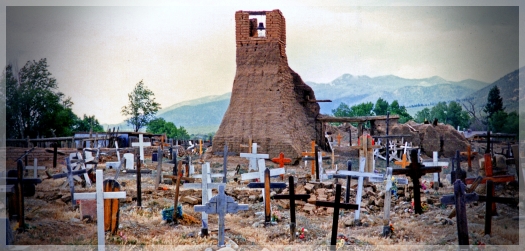
Taos NMThen he said to me, “Speak a prophetic message to these bones and say, ‘Dry bones, listen to the word of the Lord! This is what the Sovereign Lord says: Look! I am going to put breath into you and make you live again! I will put flesh and muscles on you and cover you with skin. I will put breath into you, and you will come to life. Then you will know that I am the Lord.’” [Ezekiel 37:4-6 (NLT)]

The Jewish people were in despair. Jerusalem was in ruins and the Temple destroyed. Exiled to Babylon, they were without a king, homeland, or hope. God’s promise of Israel’s restoration is depicted in Ezekiel 37 when the prophet is transported in a vision to a valley filled with desiccated bones. The Lord instructs Ezekiel to speak a prophecy over the dry bones that the Lord will bring them back to life. As the prophet begins to speak God’s words, the bones start rattling and coming together as skeletons. The prophet watches as muscles, tendons, and skin cover the bones until they became fully formed bodies. Although the bodies look alive, they are no more than unbreathing corpses until the Lord instructs Ezekiel to tell the four winds to breathe life into the lifeless beings. As the prophet speaks God’s words, he witnesses the once dead bodies come alive, stand erect, and become a great army. The initial meaning is pretty obvious: the bones coming back together illustrate Israel’s restoration and the wind or breath entering the dead bodies illustrate spiritual renewal or rebirth.

Be that as it may, as a Sunday schooler who didn’t understand the story behind Ezekiel’s somewhat eerie vision, picturing those dry bones rattling and rising up gave me the creeps. Perhaps it was because of the children’s song Dem Dry Bones. Even though we sang it in Sunday school, the song was associated more with Halloween (and its ghosts and goblins) than Biblical prophecy. Sometimes, a second verse was added in which Ezekiel, after connecting those bones, disconnected them—not a pleasant visual for any child! Perhaps I’d simply seen too many Saturday matinees with zombies, mummies, or other creatures of the night. Not understanding the context behind Ezekiel’s prophecy, the whole vision seemed as macabre as does the Body Worlds exhibit that features real skinless corpses preserved in plastic.

Yesterday’s devotion mentioned how I enjoy listening to worship music on my frequent trips to and from my doctor’s appointments. When I first heard Elevation Worship’s Rattle, with its words, “And the bones began to rattle, rattle, rattle, rattle…This is the sound of dry bones rattling,” I initially thought of Ezekiel’s vision. The thought of hearing dry bones rattling immediately brought up the old ghoulish images from childhood. But, as I listened to the rest of their words, those bones weren’t the dry ones in Ezekiel’s vision. As they sang, “Saturday was silent, Surely it was through. … Friday’s disappointment is Sunday’s empty tomb,” I understood they were singing about Jesus rising from the grave and the renewal of life for those who are restored by His power.

Today, I returned to Ezekiel 37 and saw his vision as more than a simple prophecy of the people’s return from their exile in Babylon, the reconstitution of the modern state of Israel, and/or the end times and the second coming of Christ. I saw it as a beautiful story of hope and rebirth. Although the prophecy was for Israel, I see Ezekiel’s vision as an illustration of what God can do for and with us right now—the life-giving power of His word to put back together the pieces of our broken lives and the power of the Spirit’s breath to bring us back to spiritual life! No longer will I cringe at the thought of dry bones rattling and rising. They tell me that no one ever is beyond restoration—no one is ever so spiritually dead that he or she can’t come alive again. The rattle of dry bones will remind me that, without the resurrection power of Jesus and the breath of the Spirit, we are little more than dry bones in a valley.

No difficulties in your case can baffle him, no dwarfing of your growth in years that are past, no apparent dryness of your inward springs of life, no crookedness or deformity in any of your past development, can in the least mar the perfect work that he will accomplish, if you will only put yourselves absolutely into his hands and let him have his own way with you. [ Hannah Whitall Smith]

Jesus told her, “I am the resurrection and the life. Anyone who believes in me will live, even after dying. Everyone who lives in me and believes in me will never ever die. [John 11:25-26 (NLT)]

Copyright ©2021 jsjdevotions. All rights reserved.

BROKEN-DOWN WALLS

An evil man is held captive by his own sins; they are ropes that catch and hold him. He will die for lack of self-control; he will be lost because of his great foolishness. … A person without self-control is like a city with broken-down walls. [Proverbs 5:22-23, 25:28 (NLT)]

Stagecoach Rd GalenaThe book of Nehemiah opens with Nehemiah’s distress at learning that Jerusalem’s walls remained in shambles even though decades had passed since the first Jewish exiles returned to the city. Broken walls and no gates meant Jerusalem (and the Temple) were defenseless against enemies and wild animals. Just as a city is defenseless against its enemies’ attacks, a person without self-control is defenseless against the Satan’s attacks.

The story is told of Raynald III, a 14th century duke in what now is Belgium. After his younger brother Edward led a successful revolt against him, the duke was captured. Rather than kill his elder brother, Edward built a room around him in the castle. Hardly an ordinary prison cell, it had several un-barred windows and a nearly normal-sized unlocked door. All Raynald had to do to regain both his title and property was to leave his room.

While walking out an unlocked door sounds easy to us, it wasn’t for Raynald. With the nickname of “Crassus” (Latin for “fat, gross, plump”), the deposed duke was grossly overweight. To gain his freedom, Raynald just needed to lose some of his girth so he could fit through the door. Rather than dieting his way out of prison, however, the obese man grew even fatter as he feasted on the delicious rich foods his brother sent to him each day. When Edward was accused of cruelly imprisoning his brother, he justified his actions by saying, “My brother is not a prisoner. He may leave when he so will.” Indeed, Raynald wasn’t Edward’s prisoner; he was a prisoner of his appetite. With no self-control, he gorged himself in that room for ten years until the door was widened after Edward’s death.

Just as a city with broken walls and no gates is vulnerable to attack, a person with no self-control, like Raynald, is equally vulnerable. Because of his brother’s insatiable appetite and self-indulgence, Edward knew how to defeat Raynald. Like Edward, Satan knows what tempts us—be it gluttony, lust, greed, wrath, laziness, envy, pride or any other sin. Self-control is the last (but not the least) characteristic of the fruit of the Spirit mentioned by the Apostle Paul. Indeed, without the power of the Holy Spirit, we are as defenseless as an ancient city with broken-down walls. Nevertheless, in the end, we are the ones responsible for patrolling our gates and judging what will enter into our lives. Although empowered by the Spirit with the self-control to refuse entry, we are the ones who must close the gates.

Nehemiah’s concern for Jerusalem, however, was about more than safety. Although their broken walls and burnt gates made them vulnerable to enemies, to the ancient pagan world, the strength of a city’s walls represented the strength of the people’s gods. Nehemiah knew those wrecked walls dishonored Jehovah’s name; to the rest of the world, they meant a powerless God and a disgraced and defeated people.

When we can’t control our passions, anger, conversation, spending, appetite or any other behavior, what does that say about us? Are we a disgraced and defeated people? When we, as followers of Christ, fail to exercise self-control, what does that say about our God? Because of his lack of self-control, Raynald was held captive by his appetite and dishonored his own name. Without self-control, we become captives to sin and dishonor Jesus’ name.

You say, “I am allowed to do anything”—but not everything is good for you. And even though “I am allowed to do anything,” I must not become a slave to anything. [1 Corinthians 6:12 (NLT)]

For God has not given us a spirit of fear and timidity, but of power, love, and self-discipline. [2 Timothy 1:7 (NLT)]

Copyright ©2021 jsjdevotions. All rights reserved.

THE PRINCE’S PSALM

swamp lilyI will be careful to live a blameless life—when will you come to help me? I will lead a life of integrity in my own home. … I will reject perverse ideas and stay away from every evil. [Psalm 101:2,4 (NLT)]

Starting with Solomon, Psalm 101 was sung at the kings’ coronations. Believed to have been written by David, the psalm has several “I will” statements in which the king resolves to reign righteously, sing of God’s mercy and justice, and live a blameless life in his home. Pledging to refuse to have anything to do with wickedness, he promises not to tolerate crooked dealings or evil and to be so careful about the character of his associates that only those above reproach would serve him. He vows to be intolerant of slander, conceit, arrogance, deceit, and falsehoods and he pledges that his daily task will be to search out the wicked to free the city from all evil.

Perhaps because the psalm describes the proper conduct for a Christian king, it was known as the “prince’s psalm” in Europe. Ernest I (1601 –1675), the Duke of Saxe-Gotha (and known as “Ernest the Pious”) is said to have sent an unfaithful minister a copy of the psalm as a subtle way of voicing his reproach. It soon became a popular saying that whenever an official did something wrong, he would receive a copy of the “prince’s psalm” to read! With his deep concern about civil government, Martin Luther wrote an 80-page discussion of the psalm in which he expounded on the qualities of a Christian prince or magistrate. Those leadership qualities haven’t gone out of style and 21st century Bible teacher Warren Wiersbe suggests we simply call the psalm “Leadership 101.” Indeed, the psalm is an excellent plan both for virtuous living and good governance.

The psalm’s lofty goals, however, were written by a man who didn’t live up to them and sung for other kings who couldn’t either. I’m sure David had every intention of walking in a way that pleased God. He never envisioned raping Bathsheba, committing adultery, plotting with Joab to murder Uriah, having to deal with Amnon’s rape of Tamar, nor the family and political intrigue that comes with at least eight wives and nineteen sons. When sung at Solomon’s coronation, the new king probably was filled with good intentions, as well. He never pictured having a harem of 1,000, building pagan shrines for Chemosh or Molech, or worshipping those foreign gods. Like David and Solomon, we usually start out with good intentions but seem to lose our way when it comes to achieving them. Even the Apostle Paul admitted difficulty in putting his good intentions into practice when he said, “I want to do what is right, but I can’t. I want to do what is good, but I don’t. I don’t want to do what is wrong, but I do it anyway.” [Romans 7:18-19]

In spite of our high ideals and lofty goals, sin loves to rear its ugly head. If people like David, Solomon and Paul couldn’t live up to their good intentions, what chance is there for us? Not much if we hope to do it on our own, but the good news is we’re not alone! “Thank God!” said Paul, “The answer is in Jesus Christ our Lord.” [Romans 7:25] The rest of the answer is found in Romans 8. Today, don’t just read a portion of this beautiful chapter—please read it all.

And because you belong to him, the power of the life-giving Spirit has freed you from the power of sin that leads to death. …Those who are dominated by the sinful nature think about sinful things, but those who are controlled by the Holy Spirit think about things that please the Spirit. …The Spirit of God, who raised Jesus from the dead, lives in you. And just as God raised Christ Jesus from the dead, he will give life to your mortal bodies by this same Spirit living within you. Therefore, dear brothers and sisters, you have no obligation to do what your sinful nature urges you to do. [Romans 8:2,5,11-12] (NLT)] 

Copyright ©2021 jsjdevotions. All rights reserved.