Your word is a lamp for my feet and a light for my path. … See how I have loved your guiding principles! … O Lord, in keeping with your mercy, give me a new life. There is nothing but truth in your word, and all of your righteous regulations endure forever. [Psalm 119:105,159-160 (GW)]
 I often find myself lost in the Bible, fascinated by this amazing book of history, poetry, passion, and wisdom. Comparing translations and reading commentaries helps me understand the context and meaning of verses. Knowing something about the specific church to whom Paul was writing, for example, allows me to better understand his directions, many of which seem peculiar in today’s world where churches don’t argue about circumcision and food isn’t offered to idols. For example, Paul wasn’t playing fashion police when giving instructions about hair length and head coverings to the church in Corinth. Although Greek women worshipped without head coverings, Jewish women had always covered their heads in worship—an uncovered head for them was a sign of loose morals. Moreover, in Corinth (the city with Aphrodite’s temple and its 1000 prostitutes) both long hair on men and short hair on women were signs of prostitution. Paul was trying to unify both Jewish and Gentile believers and prevent anyone’s appearance from interfering with their ability to be a witness for Christ. Bible study also makes old familiar verses take on deeper meaning. David’s sorrowful words of repentance in Psalm 51 are even more poignant when we know they refer to his adultery with Bathsheba and the murder of Uriah. Bible study, however, is far more than an intellectual exercise; it enables us to know God as He revealed himself in Scripture and then to weave His word into our daily lives.
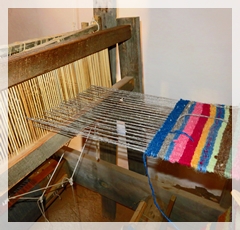
As a girl, I used to weave potholders and I’ve taught both my children and grands to do the same. We attached fabric loops across a small metal loom and interlaced other loops at right angles. Over and under the loops we’d go until the loom was filled. When finished, instead of a bunch of unconnected loops, we had a thick potholder that could withstand heat. While that’s the only thing I’ve woven, I try to weave God’s word into the fabric of my life daily. Unlike the Corinthians, I don’t live in sin city but, like them, I’ve been challenged to live up to God’s standard of morality and to behave in a way that is considerate to the sensitivities of others. I’ve neither committed adultery nor murdered anyone’s husband but, like David, I have allowed my sins to drive a wedge between God and me. Yet, as I weave God’s word into my life, I can handle all of life’s circumstances, even when I get into hot water.
“The touch, the feel, of cotton…the fabric of our lives,” the television ads for cotton tell us. Sorry, Madison Avenue, but neither cotton, linen, wool, polyester, nor silk are the fabric of my life. That honor belongs to God’s word.
A Pew Research poll in 2010 found that evangelicals ranked only a smidgen higher than atheists in familiarity with the New Testament and Jesus’s teachings. [Newsweek Magazine (1/2015)]
 How would we prove we are Christians? If we were Islamic converts to Christianity, seeking asylum in the United Kingdom or several other nations, an assessor would interview us to determine whether or not we actually are believers. Unfortunately, many of those doing the interviewing have no real understanding of Christianity themselves. Worse, as new Christians, we probably won’t know the answers to the sort of questions that are asked while those who are pretending to be Christian might have all the answers memorized. After all, back in Jesus’ time, the Pharisees had all the answers but were sorely lacking in faith. If we failed our interviews, we’d be subject to deportation. For a Christian, especially a Christian convert (an apostate), returning to one’s Islamic homeland could have dire (even fatal) consequences.
 The Philistine army, hoping to capture King David, raided the valley of Rephaim. Before responding to the attack, David stopped and asked God what action he should take. He didn’t present his battle plan for God’s consideration nor did he take action before receiving God’s instruction. God told David to go to battle, assuring him of victory over the Philistines. When the battle went as God had promised, David wisely did not take credit for the victory. “God did it!” he exclaimed, giving credit where credit was due. The Philistines, however, returned and raided the valley again. Although David had previously defeated them, he didn’t assume a similar victory the second time. Again, the shepherd king paused, looked to God for his battle plan and listened to His advice. This time, God gave him a new strategy, telling David to circle his army around behind the Philistines and wait for a sound like marching feet in the trees before attacking. David followed God’s advice and was victorious once again.
 I recently received an email from a Christian bookstore apologizing for one of their advertisements. Apparently, there had been objections to their “journaling” Bible ad, not because of the possible defacing of a Bible with doodles but because of the ad’s subject line: “Channel Your Inner Creative.” Customers protested their use of “inappropriate” New Age language. While the store’s goal had been to “embrace and celebrate the gift of creativity,” some people thought they were touting “channeling,” a New Age form of spiritualism. When channeling, people yield control of their discerning and reasoning faculties and enter a meditative or trancelike state in order to receive messages from a spiritual guide. When I first saw the ad, I gave no thought to its wording; I simply thought they were offering Bibles with extra wide margins so the reader could write notes or prayers on the pages. In their apology, the store promised to be “more vigilant and discerning” about their messaging. My first reaction upon receiving the apology was, ”Come on people—get a life!” I considered the complainers to be the kind of prissy judgmental people who give Christians a bad name.
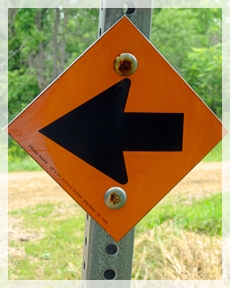 After the GPS flawlessly led us to our hotel in Orlando, we wondered how a satellite navigation system can keep track of countless cars and their various destinations. The following day, I looked at the GPS screen and the arrow indicating our position was several blocks east of us. It seemed to think we were driving over a golf course, across a canal and into a lake. Apparently, that eye in the sky is nowhere near as accurate as we’d originally thought. There are around 24 satellites orbiting at any one time to provide us with global positioning and we need to receive signals from at least three of them to get accurate directions. The line between the satellites and GPS must be unobstructed, so tall buildings, heavy woods, tunnels, mountains, and storms can all interfere with receiving a signal. We figured something had interfered with the satellites’ view of us. Later that day, after following its directions to Sea World, our faith in the system was shattered. As we passed Sea World’s clearly marked exit, we were told to continue five miles eastward and then go north. At that point, we consulted a map and turned around. Personally, I think we got someone else’s directions to an entirely different location! We were just one car among thousands of tourists using their GPS to guide them through the land of Mickey Mouse. Perhaps the system was overloaded and some other poor soul was being led to Sea Word when he probably wanted to go to the Magic Kingdom. Who knows? All I know is that I’m not getting rid of our maps anytime soon!