THE REAL STORY

And she brought forth her firstborn son, and wrapped him in swaddling clothes, and laid him in a manger; because there was no room for them in the inn. [Luke 2:7 (KJV)]

Magi
Between countless Christmas pageants, Christmas card illustrations, nativity sets, and the words of our favorite carols, the Christmas story we know actually may not be the one told by Luke. Although most translations say Mary laid Jesus in a manger because there was “no room for them in the inn,” it probably wasn’t an inn and no mention is made of an innkeeper (or his wife). The word usually translated as “inn” in this verse was kataluma and it appears one more time in Luke 22:11 and Mark 14:14 when Jesus sent Peter and John to Jerusalem to determine the location of the kataluma where they would celebrate their Passover meal. Here kataluma  is translated as guest room or guestchamber and Luke described it as a large upstairs room in a person’s house. Rather than kataluma , the word Luke used for inn when telling the Parable of the Good Samaritan was pandocheion which clearly meant inn or public house.

Rather than staying in the 1st century equivalent of a Motel 6, the couple would have stayed with relatives, as was the custom of the time. But, since everyone else in the family also was in Bethlehem for the census, the house would have been overflowing with people. Even though Mary was pregnant, the older family members had priority on rooms. Rather than no room at the inn, there was no room for them in the normal living quarters.

We wrongly assume Jesus was born in a barn or a stable because of the manger (an animal’s feeding trough) but animals usually weren’t housed in an exterior building. To keep them safe from theft and the elements, they were kept on the ground floor of the house, often under the living quarters. Because of the manger’s mention, it probably was here that Mary gave birth. Had I been Mary and about to give birth, I would have preferred the relative quiet and privacy afforded in the animals’ quarters to the commotion of a house filled with people! While it makes for great drama to think of a cruel innkeeper refusing them a room, it’s rather nice to picture the savior of mankind being welcomed into the wonderful chaos of an extended family oohing and aahing over Him!

Even though animals are included in every pageant and nativity, Scripture doesn’t mention Mary riding a donkey into Bethlehem, the shepherds bringing any sheep, or even camels. Because of the manger, we assume the presence of a cow but that’s mere speculation.

As for the angels—the only mention of angels in Luke’s account is when they announce Messiah’s birth to the shepherds. While it’s logical to think angels watched over the Holy Family that night, Scripture doesn’t say so and there’s no reason to think they were visible. Moreover, as much as I love singing the long “Gloria in excelsis Deo,” in the carol, Scripture only says the angels praised God and spoke their message.

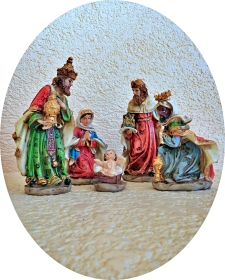
In Matthew’s gospel we read of the wise men (magi) from the east who visited Jesus. While “magi” came to mean astrologers, sorcerers, or magicians, these men probably were Magians, a priestly caste from Media, Persia, Assyria, or Babylonia. Learned in the prophecies of Hebrew Scripture, they were worshipful seekers of the truth. Their number (three) and names come from song rather than Scripture and their kingship and camels may come from their mention in Isaiah 60. Careful reading, however, tells us Isaiah’s prophecy refers to Christ’s return rather than His birth. Nevertheless, an unknown number of Magi brought this young king gifts of gold, frankincense, and myrrh. Whether such costly offerings were theirs or on behalf of a foreign king is unknown.

Even the Magi’s appearance in our pageants and nativities is incorrect. Because the Holy Family fled to Egypt immediately after their departure, the Magi must have arrived after Mary’s purification and Jesus’ presentation in the Temple 40 days after His birth. When the Magi arrive, Matthew refers to Jesus as a child rather than an infant and, based on the age of the boys Herod ordered slaughtered, their visit probably occurred when Jesus was a toddler.

Christmas is a time of great pageantry and kings kneeling in front of an infant in a manger, surrounded by animals, shepherds, and angels, makes for great theater. The facts surrounding Jesus’ birth, however, are more marvelous that any we could imagine! The message that the Son of God came in human form to sacrifice Himself for our sins and provide eternal life to all who believe in Him needs no embellishment.

It is here, in the thing that happened at the first Christmas, that the most profound unfathomable depths of the Christian revelation lie. God became man; Nothing in fiction is so fantastic as this truth of the incarnation.  [J.I. Packer]

And the angel said unto them, Fear not: for, behold, I bring you good tidings of great joy, which shall be to all people. For unto you is born this day in the city of David a Saviour, which is Christ the Lord. And this shall be a sign unto you; Ye shall find the babe wrapped in swaddling clothes, lying in a manger. And suddenly there was with the angel a multitude of the heavenly host praising God, and saying, Glory to God in the highest, and on earth peace, good will toward men. [Luke 2:10-14 (KJV)]

Copyright ©2022 jsjdevotions. All rights reserved.

IN ENEMY TERRITORY

Be alert and of sober mind. Your enemy the devil prowls around like a roaring lion looking for someone to devour. Resist him, standing firm in the faith, because you know that the family of believers throughout the world is undergoing the same kind of sufferings. [1 Peter 5:8-9 (NIV)]

anhingaAnhingas are among my favorites of our lake’s birds. Unlike most birds, their bones are heavy and dense and, rather than waders like the herons and egrets or paddlers like the ducks, they are deep-diving swimmers. Lacking the oil glands that waterproof the feathers of other water birds, anhingas (and their cormorant cousins) become water-logged in the water. While making it difficult to remain afloat, that allows them to dive up to sixty feet deep, swim underwater for several hundred feet, and stay underwater for more than a minute. Eventually, however, the birds become so heavy they will sink unless they return to land to dry their feathers.
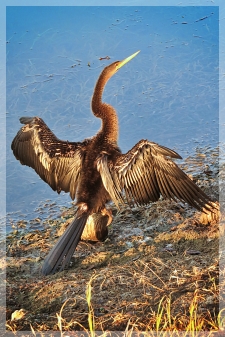
Every morning I find anhingas resting along the lake’s shoreline and spreading their wings to dry. The wettest ones get barely out of the water but, as they dry, they waddle further back until dry enough to get up onto a rock, bench, or low hanging branch. As their feathers continue to dry, they move higher up in the trees until they are dry and light enough to take flight.

Unlike the lake’s ducks who nest and sleep in the vegetation along the shoreline, anhingas remain on land only out of necessity. Vulnerable to predators, a soaking wet anhinga is like a “sitting duck.” With its stubby legs and large webbed feet, it can’t run; water-logged, the water isn’t a good option and yet it’s too wet to fly up to safety. While hissing, grunting, and trying to look intimidating by ruffling its feathers, raising its tail, lengthening and waving its long neck, and pointing its spear-like beak may deter some birds of prey, that behavior probably won’t dissuade hungry alligators or crocodiles.

Just as being vulnerable to a predator’s attack is part and parcel of being an anhinga, being vulnerable to our enemy’s attack is an inevitable part of being human in our fallen world. Rather than gators and crocs, that enemy is Satan and he can sneak up on us even more adeptly than the wiliest reptile in the Everglades. Rather than the weight of soaking wet feathers, it is the weight of things like pain, illness, betrayal, weariness, conflict, loneliness, loss, disappointment (and even hurricanes) that make us especially vulnerable to attack. The enemy will use every weapon in his armory including lies, half-truths, fear, despair, hopelessness, and (his favorite) doubt to assault our belief in the goodness of God. Fortunately, in His wisdom, God armed us for battle with more than the saber-sharp beak and intimidating appearance of the anhinga. We wage war with the weapons of our faith: God’s Word and the power of the Holy Spirit.

An anhinga, aware of its vulnerability when wet, only enters the water to hunt or bathe. With neck extended and eyes wide open, it remains watchful when drying along the shoreline and never dawdles there once dry. Like the anhinga, we must be alert to our vulnerability in our fallen world. Unlike the anhinga, however, we often act as if we’re not sitting smack dab in the middle of the enemy’s territory! A. W. Tozer warns us about thinking of the world as a “playground instead of a battleground.” May we never forget that we live in the enemy’s territory and he is as dangerous as a prowling lion or a hungry alligator!

Anyone who serves the Lord is going to be the target of Satan’s attacks. [Zac Poonen]

Finally, be strong in the Lord and in his mighty power. Put on the full armor of God, so that you can take your stand against the devil’s schemes. For our struggle is not against flesh and blood, but against the rulers, against the authorities, against the powers of this dark world and against the spiritual forces of evil in the heavenly realms. [Ephesians 6:10-12 (NIV)]

Copyright ©2022 jsjdevotions. All rights reserved.

HEARING

For twenty-three years…the word of the Lord has come to me, and I have spoken persistently to you, but you have not listened. You have neither listened nor inclined your ears to hear. [Jeremiah 25:3a,4a (ESV)]

green heron

As the language of the Scriptures, Jesus spoke and read Hebrew and, as the language of the Roman Empire, He probably spoke some Greek, as well. His everyday spoken language, however, would have been Aramaic. A Semitic language widespread throughout the Middle East by the 7th century BC, Aramaic was adopted by the Jews during their Babylonian exile. By Jesus’ time, Hebrew (considered the “holy tongue”) was reserved for holy matters such as prayer but Aramaic was used for everyday speech. Jesus may have spoken Hebrew in the Temple but, as the common language of people throughout the Middle East, He spoke Aramaic, the rest of the time.

Even though Jesus spoke Aramaic, the words of the New Testament (probably composed between 50 and 100 AD) were written in Greek, the language of scholarship at the time. Since Jewish scholars had already translated much of what we call the Old Testament from Hebrew and Aramaic into Greek, it made perfect sense for the New Testament’s authors to write in Greek, as well. As a result, when we read the Bible, we are reading English words translated from Greek but originally written or spoken in Hebrew and Aramaic. As happens with even the best translation, sometimes the nuance of a word is lost in translation.

For example, consider the Greek word akouwhich simply means “to hear, to be endowed with the ability to hear, or to hear something” and usually is translated into English as “hear” or “listen.” This meaning is sufficient when Jesus heard the Centurion express his faith, Herod heard the Magi say the Messiah had come, Jesus heard that John was imprisoned, John heard about the deeds of Jesus, and Peter heard the rooster crow. Akouό, however, is not sufficient when both the prophets and Jesus spoke of having ears that hear. The words they used had the root word shema/shama and the words “hear” or “listen” don’t catch its full meaning.

In Greek and English, hearing or listening are mental activities but the Hebrew/Aramaic word shema/shama meant more than that. It was as much a physical activity as an intellectual one. Along with hearing, it meant to take heed, submit, obey, and do what is asked. We may hear the television but we expect our children to shema/shama us when we tell them to do their homework!

As an observant Jew, Jesus would have said what is known as the Shema every morning and evening. It begins with the word shema: “Hear, O Israel! The LORD is our God, the LORD alone. You shall love the LORD your God with all your heart and with all your soul and with all your might…”  The Shema continues on to tell the Israelites the rewards of obedience and the consequences of disobedience. Shema/shama is the word prophets used when warning Israel and Jesus used when explaining His parables and the consequences of not “hearing” His words. While hearing is passive, shema/shama most definitely is not. The people of Israel failed to shema God’s words and warnings. Will we make the same mistake?

Just as the weeds are gathered and burned with fire, so will it be at the end of the age. The Son of Man will send his angels, and they will gather out of his kingdom all causes of sin and all law-breakers, and throw them into the fiery furnace. In that place there will be weeping and gnashing of teeth. Then the righteous will shine like the sun in the kingdom of their Father. He who has ears, let him hear. [Matthew 13:40-43 (ESV)]

Copyright ©2022 jsjdevotions. All rights reserved.

KNOWING HIM WELL

And now, just as you accepted Christ Jesus as your Lord, you must continue to follow him. Let your roots grow down into him, and let your lives be built on him. Then your faith will grow strong in the truth you were taught, and you will overflow with thankfulness. [Colossians 2:6-7 (NLT)]

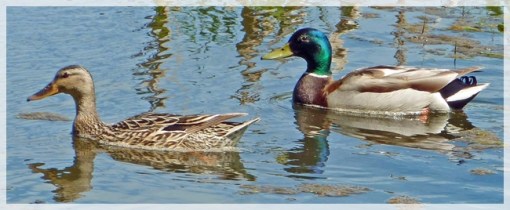
Mallards
After fifty-five years of marriage, there’s not much that surprises me about my husband. Even the surprise birthday weekend he gave me earlier this year wasn’t a surprise. Granted, bringing all three of our children together for a weekend here truly was a surprise but that he chose to do something special for me was not. I was sure that, true to form, he had something wonderful up his sleeve for my 75th birthday; I just had no idea what it actually was!

After over five decades of togetherness, more often than not, my husband and I think alike. When one of us makes a suggestion, the other usually admits to having the same thought and, with at least 97% accuracy, we know what the other will order at any restaurant. We recognize each other’s voice in a crowd and probably have a good idea what the other is saying! After more than half a century, we’ve seen one another at our best and worst. There’s nothing left to hide and any awkwardness, embarrassment, or shame is long gone. I know when he needs some nudging and he knows when I need words of encouragement. Appreciating each other’s strengths and weaknesses, we rest comfortably in the knowledge that we love, trust, and honor one another completely. The relationship is relaxed, pleasant, peaceful, and comfortable but never boring. As my birthday weekend proved, even though we know what to expect, we can still surprise one another in beautiful ways.

The covenant relationship of marriage is much like our relationship with God with one major difference. Through the last five plus decades, both my husband and I have changed so that we complement each other and accommodate one another’s likes and dislikes. God, however, is immutable. Since His characteristics and divine nature do not change, He is not about to accommodate our preferences; we are called to accommodate His! As in any relationship, however, the more time we spend in His presence, the easier it is to recognize His voice, to hear the Holy Spirit’s whisper in our hearts, to discern the meaning of His words, to know what He expects, and to offer prayers in harmony with His plan. As we draw closer to the Lord, we become attuned to His rhythm and pace and we’ll even begin to walk like Jesus.

At its most basic, Christianity isn’t a doctrine, philosophy, code of ethics, or a way of life; it is a relationship with God. Just believing in Jesus is not the same as having a relationship with Him. As with any relationship, we have to spend time in God’s presence, praying, listening to His voice, and reading His word for our relationship to flourish and grow. No serious bond is developed overnight; it took decades for my husband and me to get to this point in our marriage. Fortunately, developing a deep relationship with our triune God doesn’t take nearly that long. Like marriage, however, it is a relationship that continues to mature and mellow through the years.

After fifty-five years, I can ask myself, “What would Bob do?” and pretty much know the answer. As we develop our relationship with God, we’ll be able to ask, “What would Jesus do?” and know that answer as well!

Those who say they live in God should live their lives as Jesus did. [1 John 2:6 (NLT)]

You must grow in the grace and knowledge of our Lord and Savior Jesus Christ. All glory to him, both now and forever! Amen. [2 Peter 3:18 (NLT)]

Copyright ©2022 jsjdevotions. All rights reserved.

WHICH CAME FIRST?

Then God said, “Let there be light,” and there was light. … Then the Lord God formed the man from the dust of the ground. He breathed the breath of life into the man’s nostrils, and the man became a living person. [Genesis 1:3. 2:7 (NLT)]

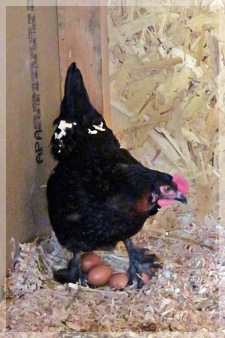
hen and eggs

Years ago, The Jerusalem Post published a joke about human arrogance. After considering all of humanity’s scientific progress, a group of scientists decided that God no longer was necessary. The chief scientist explained to God that man’s ability to clone people, manipulate atoms, build molecules, fly through space, create body parts with 3-D printers, and perform other miraculous feats meant God was unneeded and could be replaced by man. After patiently listening to the scientist, God suggested a human-making contest with only one rule: “We have to do it just like I did in the Bible.” Saying that was easy, the arrogant scientist bent over to pick up a handful of dust. “Put that down!” said God, while adding, “To do it my way, you have to make your own dust!”

Our vacation home in Idaho came complete with chickens and hen house. Every morning, the littlest grands would trek out to the hen house, check for eggs, and return with the makings of an omelet. I was relieved they never asked the age-old unanswerable question of “Which came first, the chicken or the egg?” We need a chicken (actually two) to have a fertilized egg but we need a fertilized egg to make a chicken. This seemingly futile question has been discussed for thousands of years. The Greek philosopher Aristotle considered it but evaded the answer by saying that both egg and chicken went infinitely backwards and always existed. The oldest fossilized eggs are 190 million years old and the oldest fossilized birds are only 150 million years old so paleontologists might say the egg came first. A strict reading of Genesis, however, would lead us to conclude that the chicken came first because animals appeared on the 5th day of creation. It’s a silly question but people ask it because they want to understand how something can come from nothing.

When making the children’s omelets, we still needed the raw ingredients. Along with the eggs that came from chickens (that came from eggs), we needed butter and cheese from cows, salt from the sea, pepper from the drupe of a pepper plant (Piper nigrum}, and green peppers and onions that came from seeds sown by a farmer, as well as a frying pan, whisk, spatula, and gas stove. Although my seamstress friend creates stunning clothing, she needs the silk from the silkworm (that came from an egg) or the cotton from the cotton bush (that came from a seed) to do so. My wood-working friend creates beautiful furniture but he can’t do it without the wood that comes from an oak tree that comes from an acorn that originally came from the oak! This begs the question, “Which came first, the oak or the acorn?” As the arrogant scientist learned, mankind can’t create something from nothing!

God, however, created everything from nothing. He had no eggs for the chickens, acorns for the oaks, seeds for the apple trees, or pollen for the flowers. He had no hydrogen or oxygen for water and no sodium or chloride to add to the water for the sea! Simply put, God spoke all creation into existence. That’s a rather unsatisfactory answer for those who want a technical explanation but the Bible is a book of theology that tells us the who and not a book of science that tells us how. We’re not about to get any more details as to how chaos turned to order, a void came to be filled, and nothing became something. Whether it was the chicken or its egg that came first will always be a conundrum.

The Lord merely spoke, and the heavens were created. He breathed the word, and all the stars were born. He assigned the sea its boundaries and locked the oceans in vast reservoirs. Let the whole world fear the Lord, and let everyone stand in awe of him. For when he spoke, the world began! It appeared at his command. [Psalm 33:6-9 (NLT)]

Copyright ©2022 jsjdevotions. All rights reserved.

KNOWING HE’S THERE

And the believers were filled with joy and with the Holy Spirit. [Acts 13:52 (NLT)]

zebra longwing butterfly
Zebra Longwing butterflies (Heliconius charithonia) live in hammocks and damp forests. Unless they are resting on a plant, however, they are often difficult to spot. Unlike most butterflies, they don’t stay in the sunlight for long. I may see their shadows on the boardwalk but, when I look up, they quickly vanish into the shade they prefer. With their yellow and black colors, shallow wingbeats and languid flight, they float through the woods and often seem to be little more than flickering sunlight glimmering through the trees.

Oddly, I think of the Holy Spirit whenever I get a glimpse of these beautiful creatures. Just as I’ll probably never hold one in my hand, I have difficulty grasping the concept of the Holy Spirit. Nevertheless, I know they both exist and bring me joy. There are times it’s difficult to catch sight of the winged zebras and, unfortunately, there are times I have difficulty detecting the Spirit. Nevertheless, just as I know the butterflies are in the woods, I know that He is present. Some days are better than others when it comes to spotting the Longwings and some days are better than others when it comes to sensing the Holy Spirit’s presence. If I’m jogging down a trail, I’ll never spot the butterflies and, if I’m rushing through life, it’s just as easy to overlook the Holy Spirit.

While I can blame the season, weather, light, or location for not seeing a butterfly, I have only myself to blame when I fail to perceive the Spirit. The times I feel devoid of His presence are when I neglect Scripture and prayer—the times I become so busy with the “me” and “my” of life that I don’t leave room for Him. They are the times I refuse to accept God’s control of my circumstances, ignore His direction, or don’t want to hear His conviction of my unacceptable behavior. Most often, however, I can’t feel the Holy Spirit because I’ve done something that grieves Him. Things like anger, resentment, jealousy, guilt and pride serve as barriers to feeling His presence. Fortunately, unlike the butterflies that disappear as they float through the woods, the Spirit will never leave me, even when I’ve disappointed Him.

In perfect unity with God the Father and God the Son, the Holy Spirit is the power of God that dwells within every believer in Jesus Christ. Just as it’s likely that I’ll catch a glimpse of Zebra Longwings on a certain boardwalk through the mangroves, I’m sure to feel the Spirit’s presence when I walk in His ways throughout the day.

You might as well try to see without eyes, hear without ears, or breathe without lungs, as to try to live the Christian life without the Holy Spirit. [D.L. Moody]

But when the Father sends the Advocate as my representative—that is, the Holy Spirit—he will teach you everything and will remind you of everything I have told you. [John 14:26 (NLT)]

Copyright ©2022 jsjdevotions. All rights reserved.