CAUGHT IN THE HEADLIGHTS

He walked away, about a stone’s throw, and knelt down and prayed, “Father, if you are willing, please take this cup of suffering away from me. Yet I want your will to be done, not mine.” Then an angel from heaven appeared and strengthened him. [Luke 22:41-43 (NLT)]

deer“It never occurred to me,” my friend said, “that I could outlive my wife.” Several years older than his spouse, overweight, diabetic and nearly blind, he always thought she’d be there to care for him. That, however, was before she suffered a stroke, had complications from carotid artery surgery, was diagnosed with cancer, had another surgery, and started a regimen of chemotherapy (all within a few months’ time.) Like a deer caught in the headlights, he was almost frozen in disbelief, bewilderment, and fear.

At some point in time, a “deer in the headlight” moment like that will happen to us all. Disease, disability, adversity and misfortune will slam into us and turn our version of life upside down. I think of a friend who was swindled by his trusted business partner and another one who was betrayed by her husband; neither of them ever envisioned such duplicity. When the young couple was told to expect twins, it never occurred to them that neither child would live to see his second birthday. When a friend’s wife beat cancer, her family never foresaw that, fifteen years later, it would return with such a vengeance that she’d be gone in less than a year. Such scenarios were never pictured by any of these people when asked about their hopes and dreams.

Although we are the main character in our life story, we eventually realize that we aren’t writing the script—God is the author and we don’t get consulting or editing privileges. We can’t choose the setting, rewrite the parts we dislike, dictate the ending, or decide the length of the tale. As Christians, we know that the play’s sequel will take place in God’s presence in heaven, where there will be no death, pain, crying or mourning. Nevertheless, sometimes that knowledge is of little consolation as we (or those we love) struggle to make it through the present act. All we can do is trust that our loving God will give His children the courage and strength necessary to get through it all, one day at a time.

Father, some of us are suffering and others of us are crying for those who are in the midst of difficult circumstances. If it is at all possible, please take away their cup of suffering. If not, help us all to accept what seems so unacceptable and to understand what seems so unreasonable. Strengthen our faith with trust and let us see hope on the horizon.

The truth is, in this world it’s a 100 percent guarantee that we will suffer. But at the same time, Jesus Christ is 100 percent certain to meet us, encourage us, comfort us, grace us with strength and perseverance, and yes, even restore joy in our lives. Your Savior is 100 percent certain to be with you through every challenge. [Joni Eareckson Tada]

And be sure of this: I am with you always, even to the end of the age. [Matthew 28:20b (NLT)]

Rejoice in our confident hope. Be patient in trouble, and keep on praying. [Romans 12:12 (NLT)]

Copyright ©2019 jsjdevotions. All rights reserved. 

 

THE BEST TIME TO MEET HIM

I am the resurrection and the life. Anyone who believes in me will live, even after dying. Everyone who lives in me and believes in me will never ever die. [John 11:25-26 (NLT)]

In commenting about the unexpected death of a young man, the pastor said, “The best time to meet God is when you’re right with God!” For a good part of his brief life, the young man about whom he was speaking had been a troubled unbeliever but, shortly before his death, he came to know Christ. While he will be missed by his grieving family and friends, they can find comfort in knowing his final destination. Since they, too, are believers, they know they will see him again in the future.

The pastor’s comment made me remember a sympathy note written by C.S. Lewis in 1944 to the wife of fellow professor at Oxford. After expressing how much he missed the man, Lewis told the new widow how deeply the professor’s funeral had affected him. Mentioning the many times he’d heard the same service read for non-believers, he admitted to a sense of relief at hearing those same words said for a true man of faith: “a man not unworthy of the service.” Lewis admitted that, “In some queer way it enormously strengthened my faith, and before we filed out of chapel I really felt…a kind of joy—a feeling that all was well, just as well as it could be.” Understanding that the best time to meet God is when you’re right with God, Lewis knew the professor had been welcomed home by his Father in Heaven.

I think of a friend, whose husband is nearing the end of his life.  As non-believers, she knows a religious service would be hypocritical and has been pondering what sort of funeral she might have for her husband when the time comes. For a non-believer, there is little comfort in hearing that Jesus is the resurrection and the life and His believers will never die or that our bodies “buried in brokenness…will be raised in glory.” Scripture’s words of assurance that Jesus has prepared a place for us in His Father’s house or that nothing can separate us from Christ’s love are meaningless to someone who doesn’t know Jesus.

Believers and non-believers alike experience grief but it was the faith C.S. Lewis shared with his fellow professor that allowed him to experience joy at his friend’s funeral. The words of a traditional Christian funeral/celebration of life service are only comforting to a believer if the dearly departed was a believer.

When my friend’s husband dies, I don’t know how she will mark his passing, but it won’t be with words of Scripture, prayers, psalms, or hymns. When that day comes, I will choose my words of sympathy carefully; they probably will be something innocuous about hoping her memories bring her comfort and solace. (Her lack of faith certainly won’t!) No matter how nice the memorial program or beautiful the music, I will not feel a kind of joy as I depart because I know that the best time to meet God is not when you deny His existence. The best time to meet God is when you’re good with Him!

Our bodies are buried in brokenness, but they will be raised in glory. They are buried in weakness, but they will be raised in strength. [1 Corinthians 15:43-44 (NLT)]

Copyright ©2019 jsjdevotions. All rights reserved.

ASK

And in praying do not heap up empty phrases as the Gentiles do; for they think that they will be heard for their many words. Do not be like them, for your Father knows what you need before you ask him. [Matthew 6:7-8 (RSV)]

Our Father, whose predominant residence pattern is widely perceived as being in an exo-atmospheric environment, your name shall be treated, as a matter of course, in a reverential demeanor appropriate to existing protocol guidelines. It is to be hoped that, as an optimal result of the ongoing situational development, your form of governmental institution may be, in accordance with the appropriate procedures, finalized within the foreseeable future, in forms applicable to both bilateral and multilateral fora. [Anonymous]

climbing asterThese are the first lines of the Lord’s Prayer as if they were written by a lawyer and, having recently met with our attorney to update some documents, I don’t think they’re much of an exaggeration. With all of their circumlocution, it’s difficult to know what lawyers actually mean. They use vague abstract nouns rather than concrete ones and seem to go around a subject rather than straight through it. Why can’t they use straightforward language and directly say what they mean?

While our prayers probably are not as convoluted as the above version of the Lord’s Prayer, they frequently are as indirect and vague. Of course, the lawyer uses all of that language out of caution. He’s writing so that his words can’t be misconstrued: so that anyone seeking another meaning to his words can’t find it. God, however, is not an adversary who is trying to trap us into saying something we don’t mean or attempting to find a loophole in our prayers. In fact, He already knows what we need before we say it. Nevertheless, He’s waiting to hear it from us.

When Jesus was leaving Jericho, two blind beggars called out to Him with a rather ambiguous request: “Have mercy on us!” Did they want forgiveness, food, clothing,  or money? Any of those would have been acts of mercy. Surely Jesus knew what they really wanted but He responded by asking them, “What do you want me to do for you?” Only then were they direct and asked for what they really wanted: to see! It was not until they clearly asked that Jesus acted and they received sight.

We have been told to ask before we receive. Could it be that God answers our prayers based on our requests? Jesus promised that, if we ask for bread, we won’t get a stone and, if we ask for a fish, we won’t get a serpent. Unsaid, but certainly implied, is that, if we fail to ask for that bread or fish, we won’t get either one! Could receiving depend upon asking? Could there be blessings He has for us that we haven’t received simply because we never asked?

Like lawyers, perhaps we err on the side of caution: the less specific our prayers, the less likely it is that we’ll be disappointed. Vague prayers, however, don’t exhibit faith. If someone listened to our prayers, would they know what we mean or are our prayers filled with cautious language and ambiguous requests? I think of a child’s prayers and the long list of “God blesses” usually found at their end. Are our prayers as vague? How do we want God to bless those on our prayer list? What are their specific needs? What are ours? We don’t need a lot of words to be direct and specific with God. If Jesus were passing by right now, what would we call out to Him? What would we ask?

And whatever you ask in prayer, you will receive, if you have faith. [Matthew 21:22 (RSV)]

Ask, and it will be given you; seek, and you will find; knock, and it will be opened to you. For every one who asks receives, and he who seeks finds, and to him who knocks it will be opened. Or what man of you, if his son asks him for bread, will give him a stone? Or if he asks for a fish, will give him a serpent? [Matthew 7:7-9 (RSV)]

Copyright ©2019 jsjdevotions. All rights reserved.


NAMES 

Saul, also known as Paul, was filled with the Holy Spirit, and he looked the sorcerer in the eye. … Paul and his companions then left Paphos by ship for Pamphylia, landing at the port town of Perga. [Acts 13:9,13 (NLT)]

great blue heronIt’s a common misconception that Saul became known as Paul when Jesus transformed the Christian hater into a Christ follower on the road to Damascus. Saul, however, was always named Paul. As a Roman citizen, he would have had a three part Roman name. While we don’t know the first two parts, the third (the cognomen) and commonly used name was Paullus (which becomes Paul in English). As devout Jews, however, his parents also would have given him a Hebrew name. They named him Saul, a good name for a boy from the tribe of Benjamin (King Saul’s tribe). Understandably, when among Jews, Saul would have used his Hebrew name and Luke, the writer of Acts, refers to him as Saul until Acts 13, about fifteen years after his conversion. Saul (and Luke) started using his Roman/Gentile name of Paul around the time he moved further into the Roman Empire on his first missionary journey. As he moved into Gentile territory, Paul’s Roman name was more appropriate. The Apostle was not alone in having both a Roman and Hebrew name. One of the candidates to replace Judas had two Jewish names, Joseph and Barsabbas, along with the Roman one of Justus.

Although Paul’s name was given to him by his parents, sometimes a new name was forced upon someone. When Pharaoh put Joseph in charge of the land, he gave his new second-in-command an Egyptian wife and the Egyptian name of Zaphenath-paneah. In honor of Babylonian gods, King Nebuchadnezzar gave Daniel, Hananiah, Mishael, and Azariah the names of Belteshazzar, Shadrach, Meshach, and Abednego. Sometimes, it was circumstances that changed a person’s name. When the widowed Naomi returned to Bethlehem, the grief-stricken woman called herself called Mara, meaning “bitter.” After destroying the altar of Baal and cutting down the Asherah pole next to it, Gideon became known as Jerub-baal, which meant “Let Baal defend himself.”

In some cases, it was God who did the name changing. These name changes often described someone’s character or calling. In Genesis, Abram (“exalted father”) became Abraham (“father of a multitude”) and Jacob, the “heel-catcher” or “deceiver,” became Israel, “God’s fighter.”  Jesus changed Simon’s name (meaning “he has heard”) to Cephas, the Aramaic word for “rock.” Since the New Testament was written in Greek, we know Cephas by the name of Peter, also meaning “rock.” Although Peter wasn’t rock solid during Jesus’s life, following the resurrection, he fulfilled the promise of his name by becoming the rock upon which the new church was built.

In actuality, most of us go by more than one name. My personal favorite is the one my grands use for me: “Nonnie.” Some people say they don’t care what they’re called, as long as they’re called for dinner. As for me, I don’t care what you call me as long as God has my name written in His Book of Life!

All who are victorious will be clothed in white. I will never erase their names from the Book of Life, but I will announce before my Father and his angels that they are mine. … And anyone whose name was not found recorded in the Book of Life was thrown into the lake of fire. [Revelation 3:5,20:15 (NLT)]

Copyright ©2019 jsjdevotions. All rights reserved.


CAN WE CHANGE?

leopardCan an Ethiopian change his skin or a leopard its spots? Neither can you do good who are accustomed to doing evil. [Jeremiah 13:23 (NIV)]
What words of despair from Jeremiah! Yet, why would God send him to the people of Judah with the call to repent if there was no hope of change? Surely, He didn’t send His prophet on a fool’s errand!

We all have issues with sin. While it may not be theft or adultery, chances are it’s something like anger, envy, impatience, bigotry, hostility, selfishness, pessimism, or pettiness. “It’s just the way I’m built,” we say in way of excuse. While we may justify ourselves by saying our faults are simply our nature, they aren’t! Having recently gone through genetic testing, I didn’t see any genes for things like lust, short-temper, worry, nitpicking, intolerance, arrogance, discontent, or stinginess. When we confuse our learned behavior with innate behavior, we excuse the inexcusable. While we can’t change our skin color or blood type, we can change our habits.

The gift of habit is God given; indeed, we’re blessed that we can go through life without having to deliberately think through the details of every action. If we had to consciously consider how to brush our teeth, get dressed, tie our shoes, make coffee, or start the car, we’d never get anywhere in the morning. The gift of habit, however, can also be a curse when our habitual responses are not godly—when they entail things like bigotry, anxiety, deceit, pride, anger, self-centeredness, or jealousy. 19th Century preacher Charles Spurgeon likened the force of habit to a cobweb: at first, it’s easily broken. When it grows into a thread, however, it restrains us a bit and, when the thread changes into a cord, we find ourselves in a net. As the net hardens into iron and the iron into steel, we’re shut up in a cage of our own making with no way of escape.

In discussing Jeremiah’s question, Spurgeon emphatically states that the Ethiopian cannot change his skin but, he adds as emphatically, an Ethiopian’s skin can be changed. He explains that the God who turned “primeval darkness into light” and “changed chaos into order” can do everything and, should He choose to do so, He could easily change skin color and leopard spots. Far more important than changing appearances, however, God can transform human nature! The God who designed our hearts can make them new again. After all, change or re-birth is what Jesus is all about!

Jeremiah called the people to repent; the call to put off our old sinful nature and replace it with the new continues today. Although we can’t do it by ourselves, God doesn’t ask anything of us that we are incapable of doing. When we accept Jesus, the Holy Spirit produces fruit in our lives: love, joy, peace, forbearance, kindness, goodness, faithfulness, gentleness and self-control.  [Galatians 5:22-23] We may have to dig deep to find it but God’s fruit is there! Granted, it’s difficult to put away ingrained habits; change is neither easy nor fast. Nevertheless, though the power of the Holy Spirit, change is possible; we can take off the old and put on the new!

The God who made us also can remake us. [Woodrow Kroll]

Therefore, if anyone is in Christ, the new creation has come: The old has gone, the new is here! [2 Corinthians 5:17 (NIV)]

You were taught, with regard to your former way of life, to put off your old self, which is being corrupted by its deceitful desires; to be made new in the attitude of your minds; and to put on the new self, created to be like God in true righteousness and holiness. [Ephesians 4:22 (NIV)]

Copyright ©2019 jsjdevotions. All rights reserved.

PUTTING IT IN PERSPECTIVE

I tell you the truth, you will weep and mourn over what is going to happen to me, but the world will rejoice. You will grieve, but your grief will suddenly turn to wonderful joy. It will be like a woman suffering the pains of labor. When her child is born, her anguish gives way to joy because she has brought a new baby into the world. [John 16:20-21 (NLT)]

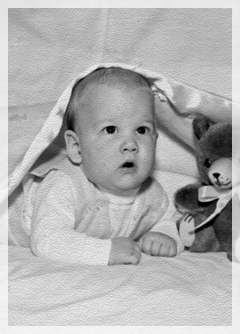
baby boyOn the night He was betrayed, Jesus forewarned the disciples of the grief and fear they’d encounter in the days ahead. In his short parable about labor and delivery, Jesus prepared the remaining eleven disciples for the emotions they would encounter over the next three days: their anguish and despair as He hung upon the cross, died, and was buried. For His followers, those three days would feel like an eternity of hopelessness. But, as happens when a woman beholds her newborn baby after hours of painful labor, their despair would turn to joy when they saw the resurrected Christ!

At the time, no one could have convinced me that I would forget the pain of my long labor and medication-free delivery but, when I held my first-born, I did. All women do (or every baby would be an only child)! Those first six months of sleepless nights spent comforting that colicky boy seemed endless; I didn’t know how I’d endure them but I did. Yesterday, he celebrated his 50th birthday and the 24-hours he spent making his way into this world make up only 1/18,251th of his life and just 1/26,406th of mine! Even the six exhausting months he spent crying in my arms every night are only 1% of his life and less than .7% of mine! While putting my labor and sleepless nights into perspective, I realized my fractions are wrong because I can’t determine the true length of my life; rather than ending here on earth, it will continue forever in God’s heavenly Kingdom.

Jesus’s parable applies to more than those three days the disciples hid in a room following his crucifixion. It applies to the suffering and pain endured by all of His children (which often lasts far longer than 24 hours, 3 days, or even six months). Anguish of any kind seems interminable and unbearable but, when put in perspective, it is but a blip on our eternal lifeline. For now, we live in a world of tears, weariness, frustration, anxiety, confusion, disappointment, loss, fear, and affliction but, on the other side of this earthly life, there is a place without pain, sorrow, grief or tragedy! Although it’s of little comfort to those hurting, our present suffering must be viewed in the light of eternity. As heavy as the weight of our present pain may be, when put on a scale and weighed against the eternal joys of heaven, it is no more than a feather. That doesn’t mean anyone’s pain is small; it simply means that eternity is absolutely enormous! Let us remember—all that’s wrong in this fallen world is temporary and will be forgotten when we joyfully behold His face in eternity!

The best we can hope for in this life is a knothole peek at the shining realities ahead. Yet a glimpse is enough. It’s enough to convince our hearts that whatever sufferings and sorrows currently assail us aren’t worthy of comparison to that which waits over the horizon. [Joni Eareckson Tada]

For our present troubles are small and won’t last very long. Yet they produce for us a glory that vastly outweighs them and will last forever! So we don’t look at the troubles we can see now; rather, we fix our gaze on things that cannot be seen. For the things we see now will soon be gone, but the things we cannot see will last forever. [1 Corinthians 4:17-18 (NLT)]

Copyright ©2019 jsjdevotions. All rights reserved.