LOST AND FOUND

After three days they found Jesus sitting in the Temple with the teachers, listening to them and asking them questions. … When Jesus’ parents saw him, they were astonished. His mother said to him, “Son, why did you do this to us? Your father and I were very worried about you and have been looking for you.” Jesus said to them, “Why were you looking for me? Didn’t you know that I must be in my Father’s house?” [Luke 2:46-49 (NCV)]
nativity

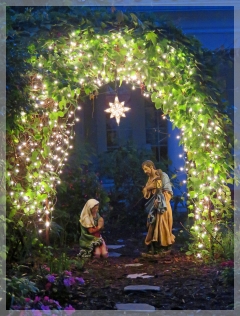
Last month, during my pre-dawn walks, I enjoyed seeing the bright holiday lights decorating many of our community’s homes. One morning, I passed by a beautifully lit arbor surrounding a nativity scene. Even though the twinkle lights and star didn’t fully illuminate the figures below them, I took a photo and hoped that a little Photoshop magic would result in a picture for a future devotion. When I finally got around to editing the photo, I discovered that Jesus was missing from the scene!

The missing baby reminded me of when my daughter’s family visited us several years ago. The young cousins were playing together at my son’s home. While the adults talked, the girls investigated the many toys in Mali’s toy chest. When Bree discovered parts from the Fisher Price Noah’s ark and nativity sets, she and Mali started rummaging through the box to find their various pieces. Bree started explaining the two stories to her younger cousin as they organized the figures. After digging to the bottom of the box, they realized one figure was missing. The girls jumped up and frantically dashed through the house toward Mali’s bedroom shouting, “We’ve lost baby Jesus!” Fortunately, after a thorough search, the missing baby was found among a few dust bunnies under Mali’s bed.

Mary and Joseph lost Jesus after they’d been in Jerusalem to celebrate the Passover. The city’s population had quadrupled as caravans of Jews from all over came to observe the holiday. Somehow, in the mayhem of people gathering to return to Nazareth, Mary and Joseph lost track of their boy and left Jerusalem without Him. Perhaps the people with the missing figure in their nativity had overlooked Jesus in a dark corner of their attic or lost him in the confusion of cartons and crates when they came to Florida. Like Mary, Joseph, and the little cousins, they didn’t notice they’d lost Jesus until they wanted Him! The same thing can happen to us in the challenges and chaos of our busy lives. Sometimes, we forget to bring Jesus with us and don’t even notice He’s missing until we need Him.

It’s important to remember that even though Mary and Joseph lost Jesus, they didn’t lose their relationship with Him. He remained their son but, by leaving Him behind, they lost His presence. The same thing can happen with us. When we lose Jesus, we don’t lose the salvation that comes with our relationship but we do lose His fellowship, our sense of His presence, and His peace and joy.

When the sheep can’t find the shepherd, it’s not the shepherd who is lost. The good shepherd is exactly where He belongs; it’s the sheep that have strayed. In actuality, Mary and Joseph were the ones who were lost, not Jesus. He was where He belonged—in His Father’s house studying God’s word. Our Lord promises He’ll never leave us but that pesky thing called free will allows us to leave Him and walk off on our own. When we feel empty or alone, when we wonder where Jesus is in our trouble, Jesus hasn’t forgotten about us. We are the ones who forgot and lost Him!

Yesterday, I walked by the house with the missing baby Jesus and was pleased to see that he’d been found and was in his rightful place. When Jesus is missing in our lives, like Joseph, Mary, Bree, Mali, and the people with the nativity scene, we must search until we find Him. Rather than looking in dark corners or under the bed, the first place to look might be where we’d expect to find Him—in His Father’s house and in His word.
If you look for me wholeheartedly, you will find me. I will be found by you,” says the Lord. [Jeremiah 29:13-14a (NLT)]

Search for the Lord and for his strength; continually seek him. [Psalm 105:4 (NLT)]

Copyright ©2021 jsjdevotions. All rights reserved.

CHRISTMAS EVE – THE CHRIST CANDLE

The people that walked in darkness have seen a great light: they that dwell in the land of the shadow of death, upon them hath the light shined… For unto us a child is born, unto us a son is given: and the government shall be upon his shoulder: and his name shall be called Wonderful, Counsellor, The mighty God, The everlasting Father, The Prince of Peace. [Isaiah 9:2,6 (KJV)]

angel

No Christmas Eve seems complete without reading Luke’s account of Jesus’s birth. Although my husband and I usually read from the NLT, it will be from the King James tonight, which is the Bible translation we both knew as youngsters. Seventy plus years ago, the Sunday schoolers at my husband’s church recited Luke’s words every Christmas Eve and he always seemed to have the same verse: “And this shall be a sign unto you; Ye shall find the babe wrapped in swaddling clothes, lying in a manger.” Although many of the words and phrases of the KJV (like “espoused wife,” days that were “accomplished,” and being “of the house and lineage of David” or “sore afraid”) seem dated, it will be comforting to read the familiar and beautiful words found in this old translation.

We’ll also read the powerful words found in Isaiah 9—a promise that those walking in the darkness of God’s judgment will see the light of deliverance with the birth of a child who will fulfill God’s promise of a messianic King. It will be difficult to read the titles given to this child without wanting to sing the words so familiar from Handel’s Messiah: “Wonderful, Counsellor, The Mighty God, The Everlasting Father, The Prince of Peace.” Whether the child would be called both “Wonderful” and “Counsellor” or “Wonderful Counsellor” is a point of contention among translators. While the King James places a comma between the two words, many other translations don’t. Since the original Hebrew had no punctuation, we’ll never really know. Regardless of the punctuation, when we look at His names, it’s clear that the promised child would do more than bring light into the world.

The Hebrew word translated as wonderful is pele’ and it meant far more than just extraordinary. Astonishing to the point of being miraculous, pele’ was so marvelous that it required an act of God! The rest the child’s names are pretty self-explanatory. As a counsellor, he would guide the people from God’s perspective and with divine wisdom. He would have God’s might and power but care for His people as does a father for his children. A father, however, can’t do that forever but this promised child would guard and sustain his people eternally. The child’s final title is that of Prince of Peace. From the Hebrew word shalom, the peace of which Isaiah speaks is far more than absence of conflict or anxiety. It is a sense of wholeness, fullness, security, safety, balance, harmony, tranquility and calm—all of which the world so desperately needed then and still needs now.

The past four Sundays, we’ve lit the colored candles of hope, peace, joy, and love on our Advent wreath. Tonight, after lighting them, we will light the white candle that sits in the wreath’s center: the Christ candle. As we look at those five candles brightly burning, we’ll remember that Jesus truly is the “light of the world” and so very much more!

And the angel said unto them, Fear not: for, behold, I bring you good tidings of great joy, which shall be to all people. For unto you is born this day in the city of David a Saviour, which is Christ the Lord. [Luke 2:10-11 (KJV)]

I am come a light into the world, that whosoever believeth on me should not abide in darkness. [John 12:46 (KJV)]

Copyright ©2020 jsjdevotions. All rights reserved.

WAITING FOR LOVE

Your house and your kingdom will continue before me for all time, and your throne will be secure forever. [2 Samuel 7:16 (NLT)]

You will conceive and give birth to a son, and you will name him Jesus. He will be very great and will be called the Son of the Most High. The Lord God will give him the throne of his ancestor David. And he will reign over Israel forever; his Kingdom will never end! [Luke 1:31-33 (NLT)]

angelSunday, we will light our Advent wreath’s fourth candle—the purple one known as the angel or love candle. We’ll read Nathan’s prophecy in 2 Samuel that David’s kingdom would continue forever. Although we know that David’s earthly dynasty ended some 400 years after Nathan’s words, God’s promise was fulfilled in Jesus—David’s direct descendant who now reigns forever. Jesus is tied to the Old Testament prophecies in two selections from Luke 1 in the angel’s words to Mary that her son, a descendant of David, would reign over Israel and His kingdom would never end and Mary’s beautiful song of praise known as the Magnificat in which she expresses her understanding that God is fulfilling His promises with the birth of her son.

Christmas celebrates the fulfillment of the promises God made to the people of Israel. Jesus’ birth, life, death, and resurrection initiated the new age promised by the prophets in the Hebrew Bible. The message of Advent, however, is that the story is not finished. Jesus must come again before the fullness of all that God promised will be realized.

We’re caught in what some theologians call the time of “already-and-not-yet.”  The Kingdom of God that arrived with Jesus is a present reality that we can experience right now but it also is the future reality for which we hope! Although the decisive battle against Satan, sin, sickness, and death has been fought and won, the enemy hasn’t surrendered and the war is not yet over. We must continue to fight Satan, resist sin, and endure sickness and death until the time Jesus returns! The King has come and His Kingdom is here but, even though His Spirit is within us and His joy and peace are ours, the story isn’t complete. Got Questions Ministries explains it this way: “The present spiritual reality does not yet match up with the future, physical reality. One day, the two will be in sync.” As we light this fourth candle of Advent, we will eagerly look forward to celebrating the birth of God’s Son, all the while remembering that the best is yet to come! “Christ has died; Christ is risen; Christ will come again.”

We may say that in the possession of the Spirit we who are in Christ have a foretaste of the blessings of the age to come, and a pledge and guarantee of the resurrection of the body. Yet we have only the firstfruits. We look forward to the final consummation of the kingdom of God, when we shall enjoy these blessings to the full. [Anthony Hoekema]

But we are citizens of heaven, where the Lord Jesus Christ lives. And we are eagerly waiting for him to return as our Savior. He will take our weak mortal bodies and change them into glorious bodies like his own, using the same power with which he will bring everything under his control. [Philippians 3:20-21 (NLT)]

Dear friends, we are already God’s children, but he has not yet shown us what we will be like when Christ appears. But we do know that we will be like him, for we will see him as he really is. [1 John 3:2 (NLT)]

Copyright ©2020 jsjdevotions. All rights reserved.

WAITING WITH PEACE

This is the Good News about Jesus the Messiah, the Son of God. It began just as the prophet Isaiah had written: “Look, I am sending my messenger ahead of you, and he will prepare your way. He is a voice shouting in the wilderness, ’Prepare the way for the Lord’s coming! Clear the road for him!’”  [Mark 1:1-3 (NLT)]

christmas starLast Sunday, my husband and I lit the candle of hope on our Advent wreath. This Sunday, we’ll re-light that one along with a second candle, the one we call the peace or Bethlehem candle. Because the Advent wreath custom has been adapted in a variety of ways through the years, there are several names for the candles and explanations for their symbolism that probably have more to do with the selling of wreaths, candles, and devotional booklets than with church tradition. There are no official names, meanings or rituals because an Advent wreath isn’t based on Scripture. It’s merely a tradition to help make this season more meaningful.


We’ve selected our Advent readings (or “lections”) from the Revised Common Lectionary (RCL), an ordered system of Scripture readings. The Christian church has used lectionaries since the 4th century but the RCL was adopted in 1992. An ecumenical project of several American and Canadian denominations, the goal was to provide a common experience of God’s word among all Christians as a way of uniting the Church. Used by a majority of the Protestant churches in the U.S. and Canada, the RCL is a three year cycle of weekly Scripture readings to be read at public worship. During most of the year, the four selections are from the Old Testament, Psalms, the Epistles and the Gospels. Chosen for their common theme and relevance to the church season, these common lections connect Christians with one another across denominational lines and enable an Episcopalian in Minneapolis to recite the same psalm or hear the same epistle as a Methodist in Denver or a Lutheran in San Diego.

Before lighting the candles Sunday, we’ll read portions of Isaiah 40, Psalm 85, and 2 Peter 3. Isaiah tells the people of Judah to be prepared: “Your God is coming!” Saying that salvation is near, the psalmist speaks of the meeting of unfailing love and truth and the kiss of righteousness and peace. Joining these verses are Peter’s words to live peaceful and righteous lives and be ready for the end times when “the day of the Lord will come.” These lections again remind us that Advent is not just about anticipating the Messiah’s birth; it’s a time to anticipate His return. As we prepare our homes for Christmas, let us remember that it is more important to prepare ourselves for meeting Jesus.

Advent is the perfect time to clear and prepare the Way. Advent is a winter training camp for those who desire peace. By reflection and prayer, by reading and meditation, we can make our hearts a place where a blessing of peace would desire to abide and where the birth of the Prince of Peace might take place. [Edward Hays]

On that day, he will set the heavens on fire, and the elements will melt away in the flames. But we are looking forward to the new heavens and new earth he has promised, a world filled with God’s righteousness. And so, dear friends, while you are waiting for these things to happen, make every effort to be found living peaceful lives that are pure and blameless in his sight. [2 Peter 3:12-14 (NLT)]

Copyright ©2020 jsjdevotions. All rights reserved.

WHAT IS ENOUGH?

After all, we brought nothing with us when we came into the world, and we can’t take anything with us when we leave it. So if we have enough food and clothing, let us be content. But people who long to be rich fall into temptation and are trapped by many foolish and harmful desires that plunge them into ruin and destruction.  [1 Timothy 6:7-9 (NLT)]

squirrel

The Bible is filled with stories of God’s provision for his people’s needs. In spite of their complaints about God’s provision, the Israelites never went hungry during their forty year journey. When Elijah was hiding from Jezebel during a time of drought and famine, he was fed by ravens. In Zarephath, God provided Elijah, the widow and her son with enough flour and oil to feed the three of them for three years! Later, God provided Elijah with food enough to sustain him during a forty day journey to Mt. Sinai. Sometimes, God even blesses us with even more than enough, as He did when thousands were fed with a boy’s lunch and several baskets of leftovers remained.

While we may receive more than we need, God doesn’t promise a surplus. Elijah and the widow didn’t have excess flour and oil with which to open a bakery and, if the Israelites tried to squirrel away their manna for anything but the Sabbath, it spoiled and got maggots. Just enough was exactly what God wanted them to have and what He gave them—no more and no less.

The problem for us is that mankind’s concept of “enough” isn’t the same as God’s; David is a perfect example of that weakness. Most of us would think David, the shepherd boy who became a hero and king, had more than enough. He possessed Saul’s entire kingdom and wealth, lived in a palace, and had seven wives along with an unknown number of concubines. Enough was no longer enough, however, once David laid eyes on Bathsheba. Solomon, with his 700 wives and 300 concubines and 25 tons of gold a year, never seemed to think he had enough either!

When is enough enough? God knows, but we don’t. Adam and Eve had all of Eden with the exception of the fruit of one tree, but that wasn’t enough for them! Whether it’s money, friends, time, status, opportunities, jewelry, health, strength, wisdom, or faith—we probably think we don’t have quite enough of something. Whatever it is, we’re sure that if God would just give us a smidgen more of it, then we’d be satisfied. Of course, we wouldn’t because, like Solomon, David, Adam and Eve, we’d want more than enough!

If we’re seeking the Kingdom of God and following God’s plan, He will make sure we have enough and all the resources we need. We may not see it but, if we dig deep enough, we’ll find that God has given us exactly what we need to do His work. If we’re seeking the Kingdom of Self, however, we’ll never be satisfied that we have enough.

Do you have enough?

And this same God who takes care of me will supply all your needs from his glorious riches, which have been given to us in Christ Jesus. [Philippians 4:19 (NLT)]

Seek the Kingdom of God above all else, and live righteously, and he will give you everything you need. [Matthew 6:33 (NLT)]

Copyright ©2020 jsjdevotions. All rights reserved.

PATIENCE

In that day the people will proclaim, “This is our God in whom we trust, for whom we waited. Now at last he is here.” What a day of rejoicing! [Isaiah 25:9 (TLB)]

Come, Thou long expected Jesus Born to set Thy people free;
From our fears and sins release us, Let us find our rest in Thee. [Charles Wesley]

giftMy daughter has become quite adept at hiding Christmas gifts from her husband. If she doesn’t, he will find the presents and open them early; patience is not one of his strong suits. It wasn’t one of Sarah and Abraham’s either. Although they’d been promised a son and many descendants, they grew impatient waiting and took matters into their own hands. Sarah gave Abraham her maidservant Hagar with whom to make a child. Although she made the offer, he didn’t have to accept—but he did. The boy Ishmael was the result of their rashness and the rivalry and strife that continue today in the Middle East came from that impatience. Like Sarah and Abraham, when my son-in-law knows a gift is coming, he just can’t wait until the correct time to receive it. Fortunately, while his wife may get annoyed when he takes matters into his own hands, his impulsiveness hasn’t resulted in centuries of international conflict.

Consider the people of Judah—they’d waited centuries for God’s promise to be fulfilled with the Messiah and most of them completely missed their gift. Tired of waiting, some lost faith and hope; they stopped looking for Him. Having anticipated royalty rather than an itinerant preacher, others didn’t recognize Him. Wanting someone to conquer Rome rather than sin, still others didn’t accept Him. Fortunately, my son-in-law isn’t like that. Even when he’s unsuccessful in his search for the gift, he never gives up. He knows it eventually will appear. Moreover, unlike the Judeans, he won’t ignore the package if it isn’t wrapped in fancy paper with an elaborate bow or reject it because it doesn’t fit his expectations.

David had to wait for God’s promise to materialize but, unlike Like Sarah, Abraham, and Judah, he waited patiently and never gave up hope. After being anointed by Samuel, he had to wait about fifteen years until being crowned king. He didn’t spend that time trying to force his kingship to happen nor did he sit idly and twiddle his thumbs impatiently. He wisely trusted God. The shepherd boy used his waiting time to prepare for the challenges of kingship by growing physically, intellectually, and spiritually so he was ready to receive his crown when God gave it to him.

Unlike David, Sarah, Abraham, and the Jews, my son-in-law knows exactly when his Christmas gifts will arrive—December 25! Unfortunately, when waiting on God to act, we rarely have a calendar marked with His delivery date and we certainly don’t know the date of Christ’s return. Needing patience, we can’t be like Sarah and Abraham who tried to make things happen before the appointed time. Needing faith, we can’t be like the Jews who stopped looking and believing in God’s promised provision. Instead, we must be like David who waited with patience and faith while readying himself for the receipt of God’s promised provision.

When He returns is not as important as the fact that we are ready for Him when He does return. [A.W. Tozer] 

Don’t be impatient. Wait for the Lord, and he will come and save you! Be brave, stouthearted, and courageous. Yes, wait and he will help you. [Psalm 27:14 (TLB)]

Copyright ©2020 jsjdevotions. All rights reserved.