
And he will answer, “I tell you the truth, when you refused to help the least of these my brothers and sisters, you were refusing to help me.” And they will go away into eternal punishment, but the righteous will go into eternal life.” [Matthew 25:45-46 (NLT)]
 Were I not a believer, I don’t think I’d find the concept of eternal life very comforting. While Jesus made it clear there is an afterlife, He also spoke of the destinations awaiting us in that afterlife. In the gospel of Luke, we find Him telling the parable of the rich man and the beggar named Lazarus. [16:19-31] Indifferent to the plight of the destitute and diseased Lazarus, the rich man lived a life of indulgence and luxury while Lazarus lay outside his gate, hoping for just a few scraps from the rich man’s table.
When Lazarus dies, angels carry him to the bosom of Abraham. The presence of both angels and Abraham told Jesus’s audience that Lazarus was in Heaven. Being in Abraham’s bosom refers to the Jewish custom of reclining on couches while dining (which brought the head of one man almost into the bosom of the one sitting beside him). From this description, Jesus’ listeners also knew that Lazarus was sitting at Abraham’s side, in a place of honor, at a banquet in Paradise. In contrast, when the rich man dies, he is sent to Hades, the realm of the dead. Jesus’ mention of it being a place of torment and flames, however, implies the rich man is in what Jewish tradition called Gehenna, a place of fiery torment and punishment. This parable makes clear that there are two destinations awaiting us when we die and one is far nicer than the other.
Still thinking that he’s in a position to call the shots and give orders, the rich man calls to Abraham, telling him to have pity and send Lazarus over with some water to relieve his agony (something he’d refused to do for the beggar). Explaining that there is a great chasm between the two places and that no one can traverse the span in either direction, Abraham reminds him that he had his reward during his lifetime. This parable leads us to the conclusion that, once we reach the end of the line here, we will not be getting a second chance to make things right in the hereafter. The impassable abyss means our first destination after death will be our final one!
Realizing that his behavior in life determined his hereafter, the rich man asks Abraham to send Lazarus back to warn his brothers about his fate. Abraham replies that they’ve already been warned in Scripture. When the rich man insists that his brothers will repent and change their ways if someone returns from the dead, Abraham answers that even someone returning from the dead couldn’t convince them. It’s ironic that when Mary and Martha’s brother Lazarus returned from death, rather than believe him, the Pharisees planned to kill him!
While the rich man could not warn his brothers about the consequences of their behavior, Jesus warns us with the rich man’s story. Hell is a real place and, after death, the unrighteous are eternally separated from God in a place of torment. There are eternal consequences to our choices and, if we prefer not to have God in our lives on earth, He will accommodate us in eternity, as well.
It is better to beg bread on earth than water in hell. [Dwight Moody]
 Bereft that the people of Israel had rejected Jesus, Paul’s words are some of the saddest ones found in the epistles. I can see the tears in his eyes and hear the anguish in his voice as he dictated them to Tertius, his scribe. Young’s Literal Translation translates Paul’s words as having “great grief and unceasing pain in my heart.” Although he knows that nothing could cut him off from Christ, Paul says he’d be willing to sacrifice himself for his people if it were possible. That’s not just his life he’s offering; the word he used was anathema, meaning he was willing give up his salvation. If it would save the people of Israel, he would be delivered over to the wrath of God for eternal destruction: to spend an eternity in Hell!
 We know little about Jesus’ childhood and young adulthood. Born in Bethlehem, He was circumcised and given His name eight days later. Forty days after His birth, Mary and Joseph took Him to the Temple in Jerusalem in accordance with the command to consecrate every firstborn male to God. Sometime after that, He received gifts from the Magi, His family fled to Egypt, and they returned to Nazareth after Herod died. That’s all we know of His childhood until He was twelve and the precocious youngster stayed behind in Jerusalem to discuss spiritual matters with the teachers there. After Mary and Joseph found Him in the Temple courts, He dutifully returned home to Nazareth with them. Although we know that Jesus learned Joseph’s construction trade and that he started his ministry around thirty, we know nothing of the years between twelve and thirty except that He was obedient to His parents and “grew in wisdom and stature and in favor with God and all the people.” [Luke 2:52]
 As I offered prayers for a good biopsy report, it occurred to me that my prayer was too late. Already excised, the tissue had been sent to a pathologist; for all I knew, the report was written and waiting to be read by my physician. Was God going to rewrite the report? Any troublesome cells in my body had been there awhile. Most likely, the biopsy result was decided months ago so I probably should have been praying about it long before anyone knew a biopsy was needed. Since the pathologist’s report was determined long before my prayers, “Why bother to pray at all?” was the whisper of doubt in my mind.
 In an attempt to avoid the day’s heat, I went walking immediately after breakfast, leaving the bed unmade and the dishes on the counter. Thinking I would tend to the bedroom and kitchen later in the day, I cleaned the lanai when I returned home. Just as I was finishing up, the gate house called: I had unexpected guests! One of my visitors is a “neatnik” and nothing about me or the house (except for the lanai) was neat or clean. In the few minutes between the gate’s call and their arrival, I managed to pull up the bedspread, throw the dishes in the sink, wipe the counter, slip on a fresh t-shirt, put on lipstick and don a baseball cap. I was thankful for the advance call that gave me just enough time to make things semi-presentable.
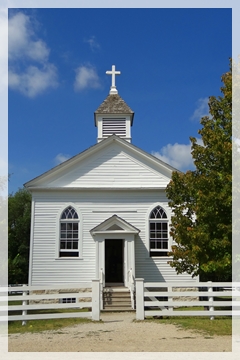 It is said that John Wesley (the founder of the Methodist movement) once dreamt of visiting the gates of Hell. Curious, he asked the gatekeeper how many in Hell were Presbyterians, Episcopalians, and Baptists. “We have many,” was the gatekeeper’s answer regarding each denomination. Nervously, Wesley then asked if there were any Methodists and was disheartened to learn there were plenty of them there, as well.

