
I will be your God throughout your lifetime—until your hair is white with age. I made you, and I will care for you. I will carry you along and save you. [Isaiah 46:4 (NLT)]
If I’d known I was going to live so long, I’d have taken better care of myself. [Anonymous]
Several years ago, a friend’s spry 94-year old mother emailed the family about having forgotten her elbow brace on the way to the exercise room in her senior residence. After returning to her apartment and donning the brace, the woman took an inventory of the other pieces of hardware she needed to get through each day. Along with the elbow brace, she wore bi-focal glasses, two hearing aids, a knee brace, two sets of dentures, two orthopedic shoe inserts, and one doe-skin support for three toes. Even without inventorying the number of medications that were part of her daily regimen, she observed that “it’s not a simple management situation” to keep track of it all. Feeling blessed that she didn’t need a cane and walker as did many her age, she closed her message by reminding the younger family members to take care of themselves. She continued her optimistic outlook and daily exercise routine until she went home to the Lord just a few months before her 100th birthday. Her light-hearted email remains a serious reminder that time takes a toll on our bodies.
Within my circle, many have reached the age when God has started to recall some of their parts. A few are nearly bionic with their titanium plates, pacemakers, implanted cardioverter defibrillators, replacement heart valves, intraocular lenses, artificial hips and knees, or portable oxygen concentrators. As my mother-in-law observed in her 102nd year, “Old age is not for sissies!” Indeed, it presents a fair number of challenges. Nevertheless, as long as we’re still breathing, we should be in good spirits and thankful. Old age is a gift from God and one denied to far too many of our friends and family. It is a privilege not a punishment, an opportunity rather than a misfortune, and a blessing not a curse.
Even though we slow down and start wearing out as the years progress, God (who is older than time itself) remains the same and is constant in His care for us. He doesn’t stop working in our lives because parts of our bodies have ceased to function properly. He doesn’t put us out to pasture because we can no longer carry a load, consign us to the trash heap because we have some broken parts, or scrap us because we’re out of date. In God’s eyes, no matter how old or run-down His children are, no one is considered unusable or obsolete! He is as close to us now as when we took our first breath and He’ll be right beside us when we take our last one. God carried us as children and He will continue to carry us until He recalls our worn out bodies and takes us on our final trip home.
Before we take that last journey, however, there is still work to be done in God’s earthly kingdom. As long as we are breathing (even if we need an oxygen concentrator to do it), there is someone somewhere with whom we can share God’s love and good news. Just don’t forget your elbow brace or cane on the way out the door!
But the godly will flourish like palm trees and grow strong like the cedars of Lebanon. For they are transplanted to the Lord’s own house. They flourish in the courts of our God. Even in old age they will still produce fruit; they will remain vital and green. They will declare, “The Lord is just! He is my rock! There is no evil in him!” [Psalm 92:12-15 (NLT)]
That is why we never give up. Though our bodies are dying, our spirits are being renewed every day. [2 Corinthians 4:16 (NLT)]
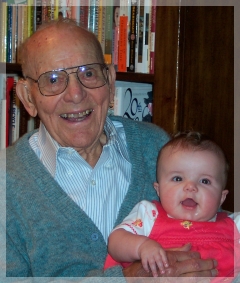
Today’s picture is of my father-in-law—a man who never grew obsolete. Even though his physical strength waned, his spiritual strength never did and he continued to bear fruit until he went home at age 96.
 Living in a country where clean water readily flows out of a faucet, we don’t fully understand the concept of “living water” or mayim chaim. Ancient Israel was an arid land where fresh water was precious. Because it only rained a few months of the year, rain was stored in cisterns and grew stagnant. In contrast, living water came directly from God either by rain or a natural spring. Unlike sea water and the hypersaline Dead Sea, which looked refreshing but were poisonous and made the surrounding land barren, mayim chaim brought life. Throughout Scripture, “living water” was associated with God.
 “Haven’t they ever seen this show? They’re sure to fail!” I exclaimed as we watched the two chefs attempt to make panna cotta in the final round of Chopped. An Italian dessert made of sweetened cream, gelatin, and flavorings, panna cotta usually requires a minimum of four hours to set. In spite of chefs using quick process gelatin, liquid nitrogen, or the blast chiller to speed things up, I don’t think there’s ever been a successful panna cotta on the show. In fact, Chopped judge chef Alex Guarnaschelli calls panna cotta “Chopped suicide!” Nevertheless, these two chefs were sure they would be the ones who could pull it off in the allotted 30-minutes. As expected, instead of ending up with a dessert resembling a Jell-O mold made with cream, they both served something more like melted ice cream. I wondered what made them think they were that much better than any of the other chefs in the twelve years the show has aired. Apparently, competitive chefs tend to be a little short in the humility department!
 Thinking of Jesus’ first miracle caused me to consider His other miracles. Along with general accounts of Him healing people in Capernaum, Gennesaret, and Jerusalem, the gospels mention 35 specific miracles He performed. When we consider the way Jesus healed the blind, His miracles seem almost tailor-made for the people blessed by them. John tells us that Jesus healed one blind man by mixing His spittle with dirt, rubbing the resulting mud over the man’s eyes, and telling the man to wash in the pool of Siloam. Mark tells of another occasion when Jesus took a blind man by the hand and led him out of the village. Surely, they talked but we don’t know about what. Jesus then spit on the man’s eyes and laid His hands on him. Although the man regained his sight, he didn’t understand what he saw so Jesus did it again. Was that one miracle done in two parts or could it have been two miracles: one to restore the man’s sight and the second so he could comprehend what he saw? Another time, Jesus skipped the spit and merely touched two blind men to restore their sight. Then we have the healing of Bartimaeus: Jesus immediately restored His sight without spit, mud, washing, or touch.
 That Jesus chose Cana for His first public miracle and turned water into wine may not be as random as it first seems. By providing wine for the wedding, Jesus took on the bridegroom’s role which foreshadowed things to come.
 Devotions of the Heart