WAITING WITH PEACE

This is the Good News about Jesus the Messiah, the Son of God. It began just as the prophet Isaiah had written: “Look, I am sending my messenger ahead of you, and he will prepare your way. He is a voice shouting in the wilderness, ’Prepare the way for the Lord’s coming! Clear the road for him!’”  [Mark 1:1-3 (NLT)]

christmas starLast Sunday, my husband and I lit the candle of hope on our Advent wreath. This Sunday, we’ll re-light that one along with a second candle, the one we call the peace or Bethlehem candle. Because the Advent wreath custom has been adapted in a variety of ways through the years, there are several names for the candles and explanations for their symbolism that probably have more to do with the selling of wreaths, candles, and devotional booklets than with church tradition. There are no official names, meanings or rituals because an Advent wreath isn’t based on Scripture. It’s merely a tradition to help make this season more meaningful.

We’ve selected our Advent readings (or “lections”) from the Revised Common Lectionary (RCL), an ordered system of Scripture readings. The Christian church has used lectionaries since the 4th century but the RCL was adopted in 1992. An ecumenical project of several American and Canadian denominations, the goal was to provide a common experience of God’s word among all Christians as a way of uniting the Church. Used by a majority of the Protestant churches in the U.S. and Canada, the RCL is a three year cycle of weekly Scripture readings to be read at public worship. During most of the year, the four selections are from the Old Testament, Psalms, the Epistles and the Gospels. Chosen for their common theme and relevance to the church season, these common lections connect Christians with one another across denominational lines and enable an Episcopalian in Minneapolis to recite the same psalm or hear the same epistle as a Methodist in Denver or a Lutheran in San Diego.

Before lighting the candles Sunday, we’ll read portions of Isaiah 40, Psalm 85, and 2 Peter 3. Isaiah tells the people of Judah to be prepared: “Your God is coming!” Saying that salvation is near, the psalmist speaks of the meeting of unfailing love and truth and the kiss of righteousness and peace. Joining these verses are Peter’s words to live peaceful and righteous lives and be ready for the end times when “the day of the Lord will come.” These lections again remind us that Advent is not just about anticipating the Messiah’s birth; it’s a time to anticipate His return. As we prepare our homes for Christmas, let us remember that it is more important to prepare ourselves for meeting Jesus.

Advent is the perfect time to clear and prepare the Way. Advent is a winter training camp for those who desire peace. By reflection and prayer, by reading and meditation, we can make our hearts a place where a blessing of peace would desire to abide and where the birth of the Prince of Peace might take place. [Edward Hays]
On that day, he will set the heavens on fire, and the elements will melt away in the flames. But we are looking forward to the new heavens and new earth he has promised, a world filled with God’s righteousness. And so, dear friends, while you are waiting for these things to happen, make every effort to be found living peaceful lives that are pure and blameless in his sight. [2 Peter 3:12-14 (NLT)]

Copyright ©2020 jsjdevotions. All rights reserved.

THE JESSE TREE

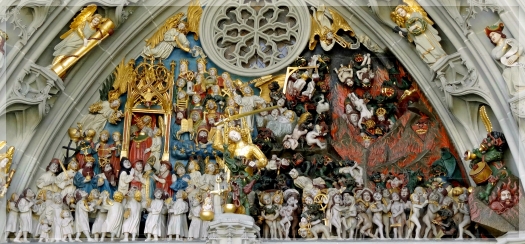
Last Judgment - Minster Cathedral - BernThere shall come forth a shoot from the stump of Jesse, and a branch shall grow out of his roots. And the Spirit of the Lord shall rest upon him, the spirit of wisdom and understanding, the spirit of counsel and might, the spirit of knowledge and the fear of the Lord. [Isaiah 11:1-2 (RSV)]

I remember standing in awe in front of an enormous sandstone sculpture of the Last Judgment at the entrance to Bern’s Minster Cathedral. With 294 figures, the naked wicked are on the right while the white-robed righteous are on the left. There are prophets, angels with trumpets, Jesus, Lady Justice, the wise and foolish virgins and both sinners and saints—the condemned and the blessed. In graphic detail, it illustrates God’s final judgment and the horrible fate of the damned!

It’s said that a picture is worth a thousand words and that’s true of the Last Judgment. In fact, much of the art in old European churches was there to illustrate Scripture for the largely illiterate population of the Middle Ages and early Renaissance. Seeing the portrayal of the last judgment, Michelangelo’s image of the outstretched hand of God giving life to Adam or Rembrandt’s picture of a distraught Moses smashing the stone tablets brought those stories to life for a people who couldn’t read them for themselves. Several churches had what was known as a Jesse Tree. Rather than a tree, these were large tapestries, carvings, or stained glass windows that illustrated the Bible’s salvation theme through the Old Testament to the birth of Jesus.

For example, the stained glass Jesse Tree in the Cathedral of Chartres (c.1150) portrays a sleeping Jesse at the bottom of the window. A shoot springing from his loins reaches up into four branches. Above Jesse are four kings (David, Solomon and two unnamed ones) and, above them, is Mary. At the top is Jesus surrounded by seven doves (representing the Holy Spirit and His gifts). Surrounding this center panel are fourteen figures holding scrolls. These are the people like Moses, Zechariah, Isaiah, and Samuel, who foretold the coming of a savior. In this single sixteen-by-five-foot window, the whole of the Old Testament prophecies and their fulfillment in Jesus is represented and God’s faithfulness in keeping His promises is illustrated.

The Jesse tree comes from Isaiah’s prophecy that the Messiah would come from Jesse’s line—the Davidic line of kings. Jesse was David’s father. The prophet referred to the lesser known Jesse rather than his famed son because, by the time of the Messiah, Judah would be a conquered nation and, with no more kings, David’s line would appear chopped off, like the stump of a hacked down tree. There was, however, life within that stump and a new branch, the Messiah, would sprout from it. The Jesse tree art in churches illustrated that Jesus’ story didn’t start in the New Testament. It began in the Old; Jesus was the fulfillment of God’s promises made thousands of years earlier.

Nowadays, some people celebrate Advent with a Jesse tree that serves as a sort of Advent calendar. Each day during December, a different Bible story is read and then a small ornament representing the story is placed on the “tree”—the family’s actual Christmas tree, a bare branch anchored in a stand, a small tabletop tree or even a felt hanging. An apple might accompany the story of the fall; an ark or rainbow, the story of Noah; and a scarlet cord, the story of Rahab.

Although I’m not decorating a Jesse tree, I am reading stories and prophecies from the Old Testament that tell of God’s faithfulness and plan for redemption. Starting in Genesis with God telling the serpent (Satan) that his final defeat will be brought about by one of Adam and Eve’s descendants, I’ll do a quick tour through the Old Testament and read about Abraham, Isaac, Jacob, Joseph, Moses, Joshua and David. As I prepare to celebrate Christ’s birth, I’ll put his arrival in historical context—in the world of Rahab, Gideon, Ruth, Samuel, Isaiah, Jeremiah, Habakkuk, and John the Baptist: a world in desperate need of salvation.

We often think of the Bible as two separate books—the Old and New, the Hebrew and the Christian, but it is one continuous story that leads across thousands of years to Christ’s birth, death and resurrection. Let us never forget that Jesus, as the Alpha, was there at the very beginning and, as the Omega, He will be there at the end.

And his delight shall be in the fear of the Lord. He shall not judge by what his eyes see, or decide by what his ears hear; but with righteousness he shall judge the poor, and decide with equity for the meek of the earth; and he shall smite the earth with the rod of his mouth, and with the breath of his lips he shall slay the wicked. Righteousness shall be the girdle of his waist, and faithfulness the girdle of his loins. … In that day the root of Jesse shall stand as an ensign to the peoples; him shall the nations seek, and his dwellings shall be glorious. [Isaiah 11:1-5,10 (RSV)]

Copyright ©2020 jsjdevotions. All rights reserved.

PATIENCE

In that day the people will proclaim, “This is our God in whom we trust, for whom we waited. Now at last he is here.” What a day of rejoicing! [Isaiah 25:9 (TLB)]

Come, Thou long expected Jesus Born to set Thy people free;
From our fears and sins release us, Let us find our rest in Thee. [Charles Wesley]

giftMy daughter has become quite adept at hiding Christmas gifts from her husband. If she doesn’t, he will find the presents and open them early; patience is not one of his strong suits. It wasn’t one of Sarah and Abraham’s either. Although they’d been promised a son and many descendants, they grew impatient waiting and took matters into their own hands. Sarah gave Abraham her maidservant Hagar with whom to make a child. Although she made the offer, he didn’t have to accept—but he did. The boy Ishmael was the result of their rashness and the rivalry and strife that continue today in the Middle East came from that impatience. Like Sarah and Abraham, when my son-in-law knows a gift is coming, he just can’t wait until the correct time to receive it. Fortunately, while his wife may get annoyed when he takes matters into his own hands, his impulsiveness hasn’t resulted in centuries of international conflict.
Consider the people of Judah—they’d waited centuries for God’s promise to be fulfilled with the Messiah and most of them completely missed their gift. Tired of waiting, some lost faith and hope; they stopped looking for Him. Having anticipated royalty rather than an itinerant preacher, others didn’t recognize Him. Wanting someone to conquer Rome rather than sin, still others didn’t accept Him. Fortunately, my son-in-law isn’t like that. Even when he’s unsuccessful in his search for the gift, he never gives up. He knows it eventually will appear. Moreover, unlike the Judeans, he won’t ignore the package if it isn’t wrapped in fancy paper with an elaborate bow or reject it because it doesn’t fit his expectations.

David had to wait for God’s promise to materialize but, unlike Like Sarah, Abraham, and Judah, he waited patiently and never gave up hope. After being anointed by Samuel, he had to wait about fifteen years until being crowned king. He didn’t spend that time trying to force his kingship to happen nor did he sit idly and twiddle his thumbs impatiently. He wisely trusted God. The shepherd boy used his waiting time to prepare for the challenges of kingship by growing physically, intellectually, and spiritually so he was ready to receive his crown when God gave it to him.

Unlike David, Sarah, Abraham, and the Jews, my son-in-law knows exactly when his Christmas gifts will arrive—December 25! Unfortunately, when waiting on God to act, we rarely have a calendar marked with His delivery date and we certainly don’t know the date of Christ’s return. Needing patience, we can’t be like Sarah and Abraham who tried to make things happen before the appointed time. Needing faith, we can’t be like the Jews who stopped looking and believing in God’s promised provision. Instead, we must be like David who waited with patience and faith while readying himself for the receipt of God’s promised provision.

When He returns is not as important as the fact that we are ready for Him when He does return. [A.W. Tozer] 

Don’t be impatient. Wait for the Lord, and he will come and save you! Be brave, stouthearted, and courageous. Yes, wait and he will help you. [Psalm 27:14 (TLB)]

Copyright ©2020 jsjdevotions. All rights reserved.

WAITING WITH HOPE

Then everyone will see the Son of Man coming on the clouds with great power and glory. And he will send out his angels to gather his chosen ones from all over the world—from the farthest ends of the earth and heaven. [Mark 13:26-27 (NLT)]

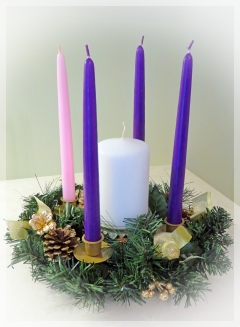
advent wreathIt’s less than a month until Christmas. This Christmas will be vastly different from past ones for us as I imagine it will be for you. Traditionally, our holiday season has been a busy and festive one of concerts, friends, church, fellowship activities, volunteering, entertaining, and family but being in the midst of a pandemic has changed all that. In an attempt to keep the spirit of Christmas alive in what has been a dreary and disappointing year, I’ve started decorating for the holiday and playing Christmas music. Christmas, however, is more than decorations, carols, presents, parties, and peppermint bark. Perhaps not having all of the fun-filled extras of this season will help us focus on its true meaning.

When I was young, I always had a special Advent calendar with a nativity scene and 24 little numbered “windows.” Starting December 1, I opened a window every day to find a special picture or Bible verse that helped tell the Christmas story. Advent, however, isn’t just a way to count down the days until Christmas. In the 4th and 5th centuries, the season of Advent wasn’t about Christmas at all. Lasting 40 days, it was a season of penance, prayer, and fasting in preparation for the baptism of new believers on the Feast of Epiphany (January 6). By the 6th century, Advent was tied to the coming of Jesus—but not His first arrival in Bethlehem. Coming from the Latin adventus, meaning “coming,” Advent was about Christ’s second coming—when the one who arrived as a lamb would return as a triumphant lion. It was not until the Middle Ages that four Sundays became Advent’s length and the season was linked to both Christ’s first and second comings along with His presence among us through the Holy Spirit.

Although the custom of an Advent wreath began with Lutheran and Roman Catholic families in 16th century Germany, it didn’t spread to churches until three centuries later. The wreath is a circle of evergreen branches; its circular shape, with no beginning or end, symbolizes the immortality of the soul and God’s promise of eternal life through Jesus Christ. Four candles, representing the four weeks of Advent, are arranged around the wreath; sometimes, a fifth candle is in its center. A new candle is lit on each of the four Sundays leading up to Christmas with the fifth candle lit on Christmas.

The season of Advent begins this Sunday and, while COVID-19 keeps us from our liturgical church and its Advent wreath ritual, it can’t prevent us from observing Advent at home. We will read the pleas for a savior found in Isaiah 60 and Psalm 80, Jesus’ words about His return in Mark 13, and Paul’s assurance that Jesus will return in 1 Corinthians 1. While it doesn’t seem Christmassy to read about Jesus’ return before He’s appeared in Bethlehem, these readings are reminders that ours is an in-between time—a time between Jesus’s first arrival and His final return. After the readings, we’ll light the first candle on our Advent wreath: the candle of hope, often called the “prophecy candle.” We’ll say a prayer of thanksgiving for the gift of hope that came with the Messiah. This first candle will remind us that we wait with hope for His return: for the time when Satan is defeated, God’s final judgment occurs, all things are made new, and all of God’s promises come true! May the candle of hope stay lit in our lives!

Let us be alert to the season in which we are living. It is the season of the Blessed Hope, calling for us to cut our ties with the world and build ourselves on this One who will soon appear. He is our hope—a Blessed Hope enabling us to rise above our times and fix our gaze upon Him. [A.W. Tozer]

However, no one knows the day or hour when these things will happen, not even the angels in heaven or the Son himself. Only the Father knows. And since you don’t know when that time will come, be on guard! Stay alert! … Don’t let him find you sleeping when he arrives without warning. I say to you what I say to everyone: “Watch for him!” [Mark 13:32-33,36-37 (NLT)]

Copyright ©2020 jsjdevotions. All rights reserved.

KEEP CALM AND PRAY ON

Naples FL sunsetDon’t panic. I’m with you. There’s no need to fear for I’m your God. I’ll give you strength. I’ll help you. I’ll hold you steady, keep a firm grip on you. [Isaiah 41:10 (MSG)]
The minute I said, “I’m slipping, I’m falling,” your love, God, took hold and held me fast. When I was upset and beside myself, you calmed me down and cheered me up. [Psalm 94:18-19 (MSG)]

In 1939, on the eve of World War II, the British government produced three posters to be used in the event of war. Printed with the goal of reassuring the public of the nation’s ultimate victory, the posters featured a plain background, a small crown logo on top, and simple block lettering. The two posters that were distributed said, “Freedom is in peril, defend it with all your might” and “Your courage, Your cheerfulness, Your resolution will bring us victory.” The third poster, with its message to “Keep calm and carry on” was only to be issued in the event of a German invasion. Fortunately, it never was needed. In 1945, most of the “Keep calm” posters were destroyed and forgotten until some were discovered and popularized sixty years later. In spite of the unsettled political climate in our nation, freedom doesn’t seem to be in peril but, if there ever were a time we need, pluck, optimism, determination, and composure, it is now!

Since we’ve been invaded by COVID, I’ve seen several memes with variations on the “Keep calm” posters. They suggest everything from keeping calm and washing our hands, quarantining on, masking up, and staying home, to drinking wine, baking brownies, eating chocolate, blaming someone else, and calling Batman. One simply said “Now panic and freak out!” When faced with a disaster, misfortune, or major mess up, I admit to having done nearly all of those things (except call Batman) but none did much to calm my troubled soul. Perhaps the Christian’s versions of the original poster would have a cross on the top and include suggestions to keep calm and pray on, remember God loves us, or trust in the Lord and His plan. At least, those suggestions would work!

Let’s remember: Jesus stilled the water and waves on the Sea of Galilee with just a word! If He can do that, He is more than capable of calming our troubled hearts and quieting every storm in our lives, even a global pandemic! In the face of life’s predicaments, troubles, uncertainties, and calamities, let us choose to carry on with courage, cheerfulness, and resolution by keeping calm and praying on!

When we fight our battles on our knees, we win every time. [Charles F. Stanley]

You can do more than pray after you have prayed, but you cannot do more than pray until you have prayed. Pray often, for prayer is a shield to the soul, a sacrifice to God, and a scourge to Satan. [John Bunyan]

Be cheerful no matter what; pray all the time; thank God no matter what happens. This is the way God wants you who belong to Christ Jesus to live. [1 Thessalonians 5:18 (MSG)]

Copyright ©2020 jsjdevotions. All rights reserved.

NEVER OBSOLETE

I will be your God throughout your lifetime—until your hair is white with age. I made you, and I will care for you. I will carry you along and save you. [Isaiah 46:4 (NLT)]

If I’d known I was going to live so long, I’d have taken better care of myself. [Anonymous]

Grandpa J

Several years ago, a friend’s spry 94-year old mother emailed the family about having forgotten her elbow brace on the way to the exercise room in her senior residence. After returning to her apartment and donning the brace, the woman took an inventory of the other pieces of hardware she needed to get through each day. Along with the elbow brace, she wore bi-focal glasses, two hearing aids, a knee brace, two sets of dentures, two orthopedic shoe inserts, and one doe-skin support for three toes. Even without inventorying the number of medications that were part of her daily regimen, she observed that “it’s not a simple management situation” to keep track of it all. Feeling blessed that she didn’t need a cane and walker as did many her age, she closed her message by reminding the younger family members to take care of themselves. She continued her optimistic outlook and daily exercise routine until she went home to the Lord just a few months before her 100th birthday. Her light-hearted email remains a serious reminder that time takes a toll on our bodies.

Within my circle, many have reached the age when God has started to recall some of their parts. A few are nearly  bionic with their titanium plates, pacemakers, implanted cardioverter defibrillators, replacement heart valves, intraocular lenses, artificial hips and knees, or portable oxygen concentrators. As my mother-in-law observed in her 102nd year, “Old age is not for sissies!” Indeed, it presents a fair number of challenges. Nevertheless, as long as we’re still breathing, we should be in good spirits and thankful. Old age is a gift from God and one denied to far too many of our friends and family. It is a privilege not a punishment, an opportunity rather than a misfortune, and a blessing not a curse.

Even though we slow down and start wearing out as the years progress, God (who is older than time itself) remains the same and is constant in His care for us. He doesn’t stop working in our lives because parts of our bodies have ceased to function properly. He doesn’t put us out to pasture because we can no longer carry a load, consign us to the trash heap because we have some broken parts, or scrap us because we’re out of date. In God’s eyes, no matter how old or run-down His children are, no one is considered unusable or obsolete! He is as close to us now as when we took our first breath and He’ll be right beside us when we take our last one. God carried us as children and He will continue to carry us until He recalls our worn out bodies and takes us on our final trip home.

Before we take that last journey, however, there is still work to be done in God’s earthly kingdom. As long as we are breathing (even if we need an oxygen concentrator to do it), there is someone somewhere with whom we can share God’s love and good news. Just don’t forget your elbow brace or cane on the way out the door!

But the godly will flourish like palm trees and grow strong like the cedars of Lebanon. For they are transplanted to the Lord’s own house. They flourish in the courts of our God. Even in old age they will still produce fruit; they will remain vital and green. They will declare, “The Lord is just! He is my rock! There is no evil in him!” [Psalm 92:12-15 (NLT)]

That is why we never give up. Though our bodies are dying, our spirits are being renewed every day. [2 Corinthians 4:16 (NLT)]

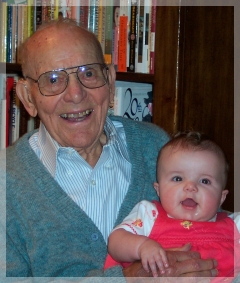
Today’s picture is of my father-in-law—a man who never grew obsolete. Even though his physical strength waned, his spiritual strength never did and he continued to bear fruit until he went home at age 96.

Copyright ©2020 jsjdevotions. All rights reserved.