THE BRIDEGROOM (Cana – Part 3)

You yourselves know how plainly I told you, “I am not the Messiah. I am only here to prepare the way for him.” It is the bridegroom who marries the bride, and the bridegroom’s friend is simply glad to stand with him and hear his vows. Therefore, I am filled with joy at his success. He must become greater and greater, and I must become less and less. [John 3:28-29 (NLT)]

wedding - 1939That Jesus chose Cana for His first public miracle and turned water into wine may not be as random as it first seems. By providing wine for the wedding, Jesus took on the bridegroom’s role which foreshadowed things to come.

John the Baptist described Jesus as a bridegroom and himself as the groom’s friend, much like today’s “best man.” In Jesus’ day, the groom’s best friend might have served as master of the banquet. The master of the banquet, however, knew he wasn’t the one hosting the party and the celebration wasn’t about him. By calling Jesus the bridegroom, John accepted his secondary role.

The bridegroom imagery continued when Jesus explained why his disciples didn’t fast. Fasting was for a time of mourning but weddings were a time to rejoice and Jesus compared his relationship with the disciples to that of a bridegroom and his guests. It would be inappropriate for the groom’s guests to fast during the celebration while the groom still was present. The time for fasting would be when He no longer was with them.

At another time, Jesus likened His followers to bridesmaids who were waiting with lamps for the groom to come and collect his bride. Some weren’t prepared with enough oil and, since the groom was a long time coming, their lamps went out. Without the light, they couldn’t accompany the wedding party back to the groom’s house for the celebration. This parable warned Jesus’ followers to be prepared for His return.

We find a bridegroom again when Jesus compared the Kingdom of Heaven to a wedding feast given by a king for his son. Two invitations were sent to such a celebration: the first asking them to attend and the second telling them it was ready. When the guests who initially accepted the king’s invitation refused to come, he sent out a third invitation but the people refused and his messenger was killed. With his invitation rejected, the king extended his invitation to everyone.

In Ephesians, we find Paul continuing the metaphor when he says the way a man and his wife are united is “an illustration of the way Christ and the church are one.”[5:31-32] It comes full circle in Revelation when Jesus, the Lamb of God, is called the bridegroom and His church the bride.

Let us not be like the guests who reject the King’s invitation or the foolish bridesmaids who weren’t ready for the bridegroom’s arrival. We want to join in the celebration. We are, after all, the bride of Christ!

Let us be glad and rejoice, and let us give honor to him. For the time has come for the wedding feast of the Lamb, and his bride has prepared herself. … And the angel said to me, “Write this: Blessed are those who are invited to the wedding feast of the Lamb.” And he added, “These are true words that come from God.” [Revelation 19:7,9 (NLT)]

Copyright ©2020 jsjdevotions. All rights reserved.

WEDDING WINE (Cana – Part 1)

“A host always serves the best wine first,” he said. “Then, when everyone has had a lot to drink, he brings out the less expensive wine. But you have kept the best until now!” This miraculous sign at Cana in Galilee was the first time Jesus revealed his glory. And his disciples believed in him. [John 2:10-11 (NLT)]

kaui weddingWhen the catering manager pulled me aside and said we had a problem, my mind rushed through various scenarios that could turn our daughter’s wedding into a fiasco. When he admitted not having the wine I’d ordered weeks earlier, I got nervous but, when he offered to substitute a better wine at a lower price, I heaved a sigh of relief and recalled another wedding when the guests unexpectedly got better wine! This happened 18 years ago but I still remember it whenever I read about Jesus’ miracle at Cana. The guests at our daughter’s wedding had no idea why they enjoyed such good wine and neither did the guests at that wedding 2,000 years ago.


Our daughter had a small destination wedding but weddings in Jesus’ day were a community celebration and the host typically invited as many as he could. The Jewish culture was one of hospitality and the festivities often lasted as long as a week. Not having the right wine was a minor glitch for us but running out of wine at that wedding was a disastrous breach of etiquette for the groom whose responsibility was to provide enough food and drink.

Perhaps Mary knew of the shortage because she was one of the women serving food. In any case, she knew that her son could fix a bad situation and instructed the servants to do whatever He said. Jesus told them to fill six stone jugs with water and then take some to the master of the banquet (whose duty was to oversee the entertainment and supervise the distribution of food and drink) for sampling. Upon tasting the wine, he expressed his surprise that the groom had reserved the best wine for the end when the guests’ palates had dulled.

Jesus’ first miracle tells us a great deal about our Lord. Prior to this, during His 40 days of fasting in the wilderness, He’d refused Satan’s temptation to use His power to satisfy His hunger. In Cana, Jesus used His power to serve others rather than Himself. Out of compassion, He prevented the disgrace of insufficient wine from haunting the newlyweds for the rest of their lives. The vessels Jesus had the servants fill were special stone jars set aside for sacred purposes and reserved for ceremonial washing. The Jews were meticulous about their rituals and these vessels would never have been used for wine. Nevertheless, as Jesus later demonstrated by healing on the Sabbath, touching the unclean, and eating with sinners, compassion and love were the new way to fulfill God’s law.

The servants were told to fill the jugs all the way to the brim. Rather than adding something to the water, Jesus changed it! He doesn’t just improve lives; He transforms them and turns sinners into saints! Because of Jesus, rather than the best wine being served first, it was served last. It was a sign of new and better things to come: a new covenant of grace that was better than the old one of the law. We see Jesus’ humility in a miracle done so quietly that only the servants and His disciples knew what had happened. It was the bridegroom, not Jesus, who got the credit for the superb vintage. We also see the richness of life that Jesus offers. Those six jugs would have provided enough wine, not just for the wedding feast, but for the entire village for several weeks.

Jesus came out of love so it is fitting that His first recorded miracle occurred at a wedding feast—a joyful celebration of love. From the outset of His ministry, it was clear that Jesus’ message was not one of asceticism and severity but one of love, joy, and abundance. Like the better wine served at our daughter’s wedding, there’s no extra cost to us; God’s grace is free. It was Jesus who paid the price for our salvation.

The same Jesus Who turned water into wine can transform your home, your life, your family, and your future. He is still in the miracle-working business, and His business is the business of transformation. [Adrian Rogers]

The thief’s purpose is to steal and kill and destroy. My purpose is to give them a rich and satisfying life. [John 10:10 (NLT)]

Copyright ©2020 jsjdevotions. All rights reserved.

UNFAIR

And the Lord’s anger was kindled against Israel, and he made them wander in the wilderness forty years, until all the generation that had done evil in the sight of the Lord was gone. [Numbers 32:13 (ESV)]

Begonia - Binos soft pink

Although my high school grand lives in a state where COVID-19 has necessitated remote schooling, I was pleased to learn that her school found a safe way for their students to take the SAT this week. On-line school would be cancelled that day, the school building would open, volunteer teachers would serve as proctors and monitors, desks would be safely spaced, and only ten students would be in any room. It seemed like a perfect solution. The reckless actions of my grand’s fellow students, however, changed all that when over 100 classmates attended an unsupervised house party over the weekend. Unfortunately, that massive gathering of teens created both a police situation and a public health nightmare. Since many of those attending were signed up for this week’s SAT, the test was cancelled. The school principal wasn’t going to put volunteer teachers and other students at risk because of the foolhardy and selfish actions of a few. Because several of those attending the party also were athletes, all sport team practices were cancelled for the next two weeks, as well.

Complaining that it’s unfair, many parents are angry at the police, school, health department, and governor when they should be mad at the thoughtless teens and careless parents who allowed such behavior. This took place in a state where COVID cases have more than doubled this week and the state is facing a public health crisis. Sadly, the students who followed the rules, abided by the protocols, and accepted the restrictions are suffering. Yes, it seems terribly unfair but it’s what had to be done.

When my daughter talked with her teen about this situation, I wonder if she mentioned Joshua and Caleb. They didn’t deserve any punishment when they returned from scouting Canaan. The two men pled with the Israelites to trust God and go forward into the Promised Land but the people rebelled and refused. As a result, the Israelites were sentenced to years of wandering the desert until the last of the rebellious adults died. Even though Caleb and Joshua weren’t sentenced to die from the plague as were the scouts whose words caused the people’s rebellion, having to wait so long when they were so close (and did nothing wrong) must have seemed incredibly unfair. Did the two men wonder why they and their families should be punished for the sins of everyone else? There’s no record of Joshua and Caleb arguing with God: “Hey, don’t punish us; we didn’t do anything wrong!” They didn’t question God saying, “Hey, what if we die in the meantime? Where’s our reward then?” They simply accepted God’s decision. Even though they were punished for the sins of others, they eventually got to the Promised Land.

Of course, Caleb and Joshua weren’t the only ones in the Bible to be unfairly punished. Think of Jesus! Completely sinless, He endured the punishment for our sins without complaint! He didn’t just miss the SAT and volleyball practice or spend forty years in the wilderness. He suffered on the cross, died and was buried for our sins. He didn’t endure that punishment so He could enter the Promised Land; Jesus did it so we could!

There was nothing fair about Jesus taking our punishment and us getting the reward! He was, however, God’s love and grace in flesh and blood. Jesus didn’t die to appease an angry God but to reveal a God who loves us enough to suffer for us. Thank you, Lord Jesus, for taking our punishment and giving us the gift of salvation and everlasting life in return.

He himself bore our sins in his body on the tree, that we might die to sin and live to righteousness. By his wounds you have been healed. For you were straying like sheep, but have now returned to the Shepherd and Overseer of your souls. [1 Peter 2:24-25 (ESV)]

For while we were still weak, at the right time Christ died for the ungodly. For one will scarcely die for a righteous person—though perhaps for a good person one would dare even to die—but God shows his love for us in that while we were still sinners, Christ died for us. [Romans 5:6-8 (ESV)]

Copyright ©2020 jsjdevotions. All rights reserved.

BENEVOLENT DETACHMENT

Live carefree before God; he is most careful with you. Keep a cool head. Stay alert. The Devil is poised to pounce, and would like nothing better than to catch you napping. Keep your guard up. You’re not the only ones plunged into these hard times. It’s the same with Christians all over the world. So keep a firm grip on the faith. The suffering won’t last forever. [1 Peter 5: 7-9 (MSG)]

great blue heron“We’re just a big ball of frustration right now!” a public information officer for the San Antonio Police said while describing the rise in road rage and violent driver incidents in that city. Unfortunately that big ball of frustration isn’t limited to the road or San Antonio. Satan must be chortling in glee as he watches people’s virus-fueled anxiety spurring rising levels of aggression and hostility everywhere.
A Texas woman recently had a complete meltdown in the grocery store. After being asked to wear a mask, she went on an expletive-deleted tirade while flinging more than a dozen items out of her cart. Although she’d worn the mask while shopping, she’d removed it in the checkout line. While she chucked her pork chops, chicken, produce, and canned goods into the aisles with one hand, she held her mask in the other. Finally, abandoning the rest of her groceries, she stormed out of the store, screaming profanities and still waving her mask. The outburst gained her nothing but embarrassment as her outburst went viral and she still had to buy groceries (in a city with a mask mandate)!

Whether it’s fear, anger, depression, unease or frustration about health and safety, racial injustice, politics, government, cabin fever, unemployment, financial challenges, on-line schooling, working remotely, or isolation, tension is high and everyone is on edge. But, instead of dealing with our feelings, we seem to be lashing out at one another. While I haven’t thrown a tantrum or screamed at anyone yet, I admit to not liking my mind’s inner dialogue when I see people flaunting the mask order, hogging the sidewalk, wearing masks improperly, with a loaded grocery cart in the express lane, or committing numerous other minor social infractions that wouldn’t have aggravated me a few months ago.

People are wound tight and living that way isn’t good for our bodies or our souls. We need to let go of those petty annoyances along with our major concerns and give them all to God! Christian counselor and author John Eldredge calls this practice “benevolent detachment.” It’s a way to be kind to ourselves as well as to those around us. To practice this detachment, he’s developed an app called “One Minute Pause.” With soothing music in the background, it begins with a few deep breaths followed by God inviting us to give everyone and everything to Him. It continues with our response: “I give everyone and everything to you, God!” followed by a few Bibles verses and a brief prayer. Although I have the app, none of us need an app on our phones to benevolently detach from the world around us. We do, however, have to hit the pause button on our emotions! We need to unclench both physically and spiritually and release whatever is troubling us to God.

The request to put on her mask probably was the least of many things bothering that Texas woman but, as “the last straw,” it was what triggered her frenzy. What if she had made a practice of benevolent detachment—of regularly pausing long enough to hand her frustrations to God? Let us all make a concerted effort to let go of life’s minor vexations before they evolve into a complete meltdown or worse. Let’s regularly step back, take a deep breath, and redirect our attention to the One who is walking through this valley with us. We’re not in this alone! As we give God our fear, anxiety, irritation, exasperation, angst, and sadness, let us choose to trust Him.

Over time I’ve found no better practice to help clear out my cluttered soul than the practice of benevolent detachment. The ability to let it go, walk away — not so much physically but emotionally, soulfully. [John Eldredge]

Don’t fret or worry. Instead of worrying, pray. Let petitions and praises shape your worries into prayers, letting God know your concerns. Before you know it, a sense of God’s wholeness, everything coming together for good, will come and settle you down. It’s wonderful what happens when Christ displaces worry at the center of your life. [Philippians 4:6-7 (NLT)]

Copyright ©2020 jsjdevotions. All rights reserved.

HE CARRIES US

Praise the Lord; praise God our savior! For each day he carries us in his arms. [Psalm 68:19 (NLT)]

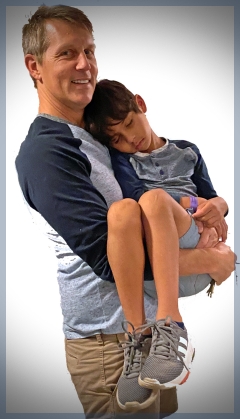
carrying his childMy daughter-in-law sent photos of the family’s day at the apple orchard. The grands picked apples, pet the farm animals, climbed the tractors, raced the pedal karts, did the zip-line, raced through the corn maze, traversed the goat bridge, and enjoyed their fill of donuts and apple cider. It was a fun-filled but exhausting day. The last picture was of my son carrying the youngest grand (who’d fallen asleep on the ride home) into the house.

The photo brought me back to my childhood when, like my grand, I’d fall asleep in the car on the way home from a family outing. Once home, my father would scoop me up in his strong arms to carry me into the house and up to my room. I remember feeling safe and loved as he carried me in his arms.

The oversized La-Z-Boy in our den was my father’s chair but, when he wasn’t home, my mother and I would snuggle there and talk for hours. I’d pour out my troubles, questions, hopes, and fears. She would quietly listen and then comfort, guide, encourage and pray with me. Holding me in her arms, she’d dry any tears and reassure me that life would eventually work out for the best.

Those childhood days are long gone; my parents passed away more than half a century ago and all that’s left are fond memories. Nevertheless, there still are times I’d like to shed the duties of adulthood and be a child again: to be the one carried instead of the one doing the carrying—the one falling apart instead of the one putting it together again. I don’t think I’m the only person who’s ever wanted to resign from adulthood. The responsibilities that come with maturity can weigh on us all.

In these troubled times, today’s responsibilities feel especially heavy. Every day seems to bring another challenge. We may be grown up but we haven’t outgrown the need to be nurtured, encouraged, comforted and restored. Many of us, however, seem to have outgrown the willingness to stop and admit our vulnerability and need. Just because we’re adults doesn’t mean we can’t rest in the arms of our Heavenly Father and let Him carry us when we’re weary. Although we can’t return to childhood, we have a Father in Heaven who loves each of us as if we were His only child. He will hold and comfort us as only a loving parent can. Rather than bandaging skinned knees and feeding our bodies, He bandages wounded hearts and nourishes our souls. He may not carry us up to our rooms but He we will carry us close to His heart for the rest of our days.

Snuggle in God’s arms. When you are hurting, when you feel lonely, left out. Let Him cradle you, comfort you, reassure you of His all-sufficient power and love. [Kay Arthur]

He tends his flock like a shepherd: He gathers the lambs in his arms and carries them close to his heart. [Isaiah 40:11 (NIV)]

Even to your old age and gray hairs I am he, I am he who will sustain you. I have made you and I will carry you; I will sustain you and I will rescue you. [Isaiah 46:4 (NIV)]

Copyright ©2020 jsjdevotions. All rights reserved.

JEHOVAH RAPHA

Steamboat SkiThe same Spirit gives great faith to another, and to someone else the one Spirit gives the gift of healing. … It is the one and only Spirit who distributes all these gifts. He alone decides which gift each person should have. [1 Corinthians 12:9,11 (NLT)]

Several years ago, what should have been my first ski run of the day became my last one of the season when a tumble down an icy slope left me with three broken ribs and tears in both my ACL and MCL. After the closing prayer at church that evening, the woman behind me said, “I see you’re in a lot of pain. May I lay hands on you and pray for you?” This woman believed she’d been gifted by the Holy Spirit with healing and I’d often seen her praying over others after church. Unsure about her supposed gift, I was in such pain and despair that I would have accepted any offer of relief. She accompanied me to the front of the church where a few others joined her as they laid hands on me and prayed.

I certainly needed prayer; my body hurt but so did my heart. Scheduled to depart in five days for a much anticipated tour of Belgium and the Netherlands, I suspected my injuries meant we’d have to cancel the trip. I also feared that I’d seen the last of my days skiing on the mountain.

While I can’t say whether those hands and prayers made an immediate difference, I know I felt far better leaving church than when I arrived. I still had torn ligaments and broken ribs, but my pain had eased and my spirits had lifted. The following day, we returned to the Midwest. Only time would heal my ribs but the orthopedic surgeon gave me a full leg brace and scheduled physical therapy. We took our trip and, in spite of my discomfort, had a wonderful time. Hoping to avoid the surgery that seemed inevitable, the next several months were spent in intense physical therapy. Fortunately, without needing surgical repair, I returned to the slopes and continued to ski, albeit with a leg brace and a little more caution, for several more years.

Was my excellent recovery because of the hands laid on me and prayers offered for me or the skill of my physician and physical therapist or both? Only God knows for sure, but I believe those petitions reached God’s ears and He acted on them. Through the healing prayers and touch of my brothers and sisters in Christ, God gave me the spiritual, emotional, and physical strength (along with good medical care) to recover fully.

Throughout the Bible we read of miraculous healings: Naaman was healed of leprosy, Elijah brought the widow’s son back to life, Peter and John healed a lame man, Paul healed the father of Publius, and physical healing was Jesus’ most common miracle.  We have a God who hears our prayers and has the power to heal: our Jehovah Rapha. Today, however, miraculous healings seem few and far between.

Before that evening, I’d questioned whether the Spirit still bestowed the gift of healing on believers. Could someone’s touch really serve as a conduit for God’s healing grace? I no longer doubt; while the spiritual gift of healing may not always manifest in immediate or inexplicable recovery, it does exist.

While few of us may be gifted with healing, every one of us should be engaged in intercessory prayers for the sick. Nevertheless, no matter how strong our faith, the faith of those who pray for us or of those for whom we pray, healing does not always occur. Let us remember that healing is more than the mending of broken bodies; it is the mending of broken souls. God is more concerned with our spiritual salvation than our physical well-being and the restoration of our bodies may have to wait until we enter God’s glory. The healing of our souls, however, can happen right now!

Are any of you suffering hardships? You should pray. Are any of you happy? You should sing praises. Are any of you sick? You should call for the elders of the church to come and pray over you, anointing you with oil in the name of the Lord. Such a prayer offered in faith will heal the sick, and the Lord will make you well. [James 5:13-15a (NLT)]

Copyright ©2020 jsjdevotions. All rights reserved.