ADMITTING WEAKNESS, ACCEPTING GRACE

Though the Lord is great, he cares for the humble, but he keeps his distance from the proud. [Psalm 138:6 (NLT)]

No one enjoys feeling weak, whether it is emotionally, spiritually or physically. There is something within the human spirit that wants to resist the thought of weakness. Many times this is nothing more than our human pride at work. Just as weakness carries a great potential for strength, pride carries an equally great potential for defeat. [Charles Stanley]

corkscrew swamp sanctuaryHere I am again, with a broken ankle and wearing a knee-high air-boot for the next eight to ten weeks! We have guests visiting next Friday and, since they’re avid gardeners, we’d initially planned on taking them to the Botanic Gardens. Yesterday, I suggested a change in plans since a stroll through the gardens is beyond my walking ability. When my husband suggested pushing me in one of the garden’s wheelchairs, I began protesting until I recalled a similar situation over six years ago when my foolish pride almost prevented me from accepting the help I needed.

That time, another fractured ankle kept us from taking our regular walk through the swamp/bird sanctuary and we were going a bit stir-crazy. When my husband suggested pushing me along the boardwalk in one of their wheelchairs, I recoiled. Unwilling to acknowledge my weakness and need, I protested that only old people and invalids needed wheelchairs (even though I qualified on both counts). My vanity and foolish pride were keeping me from accepting my husband’s offer. After hearing an inner voice whisper, “Silly woman, think again!” I realized how foolish and self-centered I’d been. Eating my pride, I allowed my husband to do for me that which I couldn’t do for myself.

After joking with a little boy in a stroller that my stroller was bigger than his, we stopped to chat with Jack and Mary, an elderly couple we frequently saw there. Every morning (and some afternoons), Jack pushed his frail and ailing wife along the boardwalk. Unlike me, Mary accepted her diagnosis and dependence without complaint. In fact, she radiated peace and joy and her beautiful smile reminded me that I needed an attitude adjustment. I realized how incredibly fortunate we both were to have husbands who loved us enough to push us around the swamp. Both Mary and I were experiencing our husbands’ grace—which simply is love in action! And to think I almost missed that wonderful day (and many more like it) simply because of pride!

Just as I’d resisted my husband’s offer because I pridefully didn’t want to admit my need, we often find ourselves missing out on God’s grace – what Matthew Henry calls “the free, undeserved goodness and favor of God” – for the same reason. With His endless supply of mercy, love, healing, goodness, joy, peace, and forgiveness, there is no limit to God’s grace; it is sufficient for our every need. The only catch is that we must come to Him with a humble and contrite heart willing to admit our need and powerlessness. Pride, however, can keep us from acknowledging our vulnerability or deficiency. Just as I couldn’t make that swamp walk until I admitted I couldn’t do it on my own, none of us can successfully walk through life without accepting and depending on God’s beautiful grace and amazing power. It is only when we admit our weakness that we become strong!

A man does not get grace till he comes down to the ground, till he sees he needs grace. When a man stoops to the dust and acknowledges that he needs mercy, then it is that the Lord will give him grace. [D.L. Moody]

Three different times I begged the Lord to take it away. Each time he said, “My grace is all you need. My power works best in weakness.” So now I am glad to boast about my weaknesses, so that the power of Christ can work through me. That’s why I take pleasure in my weaknesses, and in the insults, hardships, persecutions, and troubles that I suffer for Christ. For when I am weak, then I am strong. [2 Corinthians 12:8-10 (NLT)]

Copyright ©2021 jsjdevotions. All rights reserved.

THE WOODPECKER

You heard that it was said, “Love your neighbour and hate your enemy.” But I tell you: love your enemies! Pray for people who persecute you! [Matthew 5:43-44 (NTE)]

red-bellied woodpeckerNo respecter of early mornings, an annoying woodpecker was busy drumming on the gutters of a nearby house. A few streets later, I spotted a woodpecker determinedly drilling into the stucco of another house. As it excavated a roost hole in the decorative trim, the determined little bird was doing as much damage with his beak as a heavy sledge hammer. A plaster patch nearby told me this wasn’t the first time the wall has been under attack! Throughout our community I see reflective streamers, children’s pinwheels, life-sized plastic owls, and strips of aluminum foil hanging from the eaves of houses. Nothing, however, seems to deter these birds from their drumming and drilling.

I thought of relentless woodpeckers after talking with a friend who recently experienced a stressful (but unavoidable) time with extended family. I could hear the exasperation in her voice as she spoke of the visit. As followers of Jesus, we’re supposed to reflect God’s love to everyone but she wondered if there’s an expiration date for that command when we get nothing but rudeness, deceit, or put-downs in return? How do we continue to love others when they are unlovable? We should be channels of God’s grace but what if we’re channeling that grace into what seems to be a bottomless pit of nasty? We’re supposed to be giving but when do we get a chance to receive? If other people can be selfish, under-handed, and bad-mannered, why can’t we?

Perhaps we need to remember that other people, no matter how unpleasant, demanding, or quarrelsome, are not the real foe—it is Satan. Like the woodpecker, he doggedly pokes, prods, and pesters us and our frustration, impatience, and annoyance with troublesome people is Satan chipping away at us a little bit at a time. Given enough time, instead of a stucco wall, he hopes to break through the wall of self-control. Instead of turning the other cheek, he wants us to lash back with some of the same!

In Jesus’ call to love our enemies, the word used was agapate which is the very kind of love God has for His sinful, disappointing, deceitful, troublesome, stiff-necked, difficult, selfish, and argumentative children! His love for us is active, unconditional, consistent, and permanent—a love that builds up rather than tears down. When Satan pecks at us with unpleasant people and difficult situations, let us remember that grace—unconditional love toward a person who does not deserve it—is exactly what we got from God and what He expects us to pass on to others! Admittedly, there are times we’re sorely tempted to retaliate rather than love but, just as God never takes a break from loving us, we don’t get to take a break from loving our enemies!

Fortunately, instead of plastic owls, we have God’s armor and the shield of faith to fortify us against Satan’s attacks. While loving our enemies is impossible on our own, God’s power enables us to resist Satan’s attacks and continue to pass on God’s grace to everyone (not just the nice deserving ones).

Agape is disinterested love. Agape does not begin by discriminating between worthy and unworthy people, or any qualities people possess. It begins by loving others for their sakes. Therefore, agape makes no distinction between friend and enemy; it is directed toward both. [Martin Luther King, Jr.]

These are the clothes you must put on, then, since God has chosen you, made you holy, and lavished his love upon you. You must be tender-hearted, kind, humble, meek, and ready to put up with anything. You must bear with one another and, if anyone has a complaint against someone else, you must forgive each other. Just as the master forgave you, you must do the same. On top of all this you must put on love, which ties everything together and makes it complete. [Colossians 3:12-14 (NTE)]

Copyright ©2021 jsjdevotions. All rights reserved.

TO WHOM?

But when you pray, go into your room, close the door and pray to your Father, who is unseen. (Matthew 6:6 NIV)

And I will do whatever you ask in my name, so that the Father may be glorified in the Son. You may ask me for anything in my name, and I will do it. [John 14:13-14 (NIV)]

And pray in the Spirit on all occasions with all kinds of prayers and requests. With this in mind, be alert and always keep on praying for all the Lord’s people. [Ephesians 6:18 (NIV)]

“To whom should we pray?” is a common question. People wonder, “If we pray to God the Father, are we leaving out His Son? But if we pray to Jesus, are we leaving out God? And where does the Holy Spirit fit in?”
I’m no theologian, but it seems we certainly can’t go wrong by praying to God the Father. After all, when asked how to pray, Jesus began with “Our Father” and the Apostle Paul wrote the Romans about joining together and “giving praise and glory to God, the Father of our Lord Jesus Christ.” [15:6] Nevertheless, Jesus, as the son of God, is divine and He promised that we can ask for anything in His name. So, we can pray to Him as did Stephen who prayed, “Lord Jesus, receive my spirit,” while being stoned. [Acts 7:59] To further confuse the matter, Paul explained that the Holy Spirit intercedes for us so it appears that we also can pray to Him.

If we can pray to any of the three, how do we decide to whom we’ll pray? Some people decide who they’ll address by the topic of their prayer. When they want to offer worship and praise, ask for forgiveness, or plead for divine intervention, they call on God the Father. When they need to talk with someone who understands their earthly struggles, they call on Jesus. Since the Holy Spirit helps us pray, they pray to Him when they can’t find the words to express themselves.

When we worry about to whom we address our prayers, however, we’re forgetting that our Trinitarian God, while three persons, is one God! Calling it a “divine riddle,” Puritan minister Thomas Watson explained, “The three persons in the blessed Trinity are distinguished, but not divided; three substances, but one essence. … If there be one God subsisting in three persons, then let us give equal reverence to all the persons in the Trinity. … One person has not a majority or super eminence above another, therefore we must give equal worship to all the persons.”

When learning about Jeopardy contestant Matt Amodio for yesterday’s devotion, I discovered that his answers irk the grammar police. Jeopardy answers must be given in the form of a question and he begins every response with “what’s…” even when referring to a person. Amodio’s strategy is to keep things simple and explained that keeping his responses consistent allows him to focus on the “meat” of the clue. Just as a Jeopardy contestant’s answers don’t have to be grammatically correct to be accepted, I suspect our Trinitarian God cares far more about our hearts than our words and would prefer we give more thought to the “meat” of our prayers rather than to whom or how they’re said.

We can address our Trinitarian God in any of a number of ways—as Eternal Father, Holy Spirit, Lord, Blessed Jesus, God, Lord of My Life, Almighty and Eternal God, Holy Spirit of God, Eternal Being, Divine Love, God of Mercy, Holy One, Holy and Blessed Trinity, God, Jesus, Spirit of God, or many other reverent names. Flawed beings that we are, we seem to complicate our lives unnecessarily and worrying about how to pray (rather than simply doing it) is one of the ways we do it. Amodio’s answers are accepted by the Jeopardy judges just as our prayers, offered in faith with a humble heart, will be accepted by God the Father, Jesus the son, and the Holy Spirit.

Christian prayer is most often Trinitarian. Practically, this means we pray by the Spirit, through Jesus Christ our mediator, to God the Father. [Mark Driscoll]

In the same way, the Spirit helps us in our weakness. We do not know what we ought to pray for, but the Spirit himself intercedes for us through wordless groans. And he who searches our hearts knows the mind of the Spirit, because the Spirit intercedes for God’s people in accordance with the will of God. [Romans 8:26-27 (NIV)]

Copyright ©2021 jsjdevotions. All rights reserved.

THE PEACE POLE – WORLD PEACE DAY

God blesses those who work for peace, for they will be called the children of God. [Matthew 5:9 (NLT)]

Do all that you can to live in peace with everyone. … Don’t let evil conquer you, but conquer evil by doing good. [Romans 12:18,21 (NLT)]

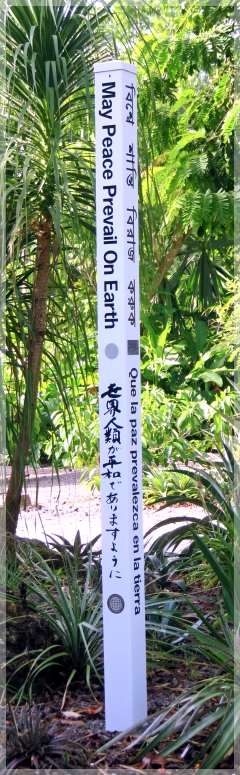
peace poleCOVID kept us from the Botanic Gardens for well over a year. When we finally returned to one of our favorite places, we came upon a peace pole planted among the palms, bamboo and bromeliads. Although a similar pole is in the city park downtown, I don’t remember seeing one here when last we visited. These poles are just two of the more than 250,000 that have been erected in over 180 nations.  Symbolizing the oneness of humanity, the words “May Peace Prevail on Earth” are written in eight different languages. The languages chosen for this pole were English, Arabic, Bengali, Chinese, Hawaiian, Hindi, Japanese, and Spanish—the languages of people who, like us, live at the 26th parallel north. Peace poles stand as a visual reminder to pray for peace on earth and to think, speak and act in the spirit of harmony and peace.

Forty years ago, the United Nations designated today as the annual International Day of Peace (commonly called World Peace Day). In 2011, the General Assembly unanimously voted to designate it as a day of cease-fire and non-violence. They ask every person and nation to halt hostilities and fighting for this one twenty-four-hour period. Unfortunately, I doubt the world can make one hour, let alone twenty-four, without aggression, hostility and bloodshed. Hopefully, you and I can go longer than twenty-four hours without conflict or violent behavior!

The causes of world conflict are many and, according to the UN, include poverty, social inequality, hunger, dwindling natural resources, water scarcity, environmental decline, disease, corruption, racism, and xenophobia (an intense fear of foreigners). This year’s theme, “Recovering Better for an Equitable and Sustainable World,” continues the UN’s focus on finding ways to overcome those causes. Indeed, as our world struggles to recover from what seems to be a never-ending pandemic, we can see how the underprivileged and marginalized have been hit the hardest. In the last eighteen months, we have seen both the best and the worst of our fellow travelers on this planet. This day is a reminder that instead of fighting with one another, we should join in fighting mankind’s common enemies!

As Christians, we have the peace of God—the peace that passes understanding—but we must be more than possessors of peace. Jesus calls us to be makers of peace but erecting a peace pole is not enough! We can start by bringing peace to our little corner of the world, beginning at home and then moving on to work, school, church and community. Our peacemaking efforts, however, can’t stop at the borders of our neighborhood or even our nation. We must take Christ’s message of peace out into the world by thinking, speaking, and acting in the cause of peace. While we each have an obligation to improve the various conditions that promote conflict, changing people’s circumstances is just a beginning. For true peace, the peace that is found in a relationship with God, we must change people’s hearts.

World peace, while a lofty goal, is not something I expect to see in my lifetime. Nevertheless, we each must do our part.

We hear much of love to God; Christ spoke much of love to man. We make a great deal of peace with heaven; Christ spoke much of peace on earth. [Henry Drummond]

I urge you, first of all, to pray for all people. Ask God to help them; intercede on their behalf, and give thanks for them. Pray this way for kings and all who are in authority so that we can live peaceful and quiet lives marked by godliness and dignity. [1 Timothy 2:1-2 (NLT)]

But the wisdom from above is first of all pure. It is also peace loving, gentle at all times, and willing to yield to others. It is full of mercy and the fruit of good deeds. It shows no favoritism and is always sincere. And those who are peacemakers will plant seeds of peace and reap a harvest of righteousness. [James 3:17-18 (NLT)]

Copyright ©2021 jsjdevotions. All rights reserved.

SOIL AND WATER

For the Lord is a great God, a great King above all gods. He holds in his hands the depths of the earth and the mightiest mountains. The sea belongs to him, for he made it. His hands formed the dry land, too. [Psalm 95:3-6 (NLT)]

Burgess Creek - Steamboat CO“The heavens proclaim the glory of God. The skies display his craftsmanship,” said the Psalmist. [19:1] It’s not just the heavens, however, that declare God’s glorious existence. Something as lowly as soil or as ordinary as water testify to His magnitude, creativity, skill, wisdom, and attention to detail, as well!
Unless we encounter an earthworm or beetle while digging in the garden, we probably think of soil as lifeless when, in actuality, it’s a dynamic living ecosystem. One handful of productive soil contains about 100 billion microorganisms of bacteria made up of about 10,000 different species. In that same handful of dirt are 100 meters of fungal cells of some 500 species of fungi, along with 20 million protozoa, 100,000 nematodes (unsegmented round worms) and 50,000 arthropods (like centipedes and microscopic mites), along with any earthworms and algae that may have tagged along. There are more living organisms in a handful of soil than there are human beings on our planet!

As small as all those microorganisms are, consider that one drop of water (.05mL) contains 1.67 sextillion molecules of H2O (that’s 21 zeroes). Smaller than those molecules are the more than 5 sextillion atoms of hydrogen and oxygen in those molecules! If we were counting the molecules of H2O in just ten drops of water (.17 oz.), we’d need 210 zeros (a quantity outnumbering the stars in the universe and all the organisms in the soil combined)! We really shouldn’t be surprised; after all, this is the same God who glued those beautiful microscopic scales on a butterfly’s wings (600 per square millimeter), dropped miniscule pollen grains (.006 mm) in the forget-me-not, and packed 100 billion neurons in the human brain.

We stand in awe at the enormity of the Grand Canyon, the striking colors of Yellowstone’s Grand Prismatic Spring, the red and orange hoodoos of Bryce Canyon, or the flood of water surging over Niagara Falls (757,500 gallons per second) without giving a thought to the atoms that make up every drop of that water or the microscopic life existing in the world beneath our feet. The heavens may declare His glory and existence but so does the rest of His magnificent creation!

All things bright and beautiful, All creatures great and small,
All things wise and wonderful: The Lord God made them all.
He gave us eyes to see them, And lips that we might tell
How great is God Almighty, Who has made all things well.
[Cecil F. Alexander]

They know the truth about God because he has made it obvious to them. For ever since the world was created, people have seen the earth and sky. Through everything God made, they can clearly see his invisible qualities—his eternal power and divine nature. So they have no excuse for not knowing God. [Romans 1:19-20 (NLT)]

Copyright ©2021 jsjdevotions. All rights reserved.

AT THE CROSS

Now, most people would not be willing to die for an upright person, though someone might perhaps be willing to die for a person who is especially good. But God showed his great love for us by sending Christ to die for us while we were still sinners. [Romans 5:7-8 (NLT)]

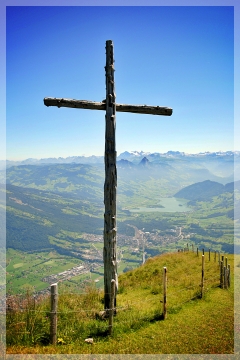
Mt. Rigi crossWhen driving on I-70 near Effingham, Illinois, you can’t miss seeing the 198-feet tall, 180-ton cross erected near the highway. Once America’s largest cross, its builders call it “a beacon of hope” to the over 50,000 travelers who pass by it each day. In 2018, Effingham’s cross was outdone when a 218-feet high cross was erected in Walnut Shade, Missouri. Near Branson and visible from Highway 65, because of its height, the FAA requires beacons on it. These two crosses, however, are small when compared to the world’s largest cross—the 500-feet tall Holy Cross from the Valley of the Fallen (Valle de los Caídos) in Spain or the 300-feet high Shrine of Valor in the Philippines.

Crucifixion was an extremely cruel form of execution that forced the condemned to suffer a prolonged agonizing death; it was such a horrible way to die that the Romans rarely used it on their own citizens. The disgrace and shame of crucifixion was used primarily for slaves and the worst kind of criminals and yet God allowed His only Son to endure the unbearable agony and horror of dying that way! Jesus’ torture began even before the cross when He was beaten with a flagrum (a short whip with pieces of bone and metal woven into its thongs), taunted by soldiers, had a crown of thorns driven into his head, beaten again and then dragged to his feet and made to carry the cross to the Golgotha. So battered, bloodied, and broken that He was unable to do so, Simon of Cyrene was called into duty. Once there, our Lord was stripped of his clothes and nailed to the cross. Before long, Jesus would have been unable to support himself with his legs. As his body’s weight was transferred to his arms, his shoulders would have been pulled from their sockets and breathing would have become extremely difficult. Without a doubt, it was a horrific and brutal way to die.

You’d never expect to see an electric chair, guillotine, or gallows erected as a monument and I question why we identify ourselves with something as grotesque as this ancient instrument of torture. Nevertheless, we wear crosses around our necks, place them on our walls, hang them in churches, set them on steeples, etch them into headstones, put them up as roadside memorials, and erect giant crosses that can been seen for miles. How did a symbol of disgrace, defeat, and suffering become a beacon of hope, triumph, and salvation?

I suppose the facetious answer to “Why the cross?” is that it’s too difficult to depict the empty tomb, a symbol which certainly would better represent the resurrected Christ! Yet, when we focus only on the resurrection and empty tomb, it’s easy to forget the suffering that preceded it. The cross of Jesus Christ is as essential to our faith as the empty tomb. Throughout his ministry, Jesus knew exactly what He was doing and the pain He would endure but it never deterred Him from His mission. He willingly suffered for all of us and it was His suffering and death on the cross that frees us from the penalty of sin. The cross represents the pardon for which a condemned criminal awaits, the forgiveness that none of us deserve, and the sacrifice of a perfect man for an imperfect people.

Until the 4th century, Christianity was illegal. Because of its close association with Jesus, Christ’s followers were scared to use the cross as a symbol because it exposed them to contempt, danger, and persecution. Oddly, it was Emperor Constantine’s vision of a cross in the sky that led to his conversion to Christianity in 312 AD. After seeing it, he vowed to worship no other god than the one the vision represented and he sought out church leaders to explain its meaning. The bishops explained that Jesus was the Son of God and the cross in Constantine’s vision symbolized Christ’s victory over death. In 313, Christianity was legalized and crucifixion was abolished. After that, rather than being a symbol of unspeakable horror, the cross became a symbol of victory.

I usually wear a small cross; when I place it around my neck, it reminds me that God sacrificed His only son for me and of the enormous price Jesus paid for my salvation. My life was purchased at a great cost to Him and the cross reminds me to whom it is I belong. It’s a daily reminder take up my cross and follow Him.

Then Jesus said to his disciples, “If any of you wants to be my follower, you must give up your own way, take up your cross, and follow me. If you try to hang on to your life, you will lose it. But if you give up your life for my sake, you will save it. [Matthew 16:24-25 (NLT)]

Copyright ©2021 jsjdevotions. All rights reserved.