THE PEACE POLE – WORLD PEACE DAY

God blesses those who work for peace, for they will be called the children of God. [Matthew 5:9 (NLT)]

Do all that you can to live in peace with everyone. … Don’t let evil conquer you, but conquer evil by doing good. [Romans 12:18,21 (NLT)]

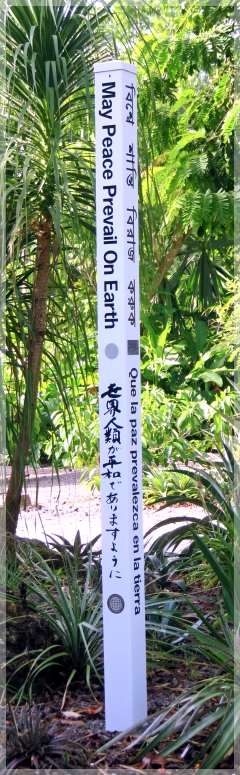
peace poleCOVID kept us from the Botanic Gardens for well over a year. When we finally returned to one of our favorite places, we came upon a peace pole planted among the palms, bamboo and bromeliads. Although a similar pole is in the city park downtown, I don’t remember seeing one here when last we visited. These poles are just two of the more than 250,000 that have been erected in over 180 nations.  Symbolizing the oneness of humanity, the words “May Peace Prevail on Earth” are written in eight different languages. The languages chosen for this pole were English, Arabic, Bengali, Chinese, Hawaiian, Hindi, Japanese, and Spanish—the languages of people who, like us, live at the 26th parallel north. Peace poles stand as a visual reminder to pray for peace on earth and to think, speak and act in the spirit of harmony and peace.

Forty years ago, the United Nations designated today as the annual International Day of Peace (commonly called World Peace Day). In 2011, the General Assembly unanimously voted to designate it as a day of cease-fire and non-violence. They ask every person and nation to halt hostilities and fighting for this one twenty-four-hour period. Unfortunately, I doubt the world can make one hour, let alone twenty-four, without aggression, hostility and bloodshed. Hopefully, you and I can go longer than twenty-four hours without conflict or violent behavior!

The causes of world conflict are many and, according to the UN, include poverty, social inequality, hunger, dwindling natural resources, water scarcity, environmental decline, disease, corruption, racism, and xenophobia (an intense fear of foreigners). This year’s theme, “Recovering Better for an Equitable and Sustainable World,” continues the UN’s focus on finding ways to overcome those causes. Indeed, as our world struggles to recover from what seems to be a never-ending pandemic, we can see how the underprivileged and marginalized have been hit the hardest. In the last eighteen months, we have seen both the best and the worst of our fellow travelers on this planet. This day is a reminder that instead of fighting with one another, we should join in fighting mankind’s common enemies!

As Christians, we have the peace of God—the peace that passes understanding—but we must be more than possessors of peace. Jesus calls us to be makers of peace but erecting a peace pole is not enough! We can start by bringing peace to our little corner of the world, beginning at home and then moving on to work, school, church and community. Our peacemaking efforts, however, can’t stop at the borders of our neighborhood or even our nation. We must take Christ’s message of peace out into the world by thinking, speaking, and acting in the cause of peace. While we each have an obligation to improve the various conditions that promote conflict, changing people’s circumstances is just a beginning. For true peace, the peace that is found in a relationship with God, we must change people’s hearts.

World peace, while a lofty goal, is not something I expect to see in my lifetime. Nevertheless, we each must do our part.

We hear much of love to God; Christ spoke much of love to man. We make a great deal of peace with heaven; Christ spoke much of peace on earth. [Henry Drummond]

I urge you, first of all, to pray for all people. Ask God to help them; intercede on their behalf, and give thanks for them. Pray this way for kings and all who are in authority so that we can live peaceful and quiet lives marked by godliness and dignity. [1 Timothy 2:1-2 (NLT)]

But the wisdom from above is first of all pure. It is also peace loving, gentle at all times, and willing to yield to others. It is full of mercy and the fruit of good deeds. It shows no favoritism and is always sincere. And those who are peacemakers will plant seeds of peace and reap a harvest of righteousness. [James 3:17-18 (NLT)]

Copyright ©2021 jsjdevotions. All rights reserved.

SOIL AND WATER

For the Lord is a great God, a great King above all gods. He holds in his hands the depths of the earth and the mightiest mountains. The sea belongs to him, for he made it. His hands formed the dry land, too. [Psalm 95:3-6 (NLT)]

Burgess Creek - Steamboat CO“The heavens proclaim the glory of God. The skies display his craftsmanship,” said the Psalmist. [19:1] It’s not just the heavens, however, that declare God’s glorious existence. Something as lowly as soil or as ordinary as water testify to His magnitude, creativity, skill, wisdom, and attention to detail, as well!
Unless we encounter an earthworm or beetle while digging in the garden, we probably think of soil as lifeless when, in actuality, it’s a dynamic living ecosystem. One handful of productive soil contains about 100 billion microorganisms of bacteria made up of about 10,000 different species. In that same handful of dirt are 100 meters of fungal cells of some 500 species of fungi, along with 20 million protozoa, 100,000 nematodes (unsegmented round worms) and 50,000 arthropods (like centipedes and microscopic mites), along with any earthworms and algae that may have tagged along. There are more living organisms in a handful of soil than there are human beings on our planet!

As small as all those microorganisms are, consider that one drop of water (.05mL) contains 1.67 sextillion molecules of H2O (that’s 21 zeroes). Smaller than those molecules are the more than 5 sextillion atoms of hydrogen and oxygen in those molecules! If we were counting the molecules of H2O in just ten drops of water (.17 oz.), we’d need 210 zeros (a quantity outnumbering the stars in the universe and all the organisms in the soil combined)! We really shouldn’t be surprised; after all, this is the same God who glued those beautiful microscopic scales on a butterfly’s wings (600 per square millimeter), dropped miniscule pollen grains (.006 mm) in the forget-me-not, and packed 100 billion neurons in the human brain.

We stand in awe at the enormity of the Grand Canyon, the striking colors of Yellowstone’s Grand Prismatic Spring, the red and orange hoodoos of Bryce Canyon, or the flood of water surging over Niagara Falls (757,500 gallons per second) without giving a thought to the atoms that make up every drop of that water or the microscopic life existing in the world beneath our feet. The heavens may declare His glory and existence but so does the rest of His magnificent creation!

All things bright and beautiful, All creatures great and small,
All things wise and wonderful: The Lord God made them all.
He gave us eyes to see them, And lips that we might tell
How great is God Almighty, Who has made all things well.
[Cecil F. Alexander]

They know the truth about God because he has made it obvious to them. For ever since the world was created, people have seen the earth and sky. Through everything God made, they can clearly see his invisible qualities—his eternal power and divine nature. So they have no excuse for not knowing God. [Romans 1:19-20 (NLT)]

Copyright ©2021 jsjdevotions. All rights reserved.

AT THE CROSS

Now, most people would not be willing to die for an upright person, though someone might perhaps be willing to die for a person who is especially good. But God showed his great love for us by sending Christ to die for us while we were still sinners. [Romans 5:7-8 (NLT)]

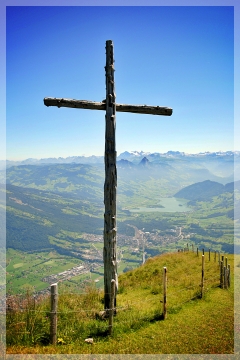
Mt. Rigi crossWhen driving on I-70 near Effingham, Illinois, you can’t miss seeing the 198-feet tall, 180-ton cross erected near the highway. Once America’s largest cross, its builders call it “a beacon of hope” to the over 50,000 travelers who pass by it each day. In 2018, Effingham’s cross was outdone when a 218-feet high cross was erected in Walnut Shade, Missouri. Near Branson and visible from Highway 65, because of its height, the FAA requires beacons on it. These two crosses, however, are small when compared to the world’s largest cross—the 500-feet tall Holy Cross from the Valley of the Fallen (Valle de los Caídos) in Spain or the 300-feet high Shrine of Valor in the Philippines.
Crucifixion was an extremely cruel form of execution that forced the condemned to suffer a prolonged agonizing death; it was such a horrible way to die that the Romans rarely used it on their own citizens. The disgrace and shame of crucifixion was used primarily for slaves and the worst kind of criminals and yet God allowed His only Son to endure the unbearable agony and horror of dying that way! Jesus’ torture began even before the cross when He was beaten with a flagrum (a short whip with pieces of bone and metal woven into its thongs), taunted by soldiers, had a crown of thorns driven into his head, beaten again and then dragged to his feet and made to carry the cross to the Golgotha. So battered, bloodied, and broken that He was unable to do so, Simon of Cyrene was called into duty. Once there, our Lord was stripped of his clothes and nailed to the cross. Before long, Jesus would have been unable to support himself with his legs. As his body’s weight was transferred to his arms, his shoulders would have been pulled from their sockets and breathing would have become extremely difficult. Without a doubt, it was a horrific and brutal way to die.

You’d never expect to see an electric chair, guillotine, or gallows erected as a monument and I question why we identify ourselves with something as grotesque as this ancient instrument of torture. Nevertheless, we wear crosses around our necks, place them on our walls, hang them in churches, set them on steeples, etch them into headstones, put them up as roadside memorials, and erect giant crosses that can been seen for miles. How did a symbol of disgrace, defeat, and suffering become a beacon of hope, triumph, and salvation?

I suppose the facetious answer to “Why the cross?” is that it’s too difficult to depict the empty tomb, a symbol which certainly would better represent the resurrected Christ! Yet, when we focus only on the resurrection and empty tomb, it’s easy to forget the suffering that preceded it. The cross of Jesus Christ is as essential to our faith as the empty tomb. Throughout his ministry, Jesus knew exactly what He was doing and the pain He would endure but it never deterred Him from His mission. He willingly suffered for all of us and it was His suffering and death on the cross that frees us from the penalty of sin. The cross represents the pardon for which a condemned criminal awaits, the forgiveness that none of us deserve, and the sacrifice of a perfect man for an imperfect people.

Until the 4th century, Christianity was illegal. Because of its close association with Jesus, Christ’s followers were scared to use the cross as a symbol because it exposed them to contempt, danger, and persecution. Oddly, it was Emperor Constantine’s vision of a cross in the sky that led to his conversion to Christianity in 312 AD. After seeing it, he vowed to worship no other god than the one the vision represented and he sought out church leaders to explain its meaning. The bishops explained that Jesus was the Son of God and the cross in Constantine’s vision symbolized Christ’s victory over death. In 313, Christianity was legalized and crucifixion was abolished. After that, rather than being a symbol of unspeakable horror, the cross became a symbol of victory.

I usually wear a small cross; when I place it around my neck, it reminds me that God sacrificed His only son for me and of the enormous price Jesus paid for my salvation. My life was purchased at a great cost to Him and the cross reminds me to whom it is I belong. It’s a daily reminder take up my cross and follow Him.

Then Jesus said to his disciples, “If any of you wants to be my follower, you must give up your own way, take up your cross, and follow me. If you try to hang on to your life, you will lose it. But if you give up your life for my sake, you will save it. [Matthew 16:24-25 (NLT)]

Copyright ©2021 jsjdevotions. All rights reserved.

GETTING OUT OF THE PIT

Dear brothers and sisters, when troubles of any kind come your way, consider it an opportunity for great joy. For you know that when your faith is tested, your endurance has a chance to grow. So let it grow, for when your endurance is fully developed, you will be perfect and complete, needing nothing. … God blesses those who patiently endure testing and temptation. Afterward they will receive the crown of life that God has promised to those who love him. [James 1:2-4,12 (NLT)]

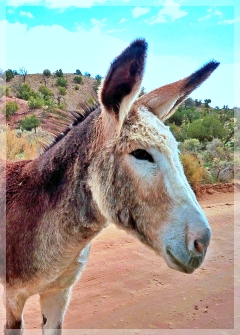
donkeyThe story is told of a donkey who fell into a deep pit. Unable to get out, the animal brayed loudly until the farmer came to investigate. Seeing no way to get his donkey out of the pit, the farmer decided the only thing he could do was to put the poor animal out of its misery. Since the pit needed to be filled anyway, he got a spade and started to shovel dirt into it. When the donkey felt those first clods of dirt on his back, he lost all hope of rescue and brayed even louder. As he shook the dirt off his back, however, he discovered a growing mound of dirt beneath his feet. Seeing a possible solution, the donkey grew silent as he continued to shake dirt off his back and started tamping it down with his hooves. As the dirt piled up beneath his feet, the donkey got higher and higher in the pit. Paying no attention to the now silent animal, the farmer kept shoveling until he finally stopped for a rest. When he turned around, the man was shocked to see the donkey step out of the pit and trot away. The animal could have chosen to wallow in his misery—simply hung his head and let that dirt cover him up—but he didn’t. Instead, he took steps to change his situation.

Giving up is often our first response when we get buried in our troubles. Deciding the marriage can’t be saved, the situation is hopeless, we’ll never beat the addiction, we’re worthless sinners, we failed, no one understands, or that the pain will never end, we don’t even try to find a fix! That, however, means we’ve ceded control of our lives to something or someone other than God. By giving up, we’ve stopped living God’s will because we’re not letting Him shape and mold us in our circumstances. God’s not done with us until He says so!

When I look back at some of my worst experiences, heaviest trials, and most heartbreaking times, I see my greatest emotional and spiritual development. Growth seems to occur in the valleys (or pits) rather than on the hilltops. Perhaps that’s because we want to maintain the status quo in the good times; when all is going smoothly, we certainly don’t want to rock the boat with any change. Bad times, however, make us as uncomfortable as that trapped animal. Like the donkey, when we are buried in trouble, we have a choice: wallow in misery or make a change.

Instead of letting the dirt bury him, the donkey turned it into a gift. We can see our troubles as penalties or gifts, endings or beginnings, impediments or opportunities. The choice is ours. Life is always going to try to weigh us down; the trick is in deciding to get out of the pit. The donkey did it by shaking off the dirt. As people of hope who know that Jesus can do within us that which we can’t do for ourselves; let us do the same!

We are always on the anvil; by trials God is shaping us for higher things. [Henry Ward Beecher]

We can rejoice, too, when we run into problems and trials, for we know that they help us develop endurance. And endurance develops strength of character, and character strengthens our confident hope of salvation. And this hope will not lead to disappointment. For we know how dearly God loves us, because he has given us the Holy Spirit to fill our hearts with his love. [Romans 5:3-5 (NLT)]

Copyright ©2021 jsjdevotions. All rights reserved.

THE RAINBOW’S END

And I am convinced that nothing can ever separate us from God’s love. Neither death nor life, neither angels nor demons, neither our fears for today nor our worries about tomorrow—not even the powers of hell can separate us from God’s love. No power in the sky above or in the earth below—indeed, nothing in all creation will ever be able to separate us from the love of God that is revealed in Christ Jesus our Lord. [Romans 8:38-39 (NLT)]

rainbowDays bled into weeks, weeks into months, and every day seemed the same for much of the last eighteen months. Life became a series of postponements, rebookings, cancelations, setbacks, inconveniences, letdowns, and disappointments. Visiting Grandma meant waving at her through a window, final farewells were FaceTime calls on a nurse’s cell phone, and we mourned from a distance while attending celebrations of life virtually. Weddings were postponed, family reunions put on hold, shut-downs and travel restrictions kept loved ones apart, theaters and concert halls went dark, vacations were delayed, businesses closed, jobs were lost, and junior year abroad became junior year on Zoom.

Many of us had something specific to which we looked forward in the COVID-free future. It was anticipation of that reward that helped sustain us through the dreary months. When vaccines rolled out and numbers dropped, we began to think the end was in sight and we finally saw the end of the rainbow! Plans resumed for family reunions, the delayed semester abroad, or the cruise of a lifetime. Vacations were scheduled, wedding venues rebooked, businesses set dates for returning to the office, and nursing homes and hospitals again allowed visitors. With the surge in cases and the return of restrictions, however, many of those plans have been pushed back yet again or cancelled altogether. We’re frustrated and disappointed because the future we hoped for isn’t the one we got!

In C.S. Lewis’ The Screwtape Letters, the demon Screwtape strategizes with his nephew Wormwood on methods of capturing a young man’s soul. The senior demon suggests using time as a weapon. Screwtape explains that the “enemy” (God) wants man to focus on only two times: eternity (which means attending to God) or the present in meditation, obedience, service, receiving grace, or giving thanks. Having found tempting someone to live in the past to be of “limited value,” Screwtape advises a far better approach is to tempt the man to attend to the future. God, he says, “does not want men to give the future their hearts, to place their treasure in it,” but the demons definitely do! He adds that, “We want a whole race perpetually in pursuit of the rainbow’s end.” Rather than being faithful, kind, happy, or thankful in the present, the demons want people to miss the gifts of the present day while looking for them in the future. “Gratitude,” says Screwtape, “looks to the past and love to the present,” but, the demon adds, it is things like fear, desire, greed, materialism, and ambition that look to the future.

As Christians, we can’t let our disappointment in the future we’d anticipated dominate our life or cause us to lose hope. Keeping our eyes on the real hope found in eternity with God, let’s not allow our disappointment in tomorrow steal today’s joy. As followers of Jesus, we live with a hope that isn’t dependent on pandemics, positivity rates, restrictions, weather, or finances because we know how the story ends. Yes, we’re disappointed now but, ultimately, we won’t be disappointed by what God has waiting for us.

Yesterday is gone. Tomorrow has not yet come. We have only today. Let us begin.  [Mother Teresa]

That is why we never give up. Though our bodies are dying, our spirits are being renewed every day. For our present troubles are small and won’t last very long. Yet they produce for us a glory that vastly outweighs them and will last forever! So we don’t look at the troubles we can see now; rather, we fix our gaze on things that cannot be seen. For the things we see now will soon be gone, but the things we cannot see will last forever. [2 Corinthians 4:16-18 (NLT)]

Copyright ©2020 jsjdevotions. All rights reserved.

DRY BONES

Taos NMThen he said to me, “Speak a prophetic message to these bones and say, ‘Dry bones, listen to the word of the Lord! This is what the Sovereign Lord says: Look! I am going to put breath into you and make you live again! I will put flesh and muscles on you and cover you with skin. I will put breath into you, and you will come to life. Then you will know that I am the Lord.’” [Ezekiel 37:4-6 (NLT)]

The Jewish people were in despair. Jerusalem was in ruins and the Temple destroyed. Exiled to Babylon, they were without a king, homeland, or hope. God’s promise of Israel’s restoration is depicted in Ezekiel 37 when the prophet is transported in a vision to a valley filled with desiccated bones. The Lord instructs Ezekiel to speak a prophecy over the dry bones that the Lord will bring them back to life. As the prophet begins to speak God’s words, the bones start rattling and coming together as skeletons. The prophet watches as muscles, tendons, and skin cover the bones until they became fully formed bodies. Although the bodies look alive, they are no more than unbreathing corpses until the Lord instructs Ezekiel to tell the four winds to breathe life into the lifeless beings. As the prophet speaks God’s words, he witnesses the once dead bodies come alive, stand erect, and become a great army. The initial meaning is pretty obvious: the bones coming back together illustrate Israel’s restoration and the wind or breath entering the dead bodies illustrate spiritual renewal or rebirth.

Be that as it may, as a Sunday schooler who didn’t understand the story behind Ezekiel’s somewhat eerie vision, picturing those dry bones rattling and rising up gave me the creeps. Perhaps it was because of the children’s song Dem Dry Bones. Even though we sang it in Sunday school, the song was associated more with Halloween (and its ghosts and goblins) than Biblical prophecy. Sometimes, a second verse was added in which Ezekiel, after connecting those bones, disconnected them—not a pleasant visual for any child! Perhaps I’d simply seen too many Saturday matinees with zombies, mummies, or other creatures of the night. Not understanding the context behind Ezekiel’s prophecy, the whole vision seemed as macabre as does the Body Worlds exhibit that features real skinless corpses preserved in plastic.

Yesterday’s devotion mentioned how I enjoy listening to worship music on my frequent trips to and from my doctor’s appointments. When I first heard Elevation Worship’s Rattle, with its words, “And the bones began to rattle, rattle, rattle, rattle…This is the sound of dry bones rattling,” I initially thought of Ezekiel’s vision. The thought of hearing dry bones rattling immediately brought up the old ghoulish images from childhood. But, as I listened to the rest of their words, those bones weren’t the dry ones in Ezekiel’s vision. As they sang, “Saturday was silent, Surely it was through. … Friday’s disappointment is Sunday’s empty tomb,” I understood they were singing about Jesus rising from the grave and the renewal of life for those who are restored by His power.

Today, I returned to Ezekiel 37 and saw his vision as more than a simple prophecy of the people’s return from their exile in Babylon, the reconstitution of the modern state of Israel, and/or the end times and the second coming of Christ. I saw it as a beautiful story of hope and rebirth. Although the prophecy was for Israel, I see Ezekiel’s vision as an illustration of what God can do for and with us right now—the life-giving power of His word to put back together the pieces of our broken lives and the power of the Spirit’s breath to bring us back to spiritual life! No longer will I cringe at the thought of dry bones rattling and rising. They tell me that no one ever is beyond restoration—no one is ever so spiritually dead that he or she can’t come alive again. The rattle of dry bones will remind me that, without the resurrection power of Jesus and the breath of the Spirit, we are little more than dry bones in a valley.

No difficulties in your case can baffle him, no dwarfing of your growth in years that are past, no apparent dryness of your inward springs of life, no crookedness or deformity in any of your past development, can in the least mar the perfect work that he will accomplish, if you will only put yourselves absolutely into his hands and let him have his own way with you. [ Hannah Whitall Smith]

Jesus told her, “I am the resurrection and the life. Anyone who believes in me will live, even after dying. Everyone who lives in me and believes in me will never ever die. [John 11:25-26 (NLT)]

Copyright ©2021 jsjdevotions. All rights reserved.