
For everyone has sinned; we all fall short of God’s glorious standard. [Romans 3:23 (NLT)]
 When I was in college, most of the girls in my sorority house played bridge. After watching a few games, newcomers would sit in and learn from the more experienced players as they played. We novices lost a lot of games in the process but, eventually, we became good players. One friend, however, wanted to start as an expert. She sat alone in her room with a deck of cards and a bridge book trying to teach herself. Unwilling to make rookie mistakes, she wouldn’t play a hand until she was a skilled player; that day never came. She wasn’t much different from the people who say they’ll join a gym once they’ve gotten in better shape; rarely does that day come either.
Bridge is an experience-based game; in order to get good at it, you have to be willing to be bad at first. No one starts by winning every hand just like no one begins at the gym as fit as ninja stunt-woman Jessie Graff or The Titan Games’ Dwayne “the Rock” Johnson. Even the legendary Charles Atlas started out as a “97-pound weakling.”
Just as feeling incompetent might keep us from playing a card game or feeling uncomfortable in spandex can keep us from the gym, being weighed down with self-judgment, shame and feelings of inadequacy can keep us from God and fellowship with our sisters and brothers in Christ. Some people think they can’t come to church until their lives are less messy or their addiction under control while others think they can’t join a small group or do a Bible study because they don’t know enough Scripture or are in the midst of a divorce. God doesn’t require life masterpoints to come to His table nor does He expect the power and strength of competitive athletes. Rather than a country club for saints, His church is a hospital for sinners!
Romans 3:23 confirms what we all know; we’re sinners and not a one of us meets God’s glorious standard. The enemy wants us to stop reading right there. Whispering, “You’re not good enough,” he wants us filled with regret, self-doubt, and guilt so that we’re unwilling to bare our shabby souls before God. He wants us to believe that we’ll never be good enough to enter God’s presence, come before Him with our prayers, enjoy fellowship with His Son, be His son or daughter, or eat at His table. The enemy is partially right; there’s nothing we can do on our own to be good enough. The work Jesus did on the cross would have no value if we could make ourselves learn, earn, or work our way into God’s presence! The good news is found in the rest of Paul’s letter to the Romans: it’s the power of Jesus that makes us good enough to come into God’s presence and do His work!
Good enough, however, is not perfect and we will continue to have shortcomings. Like playing bridge, walking with Jesus is experience-based and we’ll make plenty of mistakes in the journey. But, if we keep at it, we’ll get better. Like the trainer at the gym, Jesus welcomes us as 97-pound weaklings but He doesn’t expect us to stay that way. Like any trainer, He’s going to challenge us to become stronger and better. Remember, God loved us so much that He gave His only son for our salvation. If that’s good enough for Him, it’s good enough for me.
Why God should choose the meanest, basest, most unworthy individuals with absolutely nothing to commend them at all to God, except their miserable, lost condition, and then exalt them to become the sons of God, members of the divine family, and use them for His glory, is beyond all reason and human understanding. Yet that is grace. [M.R. DeHaan]
 A suspicious spot was removed at my annual dermatology appointment. When the biopsy indicated cancer, I had Mohs surgery to remove it. In Mohs, the tissue is sliced off in stages and examined by the pathologist to determine if (and where) any cancerous tissue remains. If it does, the surgeon removes the next layer of tissue, the pathologist examines it, and the process continues until no cancer cells remain. While it’s a time-consuming process, Mohs spares healthy tissue while eradicating all of the cancer.
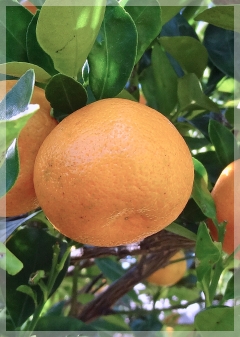 “What’s your orange?” the teacher asked her remote learning class. Before having them answer, she explained the “monkey trap.” In Southeast Asia, hunters capture monkeys by drilling a hole in a pumpkin. The hole is just large enough for a monkey’s hand but too small for his fist. They secure the pumpkin to a tree, put a piece of sweet juicy orange inside the gourd, then retreat and wait. Eventually, an unsuspecting monkey comes along, smells the orange, and reaches through that small hole into the pumpkin. Once he’s grabbed hold of the orange, however, his fist can’t get back through the same hole. The monkey pulls and pulls but can’t free his hand. While he’s struggling to pull out his orange-filled fist, hunters easily throw a net over him. Not understanding that he can’t have both his freedom and the orange, he loses them both. After telling this story, the teacher again asked her students, “What is your orange? What is it you can’t release?”
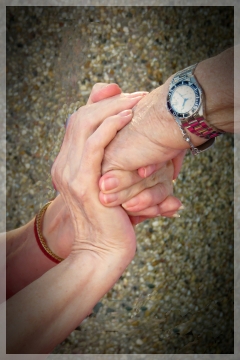 While social distancing has put an end to breaking bread with friends and holding hands while sharing a table blessing, I recall a dinner several years ago when I held the hand of our pastor’s wife during grace. For a small woman, her hands were larger and stronger than I expected. After grace, I looked at them and, comparing her youthful hands with mine, admit to feeling a twinge of envy. Like her, I played the piano but, unlike her, I could barely span an octave. Her sturdy hands had incredible reach and, unhampered by arthritis, there was power in her touch on the keyboard. I was overwhelmed by the strength of her hands and the beautiful way she uses them to praise the Lord as the worship leader at our mountain church.
 Blessed are the peacemakers, for they will be called children of God. [Matthew 5:9 (NIV)]
 Jesus was never one to follow man-made rules and, when He spoke with the woman at the well, He broke several. Jewish tradition considered it beneath any man’s dignity to publicly speak with a woman. Rabbinical writing taught: “Let no one talk with a woman in the street, no not with his own wife.” That a rabbi like Jesus did such a thing was scandalous. Those same writings considered women incapable of religious instruction with these words: “Rather burn the sayings of the law than teach them to women.” Jesus speaking of God with a Samaritan woman just made it more outrageous! But, we know from His interactions with women like Martha, Mary, and Mary Magdalene that Jesus wasn’t much for rabbinic tradition so His speaking with this Samaritan woman shouldn’t surprise us.
 Devotions of the Heart