
The next day he saw Jesus coming toward him, and said, “Behold, the Lamb of God, who takes away the sin of the world! … And John bore witness: “I saw the Spirit descend from heaven like a dove, and it remained on him. I myself did not know him, but he who sent me to baptize with water said to me, ‘He on whom you see the Spirit descend and remain, this is he who baptizes with the Holy Spirit.’ And I have seen and have borne witness that this is the Son of God.” [John 1:29,32-34 (ESV)]
After Jesus’ baptism, John the Baptizer seemed so sure that Jesus was the Christ, the promised Messiah! More than a year later, what caused him to wonder—to doubt what he’d seen, heard, and come to believe?
 At the time, Herod Antipas was the Tetrarch of Galilee and Perea. While married to the daughter of Aretas IV, king of Nabatea, Antipas visited his half-brother, Herod Philip and his wife Herodias (who was the daughter of another half-brother, Herod Aristobulus) in Rome. While there, Antipas became enamored with his brother’s wife. After divorcing their spouses, he and Herodias married and lived in Herod’s palace with Herodias’ daughter Salome. Their divorces and marriage were politically explosive and religiously scandalous and John the Baptizer was outspoken in his condemnation of their incestuous sinful relationship. While marrying a niece wasn’t uncommon, Mosaic law prohibited marrying a brother’s wife except in what was called a “levirate marriage” when a brother died childless. Philip, however, was very much alive at the time! Both Herod Antipas’ reputation and his political security were threatened by John’s public condemnation of his marriage as well as his Messianic message.
To silence the Baptizer, Herod imprisoned him underground at his palace in Macherus. Although John was silenced and out of the public eye, Herodias wanted him dead. Fearing a riot if the beloved holy man were to die, Antipas resisted his wife’s pleas. While Scripture is unclear, scholars believe John languished in his dark cell for about 15 months before Herod Antipas was tricked into ordering the Baptizer’s execution.
During the Baptizer’s imprisonment, his disciples visited him with news of Jesus. Like the rest of his countrymen, John probably expected a very different Messiah than the One who came. John preached in the wilderness; Jesus preached in homes, synagogues, cities, the countryside, and even the Temple. John lived the ascetic life of a Nazarene; Jesus freely mixed with people and openly ate and drank with tax collectors and other sinners. John spoke of repentance, God’s wrath, and a day of judgment and fire; Jesus spoke of love, forgiveness, the Kingdom of Heaven, and the ”year of the Lord’s favor.” Jesus and his disciples didn’t even fast the way John and his disciples did! Did John wonder why Jesus hadn’t proclaimed Himself the Messiah and King of Israel? Most of all, did John wonder why Jesus hadn’t freed him from prison?
Those 15 months were a long time to sit in the dark—a long time for doubts to creep into John’s mind. As the months wore on, John realized that nothing short of a miracle was going to free him but the miracle he hoped for wasn’t coming. It’s no wonder the man who once was so sure Jesus was the Christ sent his disciples to ask Jesus if he were the Messiah.
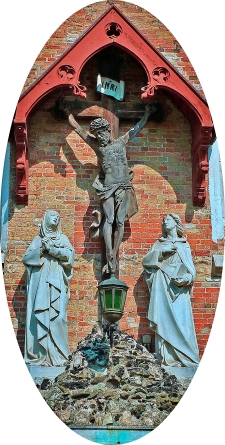
 After pointing out Jesus as the “Lamb of God,” some of John the Baptizer’s disciples left John to follow Jesus. Later, John’s remaining disciples reported that Jesus was baptizing (it actually was His disciples) and wanted to know whose purification ritual of baptism was valid. With many turning from John to Jesus, the Baptizer’s disciples were confused, concerned, and probably a little envious. Apparently, they forgot that John’s original mission was that of forerunner—the one who would prepare the way for the Messiah and point the way to the Lamb of God. Knowing that he wasn’t the bridegroom but only His friend, the Baptizer humbly affirmed his position by telling his disciples that Jesus must become more prominent while he became less and less important. J.C. Ryle likened the Baptizer’s role to that of a star growing paler and paler as the sun rises until the star completely disappears in the light of the sun. John clearly understood that he was to fade in the light of the Son.
 Along the road to the Serengeti, somewhere near the Olduvai Gorge in Tanzania, is a crescent-shaped sand dune. Measuring about 30-feet in height and 328-feet long along its curves, it is known as the Shifting Sands. Rich in iron and highly magnetized, the sand sticks to itself when tossed in the air. When the wind blows, its particles fall back on the dune rather than get carried away by the breeze. The dune, however, is constantly on the move as the prevailing winds slowly move the entire thing across the land. Moving about 50-feet a year, it’s believed that the Shifting Sands have been traveling the savannah for more than three thousand years, sometimes changing both shape and direction. Of course, the dune moves so gradually that you don’t see its motion. Nevertheless, stakes in the ground indicate its location in previous years.
 Following the Parable of the Sower and the Soils, Jesus told another parable about the coming of the Kingdom. In the Parable of the Weeds, after the farmer plants wheat, his enemy sows weeds in the same field. Jesus’ hearers would have known the weed likely was darnel. Called wheat’s “evil twin,” it looks and behaves much like wheat. When wheat is consumed it gives life but, when darnel is consumed, this inedible look-alike causes nausea and even death. Sowing weeds in a field was an act of sabotage and Roman law specifically prohibited doing so with darnel. When nations went to war, agricultural vandalism was a common practice. Olive trees were cut down, grape vines destroyed, and fields were salted so nothing would grow.
 As we came together in worship, each of us bringing the Lord our own private sins, sorrows, doubts, and fears, the hymn’s words, “Just as I am… I come, I come,” seemed a fitting way to start the service. Because its heartfelt words are so relatable, Just as I Am is one of my favorite hymns. Curious about its origin, I learned that its words were written by a Victorian hymn writer named Charlotte Elliott. The daughter of an evangelist, she suffered a serious illness at the age of 32 that left her an invalid for the rest of her life. Angry about what she perceived as uselessness because of her disability, Elliott became severely depressed and spiritually lost. After a visiting minister counseled her to come to Jesus, she asked how she could come to Him when all she had was her anger, sadness, questions, and broken body. The clergyman’s response was simple: “Come to Him just as you are.” Although she gave her life to Christ at that time, she continued to be plagued by depression.
 Devotions of the Heart