APPROVAL RATINGS

Obviously, I’m not trying to win the approval of people, but of God. If pleasing people were my goal, I would not be Christ’s servant. [Galatians 1:10 (NLT)]

green heronThe email from my dentist asked, “Would you recommend us?” When I answered in the affirmative, I was hyperlinked to a site that added my five-star rating to that of other patients. The following day, I received a longer survey regarding my recent visit. Once done, it again asked if I would recommend his services and requested use of my name in an on-line testimonial. It’s clear that my dentist wants more than feedback; he wants the public approval of his patients. Although I like him, I like my privacy more, so I declined!

Like my dentist, we all want to be noticed, liked, approved, applauded, and endorsed but, unlike him, we probably don’t employ a company to do surveys for us. Nevertheless, we tend to measure approval in other ways—the website’s metrics, “friends” on Facebook/Meta, and followers on Twitter/X, Instagram, TikTok, or Snapchat. Approval is determined by the number of compliments received, memberships (and offices held) in various organizations, honors awarded, likes on the posting, hearts on the text, or the quantity of Christmas and birthday cards received and invitations extended or accepted. We judge admiration on the number and expense of gifts we get, the reviews on Yelp or Trip Advisor, the size of the obituary, and the length of the line offering condolences at the funeral home.

Of course, it’s only natural to want the admiration of our family, friends, peers, and employers. Nevertheless, we must never seek their approval at the expense of pleasing God. When Saul initiated a sacrifice rather than wait for Samuel, he was seeking his men’s approval rather than God’s; as a result, he lost his kingdom. When we seek the approval of others, God does not approve! According to the Apostle John, many Jewish leaders would not admit their faith in Jesus for fear of being put out of their synagogues because they “loved human praise more than the praise of God.” Jesus warned us about trying to impress people with our righteousness by putting on a show of our giving, praying, or fasting. While we might be praised by others, the One who sees into our hearts is not impressed.

In Bill Watterson’s comic Calvin & Hobbes, there were several instances (usually after having been disciplined or given a chore) when the precocious Calvin informed his father that his approval ratings were dangerously low, especially among six-year-olds and stuffed tigers. To Calvin’s surprise, his dad seemed unconcerned about his approval ratings’ ups and downs. Like this wise comic strip father, we can’t let approval ratings determine our behavior! As much as we want to be liked and admired, Jesus made it clear that we must not seek the approval of people rather than that of God! Our job is to please Him and His approval rating is the only one that truly counts!

When we try to please both the world and God, the interests of our two masters eventually will collide. When that happens, and it will, whose approval will we seek—man’s or God’s?

Fear of man is the enemy of the fear of the Lord. The fear of man pushes us to perform for man’s approval rather than according to God’s directives. [Paul Chappell]

For we speak as messengers approved by God to be entrusted with the Good News. Our purpose is to please God, not people. He alone examines the motives of our hearts. [1 Thessalonians 2:4 (NLT)]

No one can serve two masters. For you will hate one and love the other; you will be devoted to one and despise the other. [Matthew 6:24a (NLT)]

Copyright ©2024 jsjdevotions. All rights reserved.

ASKING QUESTIONS – PART 2

“Are You the Coming One, or are we to look for someone else?” Jesus answered and said to them, “Go and report to John what you hear and see: those who are blind receive sight and those who limp walk, those with leprosy are cleansed and those who are deaf hear, the dead are raised, and the poor have the gospel preached to them. And blessed is any person who does not take offense at Me.” [Matthew 11:3-6 (NASB)]

canna - bandana of the evergladesHaving quoted from Isaiah when proclaiming the Messiah’s arrival, we know John knew Isaiah’s prophecies. The Messiah would “bind up the brokenhearted [and] proclaim liberty to captives and freedom to prisoners,” [61:1] but, after spending more than a year confined to a dark cell, John had neither liberty nor freedom. It’s no wonder he doubted.

While Jesus’ answer to the Baptizer’s question seems cryptic to us, it would have made perfect sense to John. By pointing to the facts, Jesus affirmed that the days of salvation had begun. Although he was using His Messianic power in a way John hadn’t envisioned, Jesus was fulfilling the Messianic promises of Isaiah 35, 42, and 61. Jesus was, indeed, the Christ! When John’s disciples returned with a report of Jesus’ words and actions, the Baptizer’s questions were answered and his doubts erased.

Encouraging John not to give in to despair or abandon his faith, Jesus added a blessing to His message: “And blessed is any person who does not take offense at Me.” Calling this the “forgotten Beatitude,” Vines Expository Bible Notes paraphrased His words as, “Blessed is the person who does not get upset by the way I [God] handle my business.”

What follows, however, is somewhat unexpected. Lest the people think less of John for his imprisonment and doubt, Jesus bore witness to the prophet and praised him. Declaring him to be a true prophet who spoke directly for God, Jesus affirmed that John was the returning Elijah, the one to announce the Day of the Lord, and the greatest of the Old Covenant’s prophets! Clearly, John’s doubt did not diminish Jesus’ respect and love for him!

While we probably aren’t languishing in a prison cell, we will have doubts. Things happen that make our confidence waver and we begin to question things we’ve come to believe. No matter how deep our faith or how long we’ve followed Jesus, doubts and questions will arise from time to time—especially when we’re in the dark places of pain, persecution, injustice, loss, disappointment, isolation, or failed expectations.

When we can’t see or understand God’s plan, like John, we tend to doubt Him. Doubt, however, is not the same as unbelief because, like John, doubt seeks an answer when unbelief doesn’t. The Psalmists certainly weren’t shy about expressing their feelings and asking God questions. “Why do You stand far away, Lord? Why do You hide Yourself in times of trouble?” [10:1] “How long, Lord? Will You forget me forever? How long will You hide Your face from me?” [13:1] “Why do You hide Your face and forget our affliction and oppression?” [44:24] “Lord, why do You reject my soul? Why do You hide Your face from me?” [88:14]

When we have questions, we must do what the Psalmists, Abraham, Moses, Jeremiah, Job, John, and the rest of Scripture’s doubters did—trust the Lord enough to share our uncertainty, express our anxiety, and ask our questions. Let us remember the question Jesus asked while hanging on the cross: “My God, My God, why have You forsaken Me?” Jesus’ words tell us that He knows what it’s like to feel abandoned by God and they give us permission to confront God with our troubling questions in the midst of our trials and despair.

To ask is to believe that somewhere there is an answer….Far from faith excluding questions, questions testify to faith….We ask, not because we doubt, but because we believe.  [Rabbi Jonathan Sacks]

My God, my God, why have You forsaken me? Far from my help are the words of my groaning. My God, I cry out by day, but You do not answer; And by night, but I have no rest.  [Psalm 22:1-2 (NASB)]

Copyright ©2024 jsjdevotions. All rights reserved.

HAVING QUESTIONS – PART 1

The next day he saw Jesus coming toward him, and said, “Behold, the Lamb of God, who takes away the sin of the world! … And John bore witness: “I saw the Spirit descend from heaven like a dove, and it remained on him. I myself did not know him, but he who sent me to baptize with water said to me, ‘He on whom you see the Spirit descend and remain, this is he who baptizes with the Holy Spirit.’ And I have seen and have borne witness that this is the Son of God.” [John 1:29,32-34 (ESV)]

After Jesus’ baptism, John the Baptizer seemed so sure that Jesus was the Christ, the promised Messiah! More than a year later, what caused him to wonder—to doubt what he’d seen, heard, and come to believe?

John the BaptizerAt the time, Herod Antipas was the Tetrarch of Galilee and Perea. While married to the daughter of Aretas IV, king of Nabatea, Antipas visited his half-brother, Herod Philip and his wife Herodias (who was the daughter of another half-brother, Herod Aristobulus) in Rome. While there, Antipas became enamored with his brother’s wife. After divorcing their spouses, he and Herodias married and lived in Herod’s palace with Herodias’ daughter Salome. Their divorces and marriage were politically explosive and religiously scandalous and John the Baptizer was outspoken in his condemnation of their incestuous sinful relationship. While marrying a niece wasn’t uncommon, Mosaic law prohibited marrying a brother’s wife except in what was called a “levirate marriage” when a brother died childless. Philip, however, was very much alive at the time! Both Herod Antipas’ reputation and his political security were threatened by John’s public condemnation of his marriage as well as his Messianic message.

To silence the Baptizer, Herod imprisoned him underground at his palace in Macherus. Although John was silenced and out of the public eye, Herodias wanted him dead. Fearing a riot if the beloved holy man were to die, Antipas resisted his wife’s pleas. While Scripture is unclear, scholars believe John languished in his dark cell for about 15 months before Herod Antipas was tricked into ordering the Baptizer’s execution.

During the Baptizer’s imprisonment, his disciples visited him with news of Jesus. Like the rest of his countrymen, John probably expected a very different Messiah than the One who came. John preached in the wilderness; Jesus preached in homes, synagogues, cities, the countryside, and even the Temple. John lived the ascetic life of a Nazarene; Jesus freely mixed with people and openly ate and drank with tax collectors and other sinners.  John spoke of repentance, God’s wrath, and a day of judgment and fire; Jesus spoke of love, forgiveness, the Kingdom of Heaven, and the ”year of the Lord’s favor.” Jesus and his disciples didn’t even fast the way John and his disciples did! Did John wonder why Jesus hadn’t proclaimed Himself the Messiah and King of Israel? Most of all, did John wonder why Jesus hadn’t freed him from prison?

Those 15 months were a long time to sit in the dark—a long time for doubts to creep into John’s mind. As the months wore on, John realized that nothing short of a miracle was going to free him but the miracle he hoped for wasn’t coming. It’s no wonder the man who once was so sure Jesus was the Christ sent his disciples to ask Jesus if he were the Messiah.

The disciples of John reported all these things to him. And John, calling two of his disciples to him, sent them to the Lord, saying, “Are you the one who is to come, or shall we look for another?” [Luke 7:18-19 (ESV)]

Copyright ©2024 jsjdevotions. All rights reserved.

HE WAS BETRAYED

On the way, Jesus told them, “All of you will desert me. For the Scriptures say, ‘God will strike the Shepherd, and the sheep will be scattered.’ But after I am raised from the dead, I will go ahead of you to Galilee and meet you there.” [Mark 14:27-28 (NLT)]

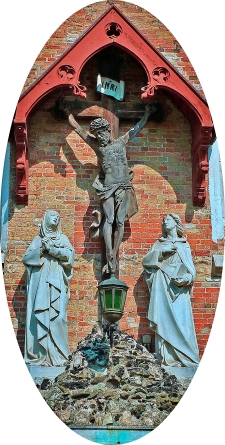
Church of our Lady - Netherlands

In the days leading up to his crucifixion, the people who claimed to love Jesus the most failed him in many ways. We know about Judas—the disciple trusted enough to carry the money bag who betrayed Jesus for thirty pieces of silver. That last night, the deceitful man had the audacity to have his feet washed by the Lord and to drink from His cup! But what of the other disciples? During that same meal, Peter vowed he’d never deny Jesus, even if it meant his death and the rest of the disciples echoed his pledge. Yet, within a matter of hours, those brave disciples would desert Jesus and Peter would deny Him three times. Even though Jesus asked Peter, James, and John to pray and keep watch with him in the Garden of Gethsemane, they fell asleep, not once but twice!

Where were the disciples when the mob shouted for Barabbas to be freed? For that matter, where were all of those people who had been healed or fed by Jesus? Just a few days earlier, a crowd had shouted, “Hosanna! Blessed is he who comes in the name of the Lord!” Where were they? Why were they silent? Instead of calling for Jesus’ freedom, the mob called, “Crucify him! Crucify him!”

The disciples weren’t even there to carry the cross for Jesus; that task fell to Simon, a stranger from Cyrene. Only John, Mary the mother of Jesus, Mary Magdalene, and some other women followers were at the foot of the cross when Jesus was crucified. Disillusioned and fearful for their lives, the other disciples were absent in His dying hours.

Rather than a disciple, it was a dying criminal who attested Jesus’ innocence, showed his faith, and asked the Lord, “Remember me when you come into your Kingdom.” When Jesus took His last breath and died, it was a Roman soldier and not a disciple who declared, “This man truly was the son of God!” The eleven remaining disciples didn’t even help bury their beloved rabbi. That responsibility was taken by Joseph of Arimathea and Nicodemus, members of the Jewish high council and secret followers of Jesus.

The disciples, confused and frightened, failed Jesus both as disciples and as friends. Nevertheless, despite the way they failed Him, Jesus didn’t fail them. Instead, after His resurrection, Jesus greeted them with words of peace and forgiveness. He then opened their minds to understand the Scriptures and charged these men—the same men who once failed Him—with the task of spreading the good news of His resurrection. Jesus knew it is better to be a believer who sometimes fails than not to believe at all.

Be assured, if you walk with Him and look to Him, and expect help from Him, He will never fail you. [George Mueller]

Jesus came and told his disciples, “I have been given all authority in heaven and on earth. Therefore, go and make disciples of all nations, baptizing them in the name of the Father, and the Son and the Holy Spirit. Teach these new disciples to obey all the commands I have given you. And be sure of this: I am with you always, even to the end of the age.” [Matthew 28-18-20 (NLT)]

Copyright ©2024 jsjdevotions. All rights reserved.

DECREASING

He must increase, but I must decrease. [John 3:30 (ESV)]

great blue heronAfter pointing out Jesus as the “Lamb of God,” some of John the Baptizer’s disciples left John to follow Jesus. Later, John’s remaining disciples reported that Jesus was baptizing (it actually was His disciples) and wanted to know whose purification ritual of baptism was valid. With many turning from John to Jesus, the Baptizer’s disciples were confused, concerned, and probably a little envious. Apparently, they forgot that John’s original mission was that of forerunner—the one who would prepare the way for the Messiah and point the way to the Lamb of God. Knowing that he wasn’t the bridegroom but only His friend, the Baptizer humbly affirmed his position by telling his disciples that Jesus must become more prominent while he became less and less important. J.C. Ryle likened the Baptizer’s role to that of a star growing paler and paler as the sun rises until the star completely disappears in the light of the sun. John clearly understood that he was to fade in the light of the Son.

During this time of Lent, I have given thought to John’s words and tried (rather unsuccessfully) to decrease so that Jesus’ presence can increase. It was upon reading the following prayer by John Wesley that I realized how much of me I refuse to surrender. Prepared by Wesley for the early Methodist societies in 1755, the prayer is part of a Covenant Renewal Service in Methodist churches today. Although Wesley’s original, with its “Thee,” “Thy,” and “Thou,” has been updated with “You,” “Your,” and “Yours,” the prayer’s level of commitment remains the same.

I am no longer my own, but Yours. Put me to what You will, rank me with whom You will; Put me to doing; put me to suffering; Let me be employed for You or laid aside for You, Exalted for You, or brought low for You; Let me be full, let me be empty; Let me have all things, let me have nothing; I freely and wholeheartedly yield all things to Your pleasure and disposal. [John Wesley]

These are the words of a man who was willing to decrease so that Jesus would increase—so that God’s light would be visible in his life. A prayer of surrender, Wesley’s words are those of a servant who loves and trusts his master enough to willingly submit in advance to whatever his master demands.

When Jesus called us to take up our crosses, He wasn’t speaking of bravely facing some tragic situation or long-term illness. A cross meant certain death and taking up our cross means dying to ourselves. Surrendering our wants, plans, and desires to Him, taking up our cross is decreasing while He increases! Unlike Wesley, my prayer of, “Do with me whatever You please, give me whatever task you would have me do, send me wherever whenever you want, take all that I have, and give me whatever you choose,” includes the unspoken words, “as long as it’s what I want and isn’t too inconvenient!”

While I may sing the old hymn’s words, “Take my life and let it be consecrated, Lord, to thee,” there are limitations to my offer. God is welcome to my life, my time, my hands and feet, my voice, my skills, my wealth, and my will just as long as it’s on my terms! By the way, Lord, don’t ask me to do manual labor, go without modern conveniences, move, learn a new language, or leave my family!

In The Weight of Glory, C.S. Lewis points out that God doesn’t want most of our time and attention or even all of it; He want us—the whole package—body and soul! There is no part of us that does not belong to Him and upon which he has no claim. He wants to completely fill us with His presence, but that’s only possible if we decrease to make room for Him. It is only when we empty our souls of our own will that He can fill us with His! Let us remember: If we’re too filled with ourselves to make room for His fasts, sacrifices, and responsibilities, then we’re too filled with ourselves to have room for His feasts, gifts, and blessings!

Lord, show me how to decrease so that You might increase!

Then Jesus told his disciples, “If anyone would come after me, let him deny himself and take up his cross and follow me. For whoever would save his life will lose it, but whoever loses his life for my sake will find it. For what will it profit a man if he gains the whole world and forfeits his soul

Copyright ©2024 jsjdevotions. All rights reserved.

MORE THAN MEETS THE EYE

But you must not forget this one thing, dear friends: A day is like a thousand years to the Lord, and a thousand years is like a day. The Lord isn’t really being slow about his promise, as some people think. [2 Peter 3:8 (NLT)]

Along the road to the Serengeti, somewhere near the Olduvai Gorge in Tanzania, is a crescent-shaped sand dune. Measuring about 30-feet in height and 328-feet long along its curves, it is known as the Shifting Sands. Rich in iron and highly magnetized, the sand sticks to itself when tossed in the air. When the wind blows, its particles fall back on the dune rather than get carried away by the breeze. The dune, however, is constantly on the move as the prevailing winds slowly move the entire thing across the land. Moving about 50-feet a year, it’s believed that the Shifting Sands have been traveling the savannah for more than three thousand years, sometimes changing both shape and direction. Of course, the dune moves so gradually that you don’t see its motion. Nevertheless, stakes in the ground indicate its location in previous years.

Like the Shifting Sands, God often appears to be standing still. David was anointed king as a boy but he didn’t rule over all of Israel until he was 37 years old. After being promised a son, Abraham and Sarah waited 25 years before Isaac’s birth. It was 22 years between Joseph’s prophetic dream that his brothers would bow to him and the day they did! Think of the centuries that passed between God’s promise of Canaan to Abraham’s descendants and Israel’s arrival there. By the time Jesus was born, thousands of years had passed since God’s first promise of a Savior in Genesis 3, one thousand had passed since God’s promise in 2 Samuel that David’s line would continue eternally, and about 700 years had elapsed since the many Messianic prophecies found in Isaiah, Hosea, and Micah! God wasn’t quick but He made good on His promises—God always does!

God moves at His own pace—and it often seems undetectable at the time. Just because we don’t see Him move, however, doesn’t mean He’s standing idly by, forgotten His promises, or ignoring His children. God works in the unseen and just because we can’t see His hand at work doesn’t mean it isn’t happening! I never saw the Shifting Sands move and yet I know they moved 1½ to 3 inches the day I was there!

Like Tanzania’s moving dune, more is happening in God’s realm than meets our mortal eyes. As Christians, we must “live by believing and not by seeing,” and “walk by faith, not by sight.” [2 Corinthians 5:7] We live by believing in God’s promises—rather than what we think we see (or don’t see) in our world! God often seems incredibly slow but His time is not the same as ours and His perspective is far broader than ours! More is happening than meets the eye! God’s promises never fail and He always is right on time!

Faith shows the reality of what we hope for; it is the evidence of things we cannot see. [Hebrews 11:1 (NLT)]

So we don’t look at the troubles we can see now; rather, we fix our gaze on things that cannot be seen. For the things we see now will soon be gone, but the things we cannot see will last forever. [2 Corinthians 4:18 (NLT)]

Copyright ©2023 jsjdevotions. All rights reserved.