
 But blessed is the man who trusts me, God, the woman who sticks with God. They’re like trees replanted in Eden, putting down roots near the rivers — Never a worry through the hottest of summers, never dropping a leaf, Serene and calm through droughts, bearing fresh fruit every season. [Jeremiah 17:7-8 (MSG)]
This morning, in a symbolic gesture of turning my worries over to God, I added a name to the “God box” that sits on my desk. Yesterday, I received a photo of my grand proudly holding a bowl of pasta with the text, “I have yet to set off the fire alarm with my cooking.” As I looked at her beautiful smile, I prayed, “Dear God, please let setting off that smoke alarm be the worst thing that happens to her this year!” She just started her freshman year of college, in a large city, in a foreign country, 5,500 miles from home. I know that drinking and drugs are pervasive on all college campuses and, having been a freshman once upon a time, I know how many foolish mistakes can be made when free from parental supervision. Yet, even if every decision my grand makes is a wise one, I know the statistics: with a more than a 20% chance of being sexually assaulted in her college years, she’s most vulnerable to attack her freshman year. Since the day my son left his daughter at her apartment, my concerns have weighed heavily on my heart. Nevertheless, I know that all the worry in the world can’t protect her from harm. Accepting that all I can do is give my concerns to God, I put her name in my box.
“Let go and let God!” is a favorite phrase in recovery but that doesn’t mean we let the troubles of this world run over us like a steamroller. When there’s a fire, we don’t stand idly by and say, “Let go and let God!” With God’s direction, we reach for a hose and do what is within our control. Letting go and letting God is refusing to worry about fires that haven’t started (and might never start) and recognizing when a fire isn’t ours to extinguish. It is, however, more than putting a name on a slip of paper and placing it in a wooden box. It’s surrendering the outcome we desire and letting God manifest His will for the outcome He wants. It’s releasing our concerns and fears to Him and trusting His plan for the lives of those we love.
I can’t protect my grand from poor decisions or the violence and sorrow that comes from living in a fallen world. But, by putting her name in that box, I’ve acknowledged that my job description as grandmother does not include running the world; I’ve relinquished that role to the One whose job it is! I will continue offering prayers on her behalf but those prayers will no longer be ones of fear, anxiety, or apprehension. They will be ones of faith and trust because I know that God loves her even more than I do.
You find no difficulty in trusting the Lord with the management of the universe and all the outward creation, and can your case be any more complex or difficult than these, that you need to be anxious or troubled about His management of it? [Hannah Whitall Smith]
 There’s probably no end of sermons and commentary on the swine that went plunging into the lake after Jesus saved the demoniac. “Why pigs?” some ask while others focus on the death of the animals rather than the salvation of a man. Non-believers criticize Jesus for his “wanton destruction” of other people’s property without realizing their criticism implies their belief in the miracle. Theologians respond that since Jesus is God, those pigs actually belonged to Him. I don’t know what the demons wanted when they asked to be sent into the pigs, why they plunged down the hillside to their death, or what happened to the demons after that. What I do know is that the value of 2,000 pigs does not exceed the value of one human soul.
 Mark and Luke tell of Jesus and the disciples crossing the Sea of Galilee to the region of the Gerasenes where they encountered a demon-possessed man. He’d been banished to live in the tombs and was so violent and strong that even shackles couldn’t restrain him. The demoniac would cut himself with sharp stones and his shrieks could be heard night and day. When Jesus restored the man, He sent the demons into a herd of swine that plunged down the steep hillside and drowned in the lake.
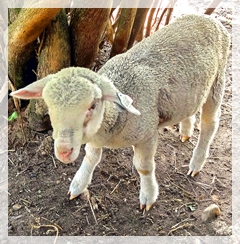 In Ezekiel 34, the Lord commanded Ezekiel to prophesy against the shepherds of Israel—not the caretakers of sheep but the prophets, priests, and leaders who were supposed to protect their people in the same way a shepherd does his sheep. He accused them of not searching for lost sheep and abandoning their flock to be attacked by wild animals.
 Mark, Matthew, and Luke all tell the story of Jesus calming the sea. He and the disciples had started to sail the five miles across the Sea of Galilee when a fierce storm struck. Tired from a day of preaching, Jesus remained asleep in the stern while the storm raged. As the waves broke and the boat began to fill with water, the disciples were sure they would perish. After they woke Jesus by shouting, “Teacher, don’t you care that we’re going to drown?” He rebuked the wind and the storm ended.
 “Blessed are You, Lord our God, King of the Universe, the True Judge,” is a blessing often said by Jews when they undergo a death or tragedy. “This is all for the good,” or “Blessed is the true judge,” is often said by other Jews in response to their tragic news. Rather than being about God’s final judgment of a person, these words remind them that only God can judge whether events are good or bad. To illustrate this point, the Talmud has a story about the second century sage, Rabbi Akiva. One night, the rabbi, along with his rooster and donkey, arrived in a village. When no one would give Akiva a place to stay, the rebbe said, “All that God does, He does for the good.” He then walked to a field outside of town, set up camp, and lit his lantern. That evening, a gust of wind knocked over the lantern breaking it, a fox came and ate the rooster, and a lion came and killed the donkey. In spite of all that, Akiva said, “All that God does, He does for the good!” Just before dawn, marauders came and attacked the village but, camped in the field without light, crowing rooster or braying donkey to reveal his presence, the rabbi remained safe.
 Devotions of the Heart