
Praise the Lord; praise God our savior! For each day he carries us in his arms. [Psalm 68:19 (NLT)]
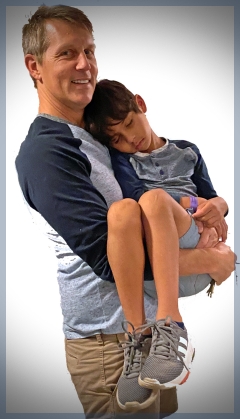 My daughter-in-law sent photos of the family’s day at the apple orchard. The grands picked apples, pet the farm animals, climbed the tractors, raced the pedal karts, did the zip-line, raced through the corn maze, traversed the goat bridge, and enjoyed their fill of donuts and apple cider. It was a fun-filled but exhausting day. The last picture was of my son carrying the youngest grand (who’d fallen asleep on the ride home) into the house.
The photo brought me back to my childhood when, like my grand, I’d fall asleep in the car on the way home from a family outing. Once home, my father would scoop me up in his strong arms to carry me into the house and up to my room. I remember feeling safe and loved as he carried me in his arms.
The oversized La-Z-Boy in our den was my father’s chair but, when he wasn’t home, my mother and I would snuggle there and talk for hours. I’d pour out my troubles, questions, hopes, and fears. She would quietly listen and then comfort, guide, encourage and pray with me. Holding me in her arms, she’d dry any tears and reassure me that life would eventually work out for the best.
Those childhood days are long gone; my parents passed away more than half a century ago and all that’s left are fond memories. Nevertheless, there still are times I’d like to shed the duties of adulthood and be a child again: to be the one carried instead of the one doing the carrying—the one falling apart instead of the one putting it together again. I don’t think I’m the only person who’s ever wanted to resign from adulthood. The responsibilities that come with maturity can weigh on us all.
In these troubled times, today’s responsibilities feel especially heavy. Every day seems to bring another challenge. We may be grown up but we haven’t outgrown the need to be nurtured, encouraged, comforted and restored. Many of us, however, seem to have outgrown the willingness to stop and admit our vulnerability and need. Just because we’re adults doesn’t mean we can’t rest in the arms of our Heavenly Father and let Him carry us when we’re weary. Although we can’t return to childhood, we have a Father in Heaven who loves each of us as if we were His only child. He will hold and comfort us as only a loving parent can. Rather than bandaging skinned knees and feeding our bodies, He bandages wounded hearts and nourishes our souls. He may not carry us up to our rooms but He we will carry us close to His heart for the rest of our days.
Snuggle in God’s arms. When you are hurting, when you feel lonely, left out. Let Him cradle you, comfort you, reassure you of His all-sufficient power and love. [Kay Arthur]
 Back in March, when this pandemic began, people began thinking seriously about worst-case scenarios. Looking at the death tolls in other countries and seeing them rise in ours, many began scrambling to write their wills and end of life directives. By late April, one on-line estate planning platform reported a 223% increase in customers. When schools announced plans to resume in-person classes, that trend continued as many teachers added will writing to their back-to-school tasks.
 When writing yesterday’s message (“Jehovah Rapha”) about my ski accident, I thought about the ten lepers healed by Jesus. Only one returned to thank Him. Did the others assume they would see Jesus some other day and could express their gratitude then? Jesus, however, was on His way to Jerusalem. The lepers had a week’s worth of purification ceremonies, cleansing, isolation, and offerings ahead of them and that “other day” would not come. By not returning immediately, they missed a precious opportunity to thank Jesus.
 Wouldn’t it be nice to live in a world where we’d never (at least rarely ever) hear a discouraging word? It shouldn’t be necessary to ride the range in Wyoming for that to happen.
 In the New Testament, the Greek word commonly translated as “worship” is proskyneō. While it came to mean kneeling down, prostrating oneself, showing reverence toward, and worshiping, its roots are thought-provoking. Coming from the Greek pro (to or toward) and kyneō (to kiss), its literal meaning is “to kiss towards!” Knowing his Greek, a pastor said of proskyneō: ”I like to think of our worship in church as being sons and daughters of God blowing kisses to our Father.” I thought of his words when I welcomed the kisses my children and grands blew to me on our recent Zoom call.
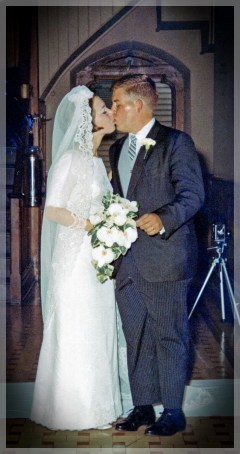 While being in lockdown for months may have given some couples a chance to reconnect, that connection wasn’t welcomed by all. Once their mandatory 10-week lockdown was lifted, Italian lawyers reported a 30% surge in couples starting divorce proceedings and both China and Saudi Arabia showed a similar rise when couples emerged from quarantine. For some couples, 24/7 togetherness for weeks on end exacerbated typical martial issues like money, housework, drinking, child care, screen and phone time, and dirty dishes in the sink. With the additional stressors of homeschooling, job loss or working at home, apprehension about the future, and trying to navigate safely in a COVID-19 world, even the best marriages have been tested.
