
God blesses those who work for peace, for they will be called the children of God. [Matthew 5:9 (NLT)]
Do all that you can to live in peace with everyone. … Don’t let evil conquer you, but conquer evil by doing good. [Romans 12:18,21 (NLT)]
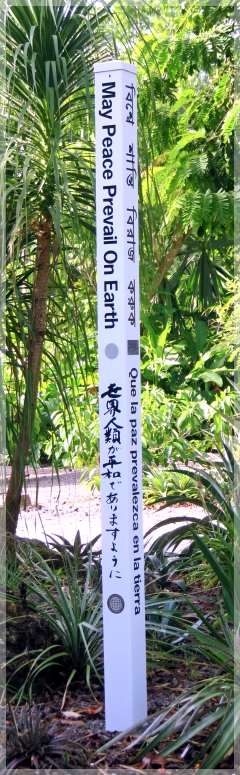 COVID kept us from the Botanic Gardens for well over a year. When we finally returned to one of our favorite places, we came upon a peace pole planted among the palms, bamboo and bromeliads. Although a similar pole is in the city park downtown, I don’t remember seeing one here when last we visited. These poles are just two of the more than 250,000 that have been erected in over 180 nations. Symbolizing the oneness of humanity, the words “May Peace Prevail on Earth” are written in eight different languages. The languages chosen for this pole were English, Arabic, Bengali, Chinese, Hawaiian, Hindi, Japanese, and Spanish—the languages of people who, like us, live at the 26th parallel north. Peace poles stand as a visual reminder to pray for peace on earth and to think, speak and act in the spirit of harmony and peace.
Forty years ago, the United Nations designated today as the annual International Day of Peace (commonly called World Peace Day). In 2011, the General Assembly unanimously voted to designate it as a day of cease-fire and non-violence. They ask every person and nation to halt hostilities and fighting for this one twenty-four-hour period. Unfortunately, I doubt the world can make one hour, let alone twenty-four, without aggression, hostility and bloodshed. Hopefully, you and I can go longer than twenty-four hours without conflict or violent behavior!
The causes of world conflict are many and, according to the UN, include poverty, social inequality, hunger, dwindling natural resources, water scarcity, environmental decline, disease, corruption, racism, and xenophobia (an intense fear of foreigners). This year’s theme, “Recovering Better for an Equitable and Sustainable World,” continues the UN’s focus on finding ways to overcome those causes. Indeed, as our world struggles to recover from what seems to be a never-ending pandemic, we can see how the underprivileged and marginalized have been hit the hardest. In the last eighteen months, we have seen both the best and the worst of our fellow travelers on this planet. This day is a reminder that instead of fighting with one another, we should join in fighting mankind’s common enemies!
As Christians, we have the peace of God—the peace that passes understanding—but we must be more than possessors of peace. Jesus calls us to be makers of peace but erecting a peace pole is not enough! We can start by bringing peace to our little corner of the world, beginning at home and then moving on to work, school, church and community. Our peacemaking efforts, however, can’t stop at the borders of our neighborhood or even our nation. We must take Christ’s message of peace out into the world by thinking, speaking, and acting in the cause of peace. While we each have an obligation to improve the various conditions that promote conflict, changing people’s circumstances is just a beginning. For true peace, the peace that is found in a relationship with God, we must change people’s hearts.
World peace, while a lofty goal, is not something I expect to see in my lifetime. Nevertheless, we each must do our part.
We hear much of love to God; Christ spoke much of love to man. We make a great deal of peace with heaven; Christ spoke much of peace on earth. [Henry Drummond]
 Found in Buddhism and Hinduism, the concept of karma is the idea that how you live your life now determines the quality of life you’ll have after reincarnation. Christians, however, believe that “each person is destined to die once and after that comes judgment,” [Hebrews 9:27] which means that karma, with its continual opportunities to get it right, is not compatible with Christianity. Nevertheless, the karmic idea of good and bad actions yielding similar consequences—that “what goes around comes around”—is present throughout the Bible. Because many of the Bible’s metaphors about cause and effect have to do with agriculture and farming, a pastor friend likes to call this concept “farma.”
 “There is nothing personal going on here,” were the words that helped author Jane Smiley get through her acrimonious divorce. Although no divorce is pretty, the circumstances surrounding hers were especially ugly. Realizing that her husband was acting out his own drama helped her to better understand and deal with his dreadful behavior and hurtful actions. Smiley explained, “This is a wiser way of understanding the people around you … how they have their own passions, motivations, and histories, that sometimes (always) grip them in ways, that even they do not grasp—ways you don’t have to respond to automatically.” Her words impressed me so much that I wrote them down after reading them several years ago. The author wrote that remembering the phrase, “There’s nothing personal going on here,” has helped her deal with other difficult people and situations in her life. I find them useful, as well.
 When all the people in the synagogue heard these things, they became very angry. They got up, forced Jesus out of town, and took him to the edge of the cliff on which the town was built. They planned to throw him off the edge, but Jesus walked through the crowd and went on his way. [Luke 4:28-30 (NCV)]
 When the ten northern tribes refused to submit to Rehoboam, they revolted and, by 930 BC, there were two political states: Israel, the northern kingdom, and Judah, the southern one. Both kingdoms suffered from inept, disobedient, and often corrupt leadership but Judah’s king Ahaz (743-728 BC) was one of weakest and most corrupt of all the southern kingdom’s leaders. Because of his apostasy (which included sacrificing some of his sons to Baal), the Lord allowed Judah’s defeat at the hands of Rezin (king of Aram) and Pekah (king of Israel). By the end of the battle, Ahaz lost a son and two of his close advisors and Judah lost 120,000 seasoned warriors. The Arameans took captives to Damascus and Israel’s warriors returned to Samaria with a huge amount of plunder and 200,000 captured women and children they intended to enslave (in spite of its prohibition in Leviticus 25:39-43).
 Last month, I received an email from my college alumni association asking alums to share 21 words of encouragement or advice with the class of 2021. The request gave me pause as I pondered what wise and pithy advice for this year’s grads I would put into a mere 21 words. Since my eldest grand is starting her senior year at NYU, I wondered what words of wisdom I would share with her next year.
 Devotions of the Heart