
He has told you, O man, what is good; and what does the Lord require of you but to do justice, and to love kindness, and to walk humbly with your God? [Micah 6:8 (ESV)]
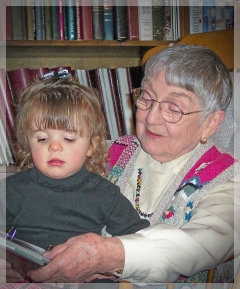 Growing up, one of my favorite hymns was, “I Sing a Song of the Saints of God.” Its author, Lesbia Scott, wrote hymns for her children as expressions of the family’s faith. Not originally intended for publication, she wrote this song to emphasize that saints lived not just in the distant past but also in the present day. My favorite verse was the final one and I recall singing it loudly with childlike enthusiasm: “The world is bright with the joyous saints who love to do Jesus’ will. You can meet them in school, on the street, in the store, In church, by the sea, in the house next door; They are saints of God, whether rich or poor, and I mean to be one too.”
It’s been years since singing that song but its words came to mind while reading C.S. Lewis’ fantasy The Great Divorce. After the dreaming narrator, presumed to be Lewis, takes his bus ride from hell to heaven, he meets his guide—the author George MacDonald. Although MacDonald was dead before Lewis read any of his books, his writing had a direct impact on Lewis’ faith and work. Lewis believed there was “hardly any other writer who seems to be closer, or more continuously close, to the Spirit of Christ Himself.” MacDonald’s writing was instrumental in causing the atheist Lewis to eventually become one of Christianity’s greatest apologists.
While conversing with his heavenly guide, the narrator sees a woman of “unbearable beauty” surrounded by a dazzling procession of angels, children, animals, and musicians. Although he’s sure she must be someone of great importance, perhaps even Jesus’ mother, MacDonald explains, “Fame in this country and fame on Earth are two quite different things.” Identifying her as “Sarah Smith of Golders Green,” he says she was “one of the great ones.”
Since MacDonald was a real person whose books I read as a girl, I thought Sarah Smith might have existed and immediately put down my book to Google her. Sarah Smith, however, was but a figment of the writer’s imagination—an ordinary person who loved children, was kind to people, and cared for animals. Nevertheless, explains MacDonald, like a stone dropped into a pool, Sarah had a ripple effect of love and joy on the lives of those she encountered and the “abundance of life she has in Christ from the Father” flowed over into the lives of all she met. As a result, children loved their parents more and men even loved their wives more. After knowing her and being loved by her, people were renewed, restored, and transformed in a meaningful and beautiful way. In short, ordinary Sarah Smith of Golders Green touched the lives of others as only a Christ follower can. She was, indeed, a saint of God.
Like the fictional Sarah Smith, the real Sarah (and Sam) Smiths of today humbly and lovingly shine the light of Christ on all whose lives they touch. Completely ordinary men and women, they are the kind of people about whom I sang as a child—and the kind of people Jesus call us to be. As followers of Christ, we are called to be the Sarah and Sam Smiths of our troubled world. May we all be saints of God.
We are told to let our light shine, and if it does, we won’t need to tell anybody it does. Lighthouses don’t fire cannons to call attention to their shining—they just shine. [D.L. Moody]
 Here I am again, with a broken ankle and wearing a knee-high air-boot for the next eight to ten weeks! We have guests visiting next Friday and, since they’re avid gardeners, we’d initially planned on taking them to the Botanic Gardens. Yesterday, I suggested a change in plans since a stroll through the gardens is beyond my walking ability. When my husband suggested pushing me in one of the garden’s wheelchairs, I began protesting until I recalled a similar situation over six years ago when my foolish pride almost prevented me from accepting the help I needed.
 No respecter of early mornings, an annoying woodpecker was busy drumming on the gutters of a nearby house. A few streets later, I spotted a woodpecker determinedly drilling into the stucco of another house. As it excavated a roost hole in the decorative trim, the determined little bird was doing as much damage with his beak as a heavy sledge hammer. A plaster patch nearby told me this wasn’t the first time the wall has been under attack! Throughout our community I see reflective streamers, children’s pinwheels, life-sized plastic owls, and strips of aluminum foil hanging from the eaves of houses. Nothing, however, seems to deter these birds from their drumming and drilling.
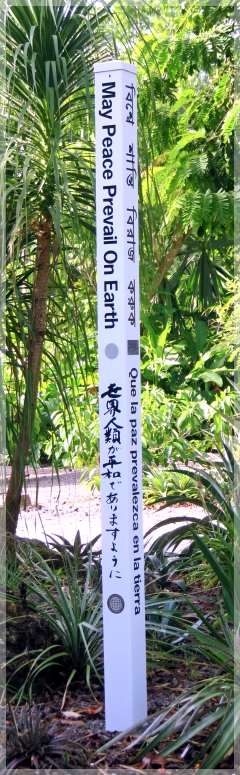 COVID kept us from the Botanic Gardens for well over a year. When we finally returned to one of our favorite places, we came upon a peace pole planted among the palms, bamboo and bromeliads. Although a similar pole is in the city park downtown, I don’t remember seeing one here when last we visited. These poles are just two of the more than 250,000 that have been erected in over 180 nations. Symbolizing the oneness of humanity, the words “May Peace Prevail on Earth” are written in eight different languages. The languages chosen for this pole were English, Arabic, Bengali, Chinese, Hawaiian, Hindi, Japanese, and Spanish—the languages of people who, like us, live at the 26th parallel north. Peace poles stand as a visual reminder to pray for peace on earth and to think, speak and act in the spirit of harmony and peace.
 Found in Buddhism and Hinduism, the concept of karma is the idea that how you live your life now determines the quality of life you’ll have after reincarnation. Christians, however, believe that “each person is destined to die once and after that comes judgment,” [Hebrews 9:27] which means that karma, with its continual opportunities to get it right, is not compatible with Christianity. Nevertheless, the karmic idea of good and bad actions yielding similar consequences—that “what goes around comes around”—is present throughout the Bible. Because many of the Bible’s metaphors about cause and effect have to do with agriculture and farming, a pastor friend likes to call this concept “farma.”
 “There is nothing personal going on here,” were the words that helped author Jane Smiley get through her acrimonious divorce. Although no divorce is pretty, the circumstances surrounding hers were especially ugly. Realizing that her husband was acting out his own drama helped her to better understand and deal with his dreadful behavior and hurtful actions. Smiley explained, “This is a wiser way of understanding the people around you … how they have their own passions, motivations, and histories, that sometimes (always) grip them in ways, that even they do not grasp—ways you don’t have to respond to automatically.” Her words impressed me so much that I wrote them down after reading them several years ago. The author wrote that remembering the phrase, “There’s nothing personal going on here,” has helped her deal with other difficult people and situations in her life. I find them useful, as well.
