LAST WORDS

When Jesus had received the sour wine, he said, “It is finished,” and he bowed his head and gave up his spirit. [John 19:30 (ESV)]

It’s been said that Leonardo da Vinci’s last words were, “I have offended God and mankind because my work did not reach the quality it should have.” A scientist, painter, architect, mathematician, musician, sculptor, geologist, botanist, historian, cartographer, and inventor, da Vinci was a true Renaissance man and it’s difficult to understand how he could feel he failed God or anyone else.

I hope my last words won’t be as depressing as da Vinci’s or as foolish as those of Major General John Sedgwick who, just moments before he was shot and killed during the Civil War, said, “They couldn’t hit an elephant at this distance!” I’d like to think my last words will be as faith-filled as those of blues singer Bessie Smith’s, “I’m going, but I’m going in the name of the Lord!” or Harriet Tubman’s, “Give my love to the churches. Tell the women to stand firm. I go to prepare a place for you.”  Nevertheless, my words probably will be as mundane Elvis Presley’s, “I’m going to the bathroom to read.”

While Nostradamus correctly predicted his death when he said, “Tomorrow, at sunrise, I shall no longer be here,” most of us won’t know when the words we speak will be our last ones. Jesus, however, knew his earthly life was ending when He spoke from the cross. He’d been hanging there for several hours and the weight of his body pulling down on his arms meant he could barely breathe. John tells us Jesus said, “It is finished!” and then died. After hearing those words, can you imagine the heartbreak of His followers? This was Jesus, the man who calmed storms, fed thousands, and healed lepers! This was the promised Messiah! How could it be finished? Everything His disciples believed and hoped for was gone! Was this how their story would end?

Last words, however, aren’t always what they seem. Jesus’ words and the crucifixion were only the end of the first act. What the disciples didn’t understand on that dark Friday afternoon was that the story was just getting started. Three days later, the resurrection opened the second act. Forty days after His resurrection, the second act closed with Jesus’ ascension into heaven. Although He spoke to the disciples and blessed them before His departure, Matthew, Mark, Luke, and John included different portions of Jesus’ final words. Nevertheless, His message was the same: our sins are forgiven, we are to go out into the world and make disciples, and the power of the Holy Spirit is promised. When Jesus physically left the disciples with His ascension into heaven, the second act ended, but the words He spoke were not His final ones. Because He promised both His presence and His return, we know there’s more to come!

The third act began with the Spirit’s presence on Pentecost and continued when Jesus spoke to Saul on the road to Damascus and revealed Himself to John on Patmos. While probably less dramatic than Paul’s encounter and less graphic than John’s, the Lord continues to speak to us today through His living word (the Bible), prayer, and in the Holy Spirit’s beautiful whisper. The only last words to be spoken in the third act will be ours when we depart the stage—whether they are as mundane as those of Elvis or as memorable as da Vinci’s. Nevertheless, when the curtain closes for us, the story still is not over!

The glorious fourth act begins when we come home to Jesus and hear His voice again. This final act has no ending and there will be no last words spoken. It never is finished and the curtain never will fall!

Let not your hearts be troubled. Believe in God; believe also in me. In my Father’s house are many rooms. If it were not so, would I have told you that I go to prepare a place for you? And if I go and prepare a place for you, I will come again and will take you to myself, that where I am you may be also. [John 14:1-3 (ESV)]

Truly, truly, I say to you, an hour is coming, and is now here, when the dead will hear the voice of the Son of God, and those who hear will live. [John 5:25 (ESV)]

Copyright ©2024 jsjdevotions. All rights reserved.


JUST LIKE US

But Moses protested to God, “Who am I to appear before Pharaoh? Who am I to lead the people of Israel out of Egypt?… What if they won’t believe me or listen to me?… I’m not very good with words. I never have been, and I’m not now, even though you have spoken to me. I get tongue-tied, and my words get tangled….Lord, please! Send anyone else.” [Exodus 3:11,4:1,10,11 (NLT)]

castle of spiez - knightWhen I learned about people like Abraham, David, Moses, and Samson as a girl, they were the Bible’s version of super-heroes like Batman or Superman. The Bible’s heroes were larger than life, obedient, invincible, and seemed to overcome their obstacles effortlessly. Appearing perfect in their faith and actions, they weren’t people to whom I could relate. In reality, they were as flawed as the rest of us but, for the most part, their imperfections and failures were redacted from the stories we learned in Sunday school.

As a child, I learned that David killed Goliath, was a great warrior, and wrote psalms but I didn’t learn about the 70,000 Israelites who died because he took a census or his sins of rape, adultery, and murder. When I colored pictures of Samson destroying Dagon’s temple, I didn’t know about the disobedience, lust, and pride that got him in such trouble! Although I learned that King Solomon was wise and wealthy, I didn’t know he disobeyed his father, broke God’s law, and over-worked and over-taxed his people.

Truth be told, the Bible’s heroes and heroines were as fallible, insecure, and willful as you and me. The apprehensive Moses listed all his shortcomings while arguing with God and the faint-hearted Gideon tested Him! Barren Hannah struggled with her sense of worth and Naomi grew bitter in widowhood. Moses let his anger get the best of him and Elijah prayed for death in the depth of despair. Abraham was a coward who, to save his skin, gave his wife to another man twice! Timothy’s youth made him timid and insecure and even John the Baptizer had doubts!

The families of our Biblical heroes were as dysfunctional as ours. There were bad marriages—Abigail was married to a brute and Gomer wasn’t faithful to Hosea. There was bad parenting—Eli and Samuel turned a blind eye to their sons’ sins, David failed to discipline his boys Amnon and Adonijah, and Abraham, Isaac, and Jacob played favorites with their sons. There was sibling rivalry—Miriam and Aaron grew jealous of Moses, Jacob stole Esau’s birthright and blessing, Joseph’s brothers sold him into slavery, Leah and Rachael competed for Jacob’s attention, and Martha and Mary had issues! There even was fratricide—Absalom murdered Amnon, Solomon had Adonijah killed, and both Jehoram and Abimelech executed their brothers! Their tangled stories rival the drama of “reality television.”

Indeed, there’s enough sex and violence in the Bible that children only learn the G versions of its stories in Sunday school. We, however, are not children and we need to look at the heroes and heroines of the Bible with the eyes of an adult. My purpose is not to throw mud on the Bible’s heroes and heroines—it’s to make them relatable.

Rather than super heroes, God used people as flawed and imperfect as we are and from families as screwed up as ours. Like us, they struggled with challenges, pain, infertility, temptation, impatience, anger, jealousy, depression, and even their faith. They faced real challenges, made mistakes, sinned more than once, questioned God, and even failed at times. If God could use such flawed people to accomplish His purpose, think of what He can do with you and me!

There will be no “knights in shining armor” in God’s kingdom; our armor will have many dings and dents. No, no perfect Hollywood heroes will ride to save the day; just wearied saints to look to God and, in weakness, find Christ’s strength. This, indeed, is the essence of God’s kingdom: divine greatness manifest in common people. [Francis Frangipane]

Each time he said, “My grace is all you need. My power works best in weakness.” So now I am glad to boast about my weaknesses, so that the power of Christ can work through me. [2 Corinthians 12:9 (NLT)]

Copyright ©2024 jsjdevotions. All rights reserved.

ASKING QUESTIONS – PART 2

“Are You the Coming One, or are we to look for someone else?” Jesus answered and said to them, “Go and report to John what you hear and see: those who are blind receive sight and those who limp walk, those with leprosy are cleansed and those who are deaf hear, the dead are raised, and the poor have the gospel preached to them. And blessed is any person who does not take offense at Me.” [Matthew 11:3-6 (NASB)]

canna - bandana of the evergladesHaving quoted from Isaiah when proclaiming the Messiah’s arrival, we know John knew Isaiah’s prophecies. The Messiah would “bind up the brokenhearted [and] proclaim liberty to captives and freedom to prisoners,” [61:1] but, after spending more than a year confined to a dark cell, John had neither liberty nor freedom. It’s no wonder he doubted.

While Jesus’ answer to the Baptizer’s question seems cryptic to us, it would have made perfect sense to John. By pointing to the facts, Jesus affirmed that the days of salvation had begun. Although he was using His Messianic power in a way John hadn’t envisioned, Jesus was fulfilling the Messianic promises of Isaiah 35, 42, and 61. Jesus was, indeed, the Christ! When John’s disciples returned with a report of Jesus’ words and actions, the Baptizer’s questions were answered and his doubts erased.

Encouraging John not to give in to despair or abandon his faith, Jesus added a blessing to His message: “And blessed is any person who does not take offense at Me.” Calling this the “forgotten Beatitude,” Vines Expository Bible Notes paraphrased His words as, “Blessed is the person who does not get upset by the way I [God] handle my business.”

What follows, however, is somewhat unexpected. Lest the people think less of John for his imprisonment and doubt, Jesus bore witness to the prophet and praised him. Declaring him to be a true prophet who spoke directly for God, Jesus affirmed that John was the returning Elijah, the one to announce the Day of the Lord, and the greatest of the Old Covenant’s prophets! Clearly, John’s doubt did not diminish Jesus’ respect and love for him!

While we probably aren’t languishing in a prison cell, we will have doubts. Things happen that make our confidence waver and we begin to question things we’ve come to believe. No matter how deep our faith or how long we’ve followed Jesus, doubts and questions will arise from time to time—especially when we’re in the dark places of pain, persecution, injustice, loss, disappointment, isolation, or failed expectations.

When we can’t see or understand God’s plan, like John, we tend to doubt Him. Doubt, however, is not the same as unbelief because, like John, doubt seeks an answer when unbelief doesn’t. The Psalmists certainly weren’t shy about expressing their feelings and asking God questions. “Why do You stand far away, Lord? Why do You hide Yourself in times of trouble?” [10:1] “How long, Lord? Will You forget me forever? How long will You hide Your face from me?” [13:1] “Why do You hide Your face and forget our affliction and oppression?” [44:24] “Lord, why do You reject my soul? Why do You hide Your face from me?” [88:14]

When we have questions, we must do what the Psalmists, Abraham, Moses, Jeremiah, Job, John, and the rest of Scripture’s doubters did—trust the Lord enough to share our uncertainty, express our anxiety, and ask our questions. Let us remember the question Jesus asked while hanging on the cross: “My God, My God, why have You forsaken Me?” Jesus’ words tell us that He knows what it’s like to feel abandoned by God and they give us permission to confront God with our troubling questions in the midst of our trials and despair.

To ask is to believe that somewhere there is an answer….Far from faith excluding questions, questions testify to faith….We ask, not because we doubt, but because we believe.  [Rabbi Jonathan Sacks]

My God, my God, why have You forsaken me? Far from my help are the words of my groaning. My God, I cry out by day, but You do not answer; And by night, but I have no rest.  [Psalm 22:1-2 (NASB)]

Copyright ©2024 jsjdevotions. All rights reserved.

SATURDAYS (Easter Monday)

Afterward he appeared to the eleven themselves as they were reclining at table, and he rebuked them for their unbelief and hardness of heart, because they had not believed those who saw him after he had risen. [Mark 16:14 (ESV)]

red admiral butterflyMost of us probably spent Saturday preparing for Easter. We may have done last minute grocery shopping, prepped for Easter dinner, purchased an Easter lily, decorated eggs, assembled Easter baskets, snacked on jelly beans, or hidden plastic eggs around the yard. The previous day’s service on Good Friday had been a somber one but we knew the following day’s worship would be one of joy and celebration. While we may have sung “Were you There When They Crucified My Lord?” on Friday, we knew that we’d be singing “Christ the Lord is Risen Today” on Sunday.
Because we know how Good Friday’s story ends, we don’t mourn, feel abandoned, or fear being arrested on Saturday. The disciples, however, didn’t know that Sunday would reveal an empty tomb. Having been unable to finish preparing Jesus’ body and offer a proper hepsed (eulogy), there must have been a feeling of unfinished business and, when the Sabbath ended, the women purchased burial spices. Scripture, however, is strangely silent about that Saturday and the narrative does not resume until Sunday morning.

Did His followers tear their clothes in grief as did Jacob when he thought Joseph was dead?  Did they wear sack cloth as did David upon Abner’s death? To show their grief and anguish, did they fast and cover themselves with ashes in sorrow and anguish as did the Jews when they learned that King Xerxes had ordered their death? Did they tear their robes, cover their heads with ashes, and silently sit shiva with Mary as Job’s friends had done for him?

Their sense of despair and defeat must have been unbearable. How could they make sense of all that happened? Thinking they’d never again see Jesus, was there regret or anger that they’d given up their homes and livelihoods for what now seemed a failed Messiah? Consider their heartache and the many “would’ves, could’ves, and should’ves” as they remembered Thursday night. Think of their remorse for having fallen asleep while Jesus prayed, the shame of abandoning Him in the garden, and Peter’s self-reproach for denying Him three times in the courtyard.

The disciples never fully understood when Jesus spoke of his impending death. Not expecting God’s plan to be the crucifixion, death, and burial of His only Son, they didn’t expect Jesus to return. When their rabbi said, “It is finished!” they didn’t know what Jesus finished. Seeing no future, the disciples lost hope and didn’t even believe the women when they reported the empty tomb.

Perhaps the gospel writers chose not to tell us about that gloomy Saturday because the disciples weren’t especially proud of it. Yet, they reported things like Peter’s denials, Thomas’ doubt, and James and John wanting places of honor. Perhaps there’s no mention of Saturday because we’re not meant to dwell in the Saturdays of our lives.

I’m not talking about the day we get the chores done, take the kids to soccer practice, or watch Saturday Night Live. I’m speaking of the times when disaster, despair, regrets, or anguish assault us and we can’t see tomorrow because of the darkness of today. The disciples’ Saturday lasted less than 48 hours but our Saturdays often last much longer.

The disciples didn’t know that Saturday was simply a day between despair and joy, but we do. Because Jesus rose from the dead on Sunday, we know that we have not been abandoned. Because Jesus gave us His Holy Spirit, we know that we’ll never be alone. No matter how long our Saturdays are, we have no reason for despair, fear, or anxiety. Whether in this world or the next, a glorious Sunday eventually will come.

Weeping may tarry for the night, but joy comes with the morning.… You have turned for me my mourning into dancing; you have loosed my sackcloth and clothed me with gladness, that my glory may sing your praise and not be silent. O Lord my God, I will give thanks to you forever! [Psalm 30:5,11-12 (ESV)]

Copyright ©2024 jsjdevotions. All rights reserved.

HE WAS BETRAYED

On the way, Jesus told them, “All of you will desert me. For the Scriptures say, ‘God will strike the Shepherd, and the sheep will be scattered.’ But after I am raised from the dead, I will go ahead of you to Galilee and meet you there.” [Mark 14:27-28 (NLT)]

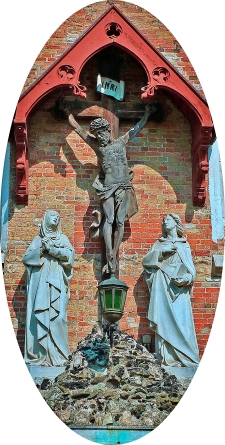
Church of our Lady - Netherlands

In the days leading up to his crucifixion, the people who claimed to love Jesus the most failed him in many ways. We know about Judas—the disciple trusted enough to carry the money bag who betrayed Jesus for thirty pieces of silver. That last night, the deceitful man had the audacity to have his feet washed by the Lord and to drink from His cup! But what of the other disciples? During that same meal, Peter vowed he’d never deny Jesus, even if it meant his death and the rest of the disciples echoed his pledge. Yet, within a matter of hours, those brave disciples would desert Jesus and Peter would deny Him three times. Even though Jesus asked Peter, James, and John to pray and keep watch with him in the Garden of Gethsemane, they fell asleep, not once but twice!

Where were the disciples when the mob shouted for Barabbas to be freed? For that matter, where were all of those people who had been healed or fed by Jesus? Just a few days earlier, a crowd had shouted, “Hosanna! Blessed is he who comes in the name of the Lord!” Where were they? Why were they silent? Instead of calling for Jesus’ freedom, the mob called, “Crucify him! Crucify him!”

The disciples weren’t even there to carry the cross for Jesus; that task fell to Simon, a stranger from Cyrene. Only John, Mary the mother of Jesus, Mary Magdalene, and some other women followers were at the foot of the cross when Jesus was crucified. Disillusioned and fearful for their lives, the other disciples were absent in His dying hours.

Rather than a disciple, it was a dying criminal who attested Jesus’ innocence, showed his faith, and asked the Lord, “Remember me when you come into your Kingdom.” When Jesus took His last breath and died, it was a Roman soldier and not a disciple who declared, “This man truly was the son of God!” The eleven remaining disciples didn’t even help bury their beloved rabbi. That responsibility was taken by Joseph of Arimathea and Nicodemus, members of the Jewish high council and secret followers of Jesus.

The disciples, confused and frightened, failed Jesus both as disciples and as friends. Nevertheless, despite the way they failed Him, Jesus didn’t fail them. Instead, after His resurrection, Jesus greeted them with words of peace and forgiveness. He then opened their minds to understand the Scriptures and charged these men—the same men who once failed Him—with the task of spreading the good news of His resurrection. Jesus knew it is better to be a believer who sometimes fails than not to believe at all.

Be assured, if you walk with Him and look to Him, and expect help from Him, He will never fail you. [George Mueller]

Jesus came and told his disciples, “I have been given all authority in heaven and on earth. Therefore, go and make disciples of all nations, baptizing them in the name of the Father, and the Son and the Holy Spirit. Teach these new disciples to obey all the commands I have given you. And be sure of this: I am with you always, even to the end of the age.” [Matthew 28-18-20 (NLT)]

Copyright ©2024 jsjdevotions. All rights reserved.

NOTHING CAN SEPARATE US FROM HIS LOVE

And I am convinced that nothing can ever separate us from God’s love. Neither death nor life, neither angels nor demons, neither our fears for today nor our worries about tomorrow—not even the powers of hell can separate us from God’s love. No power in the sky above or in the earth below—indeed, nothing in all creation will ever be able to separate us from the love of God that is revealed in Christ Jesus our Lord. Romans 8:38-39 NLT

queen butterflyI read a devotion that suggested substituting our own personal anxieties and concerns for the troubles listed by Paul in Romans 8. Perhaps your version would read: “And I am convinced that nothing can ever separate me from God’s love. Neither old age nor loss of loved ones, neither cancer nor dementia, neither my anxiety about my wayward child nor my reservations about finances—not even the powers of terrorism and hate can separate me from God’s love. No hurricanes, earthquakes, pandemics, or wars—indeed, nothing in all creation will ever be able to separate me from the love of God that is revealed in Christ Jesus our Lord.”

Then again, maybe widowhood, heart disease, migraines, foreclosure, floods, stroke, bullies, loneliness, crime, hunger, depression, fires, addiction, divorce, hard times, debt, anger, betrayal, homelessness, violence, or tornadoes would be on your list. Regardless of how you fill in the blanks, Paul’s words remain true and bear repeating. Nothing—absolutely nothing—can separate us from God’s love as shown in Jesus Christ.

Paul wasn’t saying that Christians have no enemies or won’t suffer. In fact, his words were written to the Roman church, a church that underwent tremendous persecution and hostility for centuries. Within a few years of his letter, Nero would blame Christ’s followers for the burning of Rome and, for the next 300 years, Christians would be mercilessly persecuted. Depending on the whims of whoever was emperor, they’d be expelled from their homes, see their property confiscated, be required to perform pagan rituals, watch their churches destroyed, have worship prohibited, endure brutal persecution, or suffer monstrous methods of execution. Not even the Apostle Paul escaped—he was executed in Rome on Nero’s orders.

While we’re not about to be crucified, torn apart by dogs, beheaded, hung on poles, coated in tar, or burned alive by Nero, we all encounter threats from both physical and spiritual enemies daily. Belief in Christ doesn’t shield us from enemies; it means that those enemies, even ones as evil and powerful as Nero, can’t turn God against us. Even Satan is powerless against God! Whether visible or invisible, nothing can take us from God’s love for us; even death can’t separate us from His love! Because God loved us enough to sacrifice His only Son for our salvation, we can be sure of His unchanging and everlasting love and confident that He will provide us with everything we need in the face of the day’s challenges.

What troubles would you substitute for Paul’s in Romans 8? No matter what they are, rest assured in the promise that the battle already is over and overwhelming victory is ours through Christ our Lord!

Nothing can separate you from God’s love, absolutely nothing. God is enough for time, God is enough for eternity. God is enough! [Hannah Whitall Smith]

 One of the greatest evidences of God’s love to those that love him is, to send them afflictions, with grace to bear them. [John Wesley]

What shall we say about such wonderful things as these? If God is for us, who can ever be against us? Since he did not spare even his own Son but gave him up for us all, won’t he also give us everything else? … overwhelming victory is ours through Christ, who loved us. [Romans 8: 31b-32,37b (NLT)]

Copyright ©2024 jsjdevotions. All rights reserved.