
Though you have not seen him, you love him; though not seeing him now, you believe in him, and you rejoice with inexpressible and glorious joy, because you are receiving the goal of your faith, the salvation of your souls. [1 Peter 1:8-9 (CSB)]
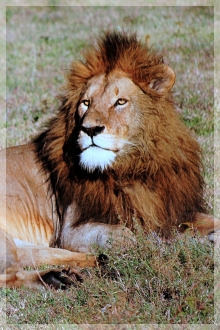
Although C.S. Lewis never intended the seven books in The Chronicles of Narnia series to be allegories, they are filled with Christian imagery and allusions. Having enjoyed reading (and re-reading) the Narnia books, I was pleased when the Pastor opened his sermon on “The Supremacy of Jesus” by quoting from it. In Prince Caspian, after a year’s absence from Narnia, Lucy encounters Aslan the lion (the Christ-like figure in the series) and says, “Aslan, you’re bigger.” The lion replies, “That is because you are older, little one.” When she asks, “Not because you are?” the lion assures her, “I am not.” He then explains, “But every year you grow, you will find me bigger.”
Only a year had passed in Lucy’s world since she last saw Aslan, but 1,300 years had passed in Narnia. Even so, in all that time, Aslan hadn’t gotten larger. As Hebrews 13:8 reminds us, “Jesus Christ is the same yesterday, today, and forever.” Indeed, God is unchangeable in His being, character, will, attributes, power, and promises.
Lucy’s misperception of Aslan’s size is not because she’s another year older or two inches taller. While we tend to think of growing as getting older or larger, growing in the spiritual sense is different. It’s a little like seeing people from a distance. From afar, they seem small but, as we grow closer to them, they seem to enlarge. Once face-to-face, we finally perceive how large they really are! Spiritual growth is coming closer to God so that we perceive how big He is and how small we are. Growth in our spiritual life doesn’t mean there is more of us; if anything, there is less of us and more of God! While God is immutable, our relationship with Him is not.
As we grow and mature spiritually, like Lucy, our perception of God will change proportionally. The more we move toward Him, the larger He becomes! We will come to see both our spiritual brokenness and the greatness of God’s mercy, our sinfulness and His immeasurable holiness, our weakness and His infinite power, our poverty and His limitless grace, our emptiness and His abundant love. As we accept our inadequacy and hopelessness, our small perspective of God changes and we begin to grasp the full extent of God’s wisdom, glory, power, and majesty. Indeed, our God is a big God!
Aslan played a prominent role in the first Narnia book so all four of the children know he exists. Nevertheless, upon their return to Narnia, they don’t see him. But, that doesn’t mean he wasn’t there. Lucy is the only one who finally sees him, perhaps because, unlike her siblings, she was the only one who believed Aslan would help them. For the other three children, Aslan remains invisible until, one by one, like Lucy, they start having faith in him. It’s been said that “seeing is believing.” In this case, it is the believing that allowed for the seeing! I expect that, as their faith increased, like Lucy, each sibling said, “Aslan, you’re bigger!”
And, so it is with Jesus. We must believe in Him to see Him and the more we trust Him, the bigger He gets!
 Occasionally, I’ll spot a partially open moonflower (Ipomoea alba) during an early morning walk at the park. While the Moonflower’s cousin the Morning Glory opens wide to welcome the sunlight, the Moonflower prefers darkness. It’s only when the sun sets that it opens to a large trumpet-shaped bloom. Rather than competing during the day with brightly colored flowers for pollinators like bees and butterflies, Moonflowers enjoy pollinators like bats and moths at night. As the morning sun rises, the Moonflower again rejects the light and rolls up into itself.
 Some of the lesser-known heroes of the Bible are found in the lists of David’s mightiest men. Among his warriors, David’s mighty Three had the most authority, influence, and leadership. Their leader was Jashobeam, a man who once used his spear to kill 800 warriors in a single battle. Next in rank was Eleazar who remained with David in battle when the rest of the troops fled. He killed Philistines until he no longer could lift his sword. The third of the Three was Shammah. After being attacked in a field by the Philistines, the troops fled. Shammah alone remained to defend it and bring victory to Israel. These three were so devoted to David that, when he expressed a desire for fresh water from Bethlehem, they risked their lives to break through enemy lines to get some for him. David’s Three were among the best of the best when it came to valor, courage, and allegiance.
 The Resurrection story didn’t end on Easter with Jesus’ appearance to ten disciples, Mary Magdalene, Mary the mother of James and John, Salome, and Joanna, along with Cleopas and another believer who broke bread with Him in Emmaus. Appearing and disappearing at will, Jesus remained on earth for forty days. While He probably appeared other times, Scripture tells us He later appeared to Thomas and the ten others, to seven of the disciples beside the Sea of Galilee, to His half-brother James, to over 500 believers at one time, and to the disciples on his last day with them.
 In my last post, I pondered why Jesus chose the men he did as his apostles. As we enter Holy Week and the events leading to the Lord’s arrest and crucifixion, I wonder specifically about Judas Iscariot. We don’t know what Jesus saw in Judas when he was chosen as one of the twelve or even what was in Judas’ heart in the beginning of Jesus’ ministry. We only know that discontent, ambition, and greed had entered his treacherous heart by the end.
 In a cartoon drawn by Paul Noth, an enormous political billboard overlooks a pasture inhabited by a flock of sheep. Looking up at the picture of a grinning wolf in coat and tie saying, “I am going to eat you!” one sheep tells another, “He tells it like it is.” Would that all politicians were so forthright!
