THE GOOD SHEPHERD

I am the good shepherd; I know my own sheep, and they know me, just as my Father knows me and I know the Father. So I sacrifice my life for the sheep. I have other sheep, too, that are not in this sheepfold. I must bring them also. They will listen to my voice, and there will be one flock with one shepherd. [John 10:14-16 (NLT)]

lambIn Ezekiel 34, the Lord commanded Ezekiel to prophesy against the shepherds of Israel—not the caretakers of sheep but the prophets, priests, and leaders who were supposed to protect their people in the same way a shepherd does his sheep. He accused them of not searching for lost sheep and abandoning their flock to be attacked by wild animals.

Surely the people were familiar with Ezekiel’s words when they heard Jesus tell the parable we know as “The Lost Sheep” or “The Good Shepherd.” Told both in Luke 15 and Matthew 18, the shepherd leaves his ninety-nine sheep in the wilderness so he can search for a lost one. Although its point is to illustrate God’s overwhelming concern for saving His people and to explain Jesus’s conduct in associating with sinners, the shepherd’s behavior in abandoning ninety-nine sheep seems irresponsible. Who’s going to keep them from going astray, drowning in a pond of water (that wet wool is heavy), or being devoured by hungry wolves? Won’t the shepherd return with the one stray sheep only to find a dozen or more missing or dead? That’s hardly cause for celebration! Did that shepherd abandon his flock like the shepherds in Ezekiel’s prophecy?

If this was a true story, before heading off into the wilderness, the good shepherd would have entrusted his flock to another shepherd. Biblical scholars, however, remind us that Jesus’s parables weren’t meant to portray real-life situations any more than were Aesop’s fables. We know a tortoise won’t challenge a hare to a race, geese don’t lay golden eggs, and a fox can’t talk to a crow. Yet, in spite of their inconsistencies, both Jesus’s and Aesop’s stories make their points.

Nevertheless, Jesus always seemed to be very concise in His choice of words and I wonder if he deliberately omitted a second shepherd or caretaker for a reason. Perhaps there is only one shepherd because there is only one God. He is not about to share us with another god so the shepherd won’t entrust the care of his beloved flock to anyone else. God is omnipresent, unlimited by time or space, and can be in all places at the same time. When the good shepherd rashly goes into the wilderness for the one lost sheep, he hasn’t abandoned the other ninety-nine. Ever-present, while he’s off saving the stray, he also is there tending the rest of the flock.

The Pharisees never questioned Jesus about those abandoned sheep. Like their predecessors, they’d abandoned their flock and failed to seek the lost; Jesus’s parable made it clear that a new shepherd was in town. Perhaps the parable also helped prepare the disciples for a time when they would feel abandoned. Jesus soon would be leaving them but, like the good shepherd, He would return. His disciples, like the sheep left behind, would remain safe in His care. I’m no longer troubled by those abandoned sheep because I know God will never desert us. Indeed, the Lord is our shepherd and we will not be afraid. Whether or not we are aware of His presence, He is close beside us.

I know the Lord is always with me. I will not be shaken, for He is right beside me. [Psalm 16:8 (NLT)]

I will remain in the world no longer, but they are still in the world, and I am coming to you. Holy Father, protect them by the power of your name, the name you gave me, so that they may be one as we are one. While I was with them, I protected them and kept them safe by that name you gave me. [John 17:11-12a (NLT)]

Copyright ©2018 jsjdevotions. All rights reserved.

STILLING THE WATERS

Their ships were tossed to the heavens and plunged again to the depths; the sailors cringed in terror. They reeled and staggered like drunkards and were at their wits’ end. “Lord, help!” they cried in their trouble, and he saved them from their distress. [Psalm 107:26-18 (NLT)]

sunset - Naples FLMark, Matthew, and Luke all tell the story of Jesus calming the sea. He and the disciples had started to sail the five miles across the Sea of Galilee when a fierce storm struck. Tired from a day of preaching, Jesus remained asleep in the stern while the storm raged. As the waves broke and the boat began to fill with water, the disciples were sure they would perish. After they woke Jesus by shouting, “Teacher, don’t you care that we’re going to drown?” He rebuked the wind and the storm ended.

Since we’ve probably heard more than one sermon on this story, we know that the presence of Jesus in our boat is no guarantee of a storm-free life and that, even when it seems like God is asleep on the job, He has the situation firmly in hand. But think about the storm and imagine the sounds that night: the howling of the wind, waves smacking the sides of the boat, rain pounding down, sails furiously flapping, the crack of thunder, and men shouting to one another as they tried to lower the sails, bail and row. With all that noise and the boat pitching and heaving as the waves tossed it about, even the soundest sleeper would have difficulty sleeping. Jesus, however, was undisturbed by the commotion and remained asleep. Although the storm couldn’t wake Him, the disciples’ call to Him did! Whether we are shouting over the sound of thunder or whispering to Him beside a loved one’s hospital bed, this story tells us God will hear our call.

My final take-away from this story is not to underestimate the power of Jesus, something I think the disciples did. When they spotted the first black clouds on the horizon, they didn’t wake Jesus and ask Him to send the storm elsewhere. They tried to sail through the storm on their own power. It wasn’t until they feared they were at death’s door that they finally called to Him. Did the men wake Him because they thought He could still the storm or because they needed His help bailing and rowing? In spite of the miracles they’d seen Jesus do, their shock and terror when He stopped the wind and calmed the sea instantly (something that normally took 24 to 48 hours after a storm’s end) makes me think they expected a helping hand rather than a supernatural solution.

I wonder how often we, like the disciples, underestimate God’s power to handle the crises in our lives and wait until we’re desperate before calling to Him. While we may not get a miracle, His power is enough to get us through any storm. Even if He doesn’t calm the waters, He will bring us safely into harbor.

He calmed the storm to a whisper and stilled the waves. What a blessing was that stillness as he brought them safely into harbor! Let them praise the Lord for his great love and for the wonderful things he has done for them. [Psalm 107:29-31 (NLT)]

Copyright ©2018 jsjdevotions. All rights reserved.

ALL FOR THE GOOD

And we know that God causes everything to work together for the good of those who love God and are called according to his purpose for them. [Romans 8:28 (NLT)]

“Blessed are You, Lord our God, King of the Universe, the True Judge,” is a blessing often said by Jews when they undergo a death or tragedy. “This is all for the good,” or “Blessed is the true judge,” is often said by other Jews in response to their tragic news. Rather than being about God’s final judgment of a person, these words remind them that only God can judge whether events are good or bad. To illustrate this point, the Talmud has a story about the second century sage, Rabbi Akiva. One night, the rabbi, along with his rooster and donkey, arrived in a village. When no one would give Akiva a place to stay, the rebbe said, “All that God does, He does for the good.” He then walked to a field outside of town, set up camp, and lit his lantern. That evening, a gust of wind knocked over the lantern breaking it, a fox came and ate the rooster, and a lion came and killed the donkey. In spite of all that, Akiva said, “All that God does, He does for the good!” Just before dawn, marauders came and attacked the village but, camped in the field without light, crowing rooster or braying donkey to reveal his presence, the rabbi remained safe.
The Talmud explains this story by saying that we must bless God for the bad news that comes our way in the same manner we bless Him for the good things that befall us. Indeed, when Scripture tells us we are told to love God with our whole heart, soul and strength it doesn’t mention any exceptions for circumstances we don’t like. While it’s easy to love God with our entire being when all is good, we must also love Him that same way in our suffering, sorrow and misfortune. Rest assured, in the long run, whatever happens to us is for our good. That, however, does not mean everything that happens to us will be good. Indeed, even when we don’t know why, pain, grief and adversity are blessings. All that God does, He does for the good! Blessed be the true judge.

God judged it better to bring good out of evil than to suffer no evil to exist. [Saint Augustine]

Can anything ever separate us from Christ’s love? Does it mean he no longer loves us if we have trouble or calamity, or are persecuted, or hungry, or destitute, or in danger, or threatened with death? … And I am convinced that nothing can ever separate us from God’s love. Neither death nor life, neither angels nor demons, neither our fears for today nor our worries about tomorrow—not even the powers of hell can separate us from God’s love. No power in the sky above or in the earth below—indeed, nothing in all creation will ever be able to separate us from the love of God that is revealed in Christ Jesus our Lord. [Romans 8:35,38-39 (NLT)]

Copyright ©2018 jsjdevotions. All rights reserved.

MEH

When the master of the house has locked the door, it will be too late. You will stand outside knocking and pleading, “Lord, open the door for us!” But he will reply, “I don’t know you or where you come from.” [Luke 13:25 (NLT)]

Not to decide is to decide. [Woodrow Kroll]

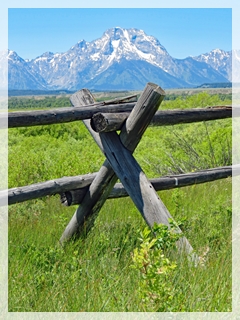
Tetons - Wyoming“Meh,” the verbal equivalent of a shoulder shrug, was added to the dictionary in 2008. Popularized by The Simpsons, it is a decisive assertion of non-commitment (or as decisive as having no opinion about something can be.) The New York Times used to run a list with the tagline, “Not hot. Not not. Just meh.” The list has included assorted celebrities and such things as Harrison Ford’s earring, petting zoos, Febreze, stocking stuffers, Tufts University, pumpkin ale, mugs with slogans, and the Golden State Warriors. The magazine’s culture editor, Adam Sternbergh, said the list was meant “to celebrate all those things in life that [are]…neither adored nor reviled, but, simply, meh.”

Whether we say “meh,” or dismissively use words and phrases like “whatever, it is what it is, I don’t care, not my problem, booooring, who cares” and “so what” we’re expressing indifference and an unwillingness to think about something. Apathy and disinterest are insulting: we don’t care enough to muster up any sort of approval, support, or regard for something but we also don’t care enough to dislike, oppose, or reject it.

Some in the media call Millennials “The Meh Generation,” but I fear that indifference, cynicism, disillusionment and jadedness are not limited to those born between 1982 and 2002. They’re not the only ones who find it easier to live together than commit to marriage or to walk away from a marriage than fight to save a family. They’re not the only ones who find it simpler to go along with the crowd than to stand up and speak or to accept what’s wrong rather than try to make it right. They’re certainly not the only ones who’ve decided the concept of sin is out of date, right and wrong is relative, or that anything goes as long as they aren’t the ones who get hurt. An ostrich puts its head in the sand to turn eggs but we put our heads there to avoid seeing what we don’t want to see. And, sadly, way too many in this world would put Jesus on “The Meh List” because He is “neither adored nor reviled, but, simply, meh.”

Jesus spoke of going through the gate to God’s Kingdom. At some point, we can’t ignore the gate’s presence or fail to form an opinion about the gatekeeper. We can no longer remain impartial, dispassionate or wishy-washy; a decision about following the shepherd has to be made. While neither death nor taxes can be avoided, remember that only the IRS grants extensions! Adore Jesus or revile Him but don’t simply shrug your shoulders and say, “Meh!”

I believe in my soul that there are more at this day being lost for want of decision than for any other thing. [Dwight L. Moody]

You can enter God’s Kingdom only through the narrow gate. The highway to hell is broad, and its gate is wide for the many who choose that way. But the gateway to life is very narrow and the road is difficult, and only a few ever find it. [Matthew 7:13-14 (NLT)]

Copyright ©2018 jsjdevotions. All rights reserved.

SEEING THE OTHER SIDE

Monarch buttefliesNow all glory to God, who is able, through his mighty power at work within us, to accomplish infinitely more than we might ask or think. [Ephesians 3:20 (NLT)]

“He’s so young!” said my husband when my brother died at the age of fifty-six. I reminded him that my dad was the same age when he died. “But he was old!” my husband exclaimed. The difference, of course, is that we were in our fifties when my brother died but only in our twenties when my father did. That the same thing can look so different from two viewpoints makes me think of those tilt or magic motion cards that used to come in Cracker Jack© boxes. Done by something called lenticular printing, one card holds two or more different images. Titled one way, there might be the traditional Mona Lisa but, tilted the other way, she would be winking with a goofy grin on her face. Just as whether someone seems young or old depends as much on our age as theirs, what is perceived on a tilt card depends on the angle at which it is viewed.

When we look at a magic motion card, we only see what’s right in front of us but, when God looks at one, He sees if from all sides. Looking at life from just our viewpoint, we only see what’s happening now and how it affects us and those we love. We see the delay and feel the frustration of waiting but, from His viewpoint, God also sees us learning patience. We see the task and protest that our work is too demanding but He sees that we’re learning determination. We see the unknown and hesitate in fear but He sees us learning to trust Him. We see the betrayal and feel resentment but He sees us learning to forgive. We see the burden of caregiving and grow tired but He sees us learning about sacrifice. We see the cranky in-laws and get exasperated but He see us learning about unconditional love. We see the failure and are disheartened but He sees us developing resilience. Rather than looking at circumstances from just our viewpoint, we need to tilt the picture and look at circumstances through the eyes of God.

One of my favorite Bible verses is Jeremiah 29:11: “For I know the plans I have for you,” says the Lord. “They are plans for good and not for disaster, to give you a future and a hope.” Unfortunately, that’s about as specific as God gets in detailing those plans. So, just as I can’t see both pictures on a tilt card at once, I have no idea what is on the other side of today’s challenges. I will just have to settle for knowing that our loving God sees it all and His plans for me are good ones.

God allows us to experience the low points of life in order to teach us lessons we could not learn in any other way. The way we learn those lessons is not to deny the feelings but to find the meanings underlying them. [Stanley Lindquist]

We can rejoice, too, when we run into problems and trials, for we know that they help us develop endurance. And endurance develops strength of character, and character strengthens our confident hope of salvation. And this hope will not lead to disappointment. For we know how dearly God loves us, because he has given us the Holy Spirit to fill our hearts with his love. [Romans 5:3-5 (NLT)]

Copyright ©2018 jsjdevotions. All rights reserved.

ONE OF THE BEST DAYS

Not that I was ever in need, for I have learned how to be content with whatever I have. I know how to live on almost nothing or with everything. I have learned the secret of living in every situation, whether it is with a full stomach or empty, with plenty or little. For I can do everything through Christ, who gives me strength. [Philippians 4:11-13 (NLT)]

clam pass - naplesThe weatherman declared it to be “one of the ten best days of summer” and I thought of his words throughout the day. How many of those ten days have we already had this summer? What if, not knowing it was one of the ten best days, I missed it? Could I have been blinded to its beauty by the routine obligations, boring chores, petty annoyances, and minor frustrations of everyday life?

When reading the list of his ordeals in 2 Corinthians, is would seem that the Apostle Paul probably missed enjoying most of the best days of every season. He faced death many times and endured several imprisonments, countless beatings (three times with rods), and numerous whippings (five times with 39 lashes which was the maximum punishment allowed). The victim of stoning once, Paul also was adrift at sea for a day and night and shipwrecked three times. Not only was Paul weighted down with his concern for the early church but he also had a “thorn” in his flesh, quite likely a chronic ailment, that had tormented him for fourteen years. Since he lived another nine to twelve years after writing the Corinthians, that thorn probably continued to plague him and more trials and troubles certainly followed. All in all, Paul travelled about 15,000 miles on land and sea and endured sleepless nights, hunger, thirst and cold, faced hazards from bandits and even his own people, and spent between five and six years of his life imprisoned before being beheaded by the Romans between 64 and 67 AD. He endured all of this to proclaim the gospel and yet Paul never complained about missing out on any of the “best” days because he knew the secret of living in every situation—of making every day his best day.

We shouldn’t need a weatherman to tell us it’s one of the ten best days and we certainly don’t need good weather for the day to qualify. In fact, every day should qualify as one of the ten best days of whatever season it happens to be. Paul, a man who endured horrible ordeals both physically and emotionally for the church, knew that best days had nothing to do with circumstances but everything to do with attitude. He tells us to be joyful, to pray, and to give thanks to God in all circumstances (and not just on the good days). With an attitude like his, in spite of his sufferings, every day Paul experienced must have been one of his best. I’d venture to say that most of us suffer far less than did the Apostle and yet, instead of starting the day cheerfully saying, “Good morning, Lord!” many of us grumble, “Good Lord, it’s morning!” Let this day be one of your ten best; after all, you don’t know how many more remain!

Always be full of joy in the Lord. I say it again—rejoice! [Philippians 4:4 (NLT)]

Always be joyful. Never stop praying. Be thankful in all circumstances, for this is God’s will for you who belong to Christ Jesus. [1 Thessalonians 5:16-18 (NLT)]

Copyright ©2018 jsjdevotions. All rights reserved.