
Other seed fell among thorns that grew up and choked out the tender plants so they produced no grain. [Mark 4:7]
 Some of the farmer’s seeds fell among the thorns (probably what we’d call thistles). Prolific seed producers, thorny plants like thistles can grow in the harshest environment. While they may have been cut down and no longer were visible to the farmer, their seeds and roots remained. With their deep roots, thistles are masters of survival and can flourish in adverse conditions. Stealing the moisture and sunlight from the plants around them, they stunt their growth and, if allowed to grow, can overtake a field.
The farmer’s seed was good, it took root, and started to grow but, because of the thistles, it never developed into maturity. The thistles represent the material concerns of the world—the cares, riches and pleasures that distract us from God’s word and, like a thistle’s roots, are deeply seated in our hearts. Rather than robbing us of water, sunlight, and nutrients, they stunt our growth by keeping us from God’s living water, the light of Christ, and the nourishment of His church. The busyness, distractions, and cares of life; the challenges of work and tending a family; the pursuit of wealth; the desire for possessions, status, amusement, contentment, and even revenge: all of these distract us from letting God’s Word bear fruit in our lives.
The faith of Judas was like a field with thistles. He heard the word and followed Jesus as a faithful disciple and yet he betrayed our Lord. We never know exactly why. Perhaps, it was simply for riches. John tells us he was a thief who stole from the disciples’ purse and we know he received money for his betrayal. Judas also may have been distracted by politics and a desire to be among the elite when Jesus defeated the Romans. Disillusionment may have set in when he realized that wouldn’t happen. Whatever it was, like a field of thistles, those distractions allowed Satan to enter him
In God’s perfect plan, there were no weeds and He didn’t mean for thorns or thistles to be in hearts, either. Weeds and sin both came with the fall. Ridding a field of thistles and other weeds is nearly impossible but, with diligence and hard work, it can be done. It takes continual inspection of the field and, once spotted, the weeds must be eradicated. The questions we must ask are simple ones. What are the thistles or thorns in my life? What is holding me back? What is keeping me from bearing His fruit? Is my faith genuine?
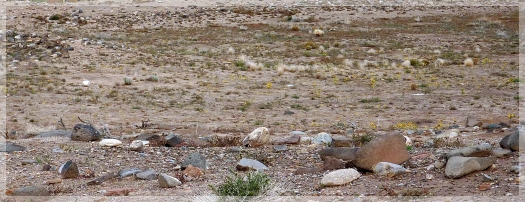 Other seed fell among rocks. It began to grow, but the plant soon wilted and died for lack of moisture. [Luke 8:6 (NLT)]
 In the gospels of Matthew, Mark and Luke, we find Jesus telling the parable of the four soils in which the farmer’s seed falls on four types of ground and yields four different results. Although the same good seed is sown over the entire field, only one kind of soil will yield a good crop. Jesus isn’t giving a lesson about agricultural practices; the seed that is sown is God’s word and the soils represent the different responses we have to God’s word. The lessons taught are both for the sowers—those who teach, preach, or witness—and for the soil—the people who hear the Word.
 Although it was noon during the heat of the day when most people would be resting, the woman came to the well for water. Perhaps, because she’d been married five times and was living with a man not her husband, the other women in the village made it clear that she wasn’t welcome in the early morning or late evening when they gathered there. Nevertheless, it was with this woman that Jesus had the longest one-on-one conversation recorded in Scripture. It was to this Samaritan woman that Jesus revealed He was the Living Water she so desperately needed.
 Yesterday, I wrote about the sin of sloth, a sort of spiritual weariness; fortitude is considered its contrasting virtue. Taken captive in 605 BC and forced to trudge the 500 miles from Jerusalem to Babylon, Daniel is an example of fortitude. He lost his home, family, name, language, culture, nation, and possibly his manhood but the one thing he never lost was his faith in God. From the moment he arrived in Babylon, Daniel refused to compromise his principles by refusing to defile himself with prohibited food. Sixty-six years later, he was still determined to stay true to God. In spite of knowing he would be thrown to the lions for his actions, he ignored the law prohibiting praying to anyone but King Darius. Instead, Daniel opened his windows and, as he’d “always done,” prayed to the one true God while offering thanks and asking for God’s help. [Daniel 6:10-11]
 While some of us may have become couch-potatoes during his time of sheltering in place, that’s not truly the sin of sloth. Thought of as one of the seven “deadly sins,” sloth originally was two sins: acedia (meaning absence of care) and trisitia (meaning sorrow). A 4th century monk, Evagrius of Ponticus, listed them (along with gluttony, lust, greed, anger, vainglory, and pride) as the “terrible temptations” of life. Acedia and sadness were seen as particularly dangerous threats to the ascetic life of a monk living in the Egyptian desert, as was Evagrius. The monks easily could grow despondent, lonely, weary or discontented as they prayed, fasted, and labored in their harsh and isolated setting.
