HIS CLOAK (Part 2 – Mark 10:46-52)

So throwing off his cloak, he sprang up and came to Jesus. Then Jesus said to him, “What do you want me to do for you?” The blind man said to him, “My teacher, let me see again.” Jesus said to him, “Go; your faith has made you well.” Immediately he regained his sight and followed him on the way. [10:50-52 (NSRV)]

eastern bluebird

There is so much packed into the seven verse story of Bartimaeus that it justifies a closer look. Let’s back up just a few verses in Mark 10 to when, after reminding Jesus that they’d given up everything to follow Him, James and John asked for a favor. When Jesus inquired what they wanted, the disciplines said they desired privileged places in His coming Kingdom. In stark contrast, Bartimaeus didn’t ask a favor; instead he pled for mercy and asked only for his sight. The blind man got his request but the selfish disciples didn’t. If we have unfulfilled prayers, perhaps we should consider what we’re asking—are they favors for our advantage or pleas for God’s mercy?

If we back up a few more verses in Mark’s gospel, we come to when Jesus was just starting his journey toward Jerusalem and a young rich man approached Him. While he was sure he’d kept all the commandments, the man sensed something was missing so he asked Jesus what he needed to do to inherit eternal life. When Jesus told him to sell his possessions, give the proceeds to the poor, and come follow Him, the man’s face fell in disappointment. Treasuring his possessions more than eternal life, he departed.

In another contrast, we have Bartimaeus, the blind beggar who followed Jesus immediately and without question. It’s easy to think the sightless beggar left nothing behind when he followed Jesus but we’d be wrong. Mark adds an interesting detail—when Jesus called to Bartimaeus, the man threw aside his cloak before jumping up and going to Him. That cloak, a wide vest reaching to the ankles, was far more than an outer garment worn during the day. A man’s cloak was so valuable that it could be used as collateral for a loan. Mosaic Law, however, prohibited a lender from keeping it overnight because a cloak often was the only shelter, bed, pillow, or blanket a man had at night. Bartimaeus’ cloak was more than a coat; it was his home. While begging, he would have been sitting on his cloak with its lower part spread out in front of him to collect any coins dropped his way.

Throwing aside his cloak was an act of faith. That piece of clothing (and whatever money may have been on it) was all Bartimaeus had and as valuable to the beggar as all the rich man’s possessions were to him. The moment Bartimaeus threw it aside, the cloak and money were as good as gone—either stolen or kicked aside along the road. Whether blind or sighted, any man would be in dire straits without a cloak, but Bartimaeus did what the rich man couldn’t and left all he had to follow Jesus!

Bartimaeus left his cloak, John and James left their father, Simon Peter and Andrew left their fishing nets, Matthew left a lucrative job as a publican, and Paul left a promising career as a Pharisee but the rich young man wanted to take his old life with him. Thinking that we can keep our old lives while following Jesus is a little like expecting to stay dry when we jump into the pool! It just can’t be done!

When God becomes your only source, you don’t need plan B or C. He is more than enough! [Buky Ojelabi] 

Then Jesus told his disciples, “If any want to become my followers, let them deny themselves and take up their cross and follow me. For those who want to save their life will lose it, and those who lose their life for my sake will find it. [Matthew 16:24-25 (NSRV)]

Copyright ©2020 jsjdevotions. All rights reserved.

SON OF DAVID (Part 1 – Mark 10:46-52)

When Bartimaeus heard that Jesus of Nazareth was nearby, he began to shout, “Jesus, Son of David, have mercy on me!” [Mark 10:47 (NLT)]

columbine

Jesus and his followers were among the crowd of pilgrims passing through Jericho on their way to Jerusalem to celebrate Passover and the city was teeming with people. Picture the scene as pilgrims, donkeys, carts, and even sheep slated for sacrifice moved along the road. With people talking, animals bleating and braying, children running back and forth, and beggars calling out for alms, it was difficult for those following Jesus to hear Him speak.

Sitting by the road, in the midst of this confusion, was the blind beggar Bartimaeus. When he heard that Jesus was in the crowd, Bartimaeus stopped begging for alms and pled for mercy, crying out, “Son of David! Jesus! Take pity on me!” When people tried to quiet him, the beggar just shouted louder. Over the din of the crowd, this man’s desperate cry was enough to make Jesus stop. Of course, Jesus made it a practice to stop for the lost, outcast, and hurting. Just as He halted for the bleeding woman desperate for his healing touch and the tax man desperate enough to climb a tree, Jesus stopped for Bartimaeus and called the beggar to Him.

Throwing his cloak aside, the blind man stumbled his way through the crowd to find Jesus. When Jesus inquired what he wanted, Bartimaeus immediately asked for his sight. It was restored instantly and Mark’s gospel tells us the once blind beggar followed Jesus down the road toward Jerusalem.

One thousand years earlier, God had promised David that one of his descendants would be the Messiah: the one who would reign forever as the head of God’s kingdom. By Jesus’ day, the term “Son of David” was a title for the Messiah. Other Messianic prophecies promised that the Messiah would heal the sick, bring hearing to the deaf, make the lame walk, and give sight to the blind. Bartimaeus may have been blind but he recognized Jesus as the Messiah when he called Him “Son of David” and without hesitation asked for his sight. Acknowledging the man’s blind faith, Jesus said, “Your faith has saved you.” Indeed, had he not called out in faith, he would have remained a blind beggar until his dying day.

The blind man who received sight contrasts with the sighted religious leaders Jesus would soon meet in Jerusalem and call “blind guides” and “blind fools.” It’s ironic that a blind beggar, sitting in the dirt by the road, understood the prophecies and recognized the Messiah when the sighted couldn’t even see who was right in front of them!

The scroll of Isaiah the prophet was handed to him [Jesus]. He unrolled the scroll and found the place where this was written: “The Spirit of the Lord is upon me, for he has anointed me to bring Good News to the poor. He has sent me to proclaim that captives will be released, that the blind will see, that the oppressed will be set free, and that the time of the Lord’s favor has come.” He rolled up the scroll, handed it back to the attendant, and sat down. All eyes in the synagogue looked at him intently. Then he began to speak to them. “The Scripture you’ve just heard has been fulfilled this very day!” [Luke 4:17-21 (NLT)]

Copyright ©2020 jsjdevotions. All rights reserved.

THE POSSIBILITY OF FAILURE

For I can do everything through Christ, who gives me strength. [Philippians 4:13 (NLT)]

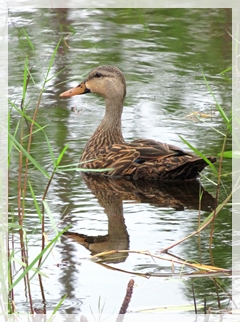
mottled duck“What would you do if you knew you could not fail?” the bumper sticker asked. That’s the sort of query that used to be posed to beauty pageant contestants. Their answers typically had to do with curing cancer, attaining world peace, or solving the problems of illiteracy, poverty and hunger. Of course, we’d all like to be able to wave a magic wand and solve the world’s difficulties. Unfortunately, it’s not that easy.

The question, however, continued to intrigue me. Is there something I would do if there was absolutely no possibility of failure? Would I even want to? Would there be joy in achievement if there were no struggles, no hurdles to jump and no problems to solve? There’s no sense of victory in playing a game when the opponent doesn’t present a challenge. The value of a diploma would be cheapened if we never had to study for final exams. The sense of satisfaction at a job well done would be diminished if we never had the possibility of failure. Failure is part of God’s training plan. The risk of failure brings us closer to God and reminds us that we can do nothing without faith in Him.

When Paul wrote the Philippians that he could do all things through Christ, did he mean he would be successful in every endeavor? Rather than a statement of self-reliance or guaranteed success, Paul was declaring his reliance on Christ. He wasn’t denying the possibility of adverse circumstances or failure; he was affirming his faith.

If we knew we couldn’t fail in an endeavor, we’d have no need for faith. Furthermore, the possibility of success or failure should never keep us from obediently following God’s direction. While the risk of failure should never stop us, lack of faith will.  As long as His Spirit is in us and we are walking in His footsteps, whether we succeed or fail, we will not fail the test of faith!

What would I do if I knew I couldn’t fail? Exactly what I’m doing now—sometimes successfully and other times not, but always in obedience to Him.

Our greatest fear should not be of failure but of succeeding at things in life that don’t really matter. [Francis Chan]

Examine yourselves to see if your faith is genuine. Test yourselves. Surely you know that Jesus Christ is among you; if not, you have failed the test of genuine faith. [2 Corinthians 13:5 (NLT)]

Three different times I begged the Lord to take it away. Each time he said, “My grace is all you need. My power works best in weakness.” So now I am glad to boast about my weaknesses, so that the power of Christ can work through me. That’s why I take pleasure in my weaknesses, and in the insults, hardships, persecutions, and troubles that I suffer for Christ. For when I am weak, then I am strong. [2 Corinthians 12:8-10 (NLT)]

Copyright ©2020 jsjdevotions. All rights reserved.

THE BUTTERFLY EFFECT

Remember the things I have done in the past. For I alone am God! I am God, and there is none like me. Only I can tell you the future before it even happens.  Everything I plan will come to pass, for I do whatever I wish. [Isaiah 46:9-10 (NLT)]

For want of a nail the shoe was lost, For want of a shoe the horse was lost, For want of a horse the rider was lost, For want of a rider the battle was lost, For want of a battle the kingdom was lost, And all for the want of a horseshoe nail. [Poor Richard’s Almanack (1758)]

painted lady - marigoldOf course, in another time or place, a missing nail might have better consequences. Without the nail, horseshoe and rider, the horse wouldn’t have been on the road, reared at the sight of a snake, and thrown off his rider (who died from his injuries)! Life is unpredictable.
Theorizing that weather prediction models are inaccurate because knowing the precise starting conditions is impossible and a tiny change can throw off the results, meteorology professor Edward Lorenz posed this question in 1972: “Does the flap of a butterfly’s wings in Brazil set off a tornado in Texas?” Of course, a single act like the butterfly flapping its wings won’t cause a cyclone but Lorenz’s point was that nature’s interdependent cause-and-effect relationships are too complex to resolve. Small variations in conditions can have massive, minor, or imperceptible consequences and it is impossible to predict which will be the case.

As if the magnitude of this pandemic isn’t proof enough, Lorenz’s “butterfly effect” reminds us that life is amazingly unpredictable. We often pray that God will fix, heal, repair, reverse, or resolve situations or people and are disappointed when it seems that God has turned a deaf ear to us. The answers to our prayers, however, are not up to us—they are up to Him and the people and situations we want God to change are frequently the people and circumstances that God is using to change us!

As weather forecasters have learned with the “butterfly effect,” we mortals can’t possibly see all of the consequences of the changes we request in our prayers. God is the only one capable of knowing the repercussions of any alteration. While we have a limited concept of what the future will bring, His view is all-encompassing; He sees not just our lives, but all of the lives before us, with us, and those yet to come. God knows exactly what will happen if He grants our prayers, not just to us but also to everyone else. Our faith is not that God will give us what we want but that God will give us what is best!

In retrospect, I can only offer thanks that God, in His infinite wisdom and love, didn’t give me everything for which I asked. When Garth Brooks thanked God for unanswered prayers, he was wrong. God always answers prayers; it’s just that sometimes He answers with a “No!”

Sometimes I thank God for unanswered prayers.
Remember when you’re talkin’ to the man upstairs
That just because he doesn’t answer doesn’t mean he don’t care.
Some of God’s greatest gifts are unanswered prayers. [Garth Brooks]

Oh, how great are God’s riches and wisdom and knowledge! How impossible it is for us to understand his decisions and his ways! For who can know the Lord’s thoughts? Who knows enough to give him advice? [Romans 11:33-34 (NLT]

Copyright ©2020 jsjdevotions. All rights reserved.

THE PEACE STORE

I have told you all this so that you may have peace in me. Here on earth you will have many trials and sorrows. But take heart, because I have overcome the world. [John 16:33 (NLT)]

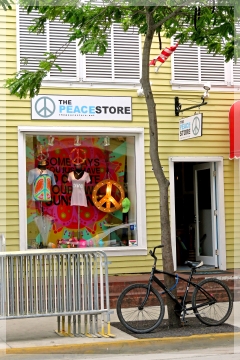
Peace Store - Key West, FLBetween demonstrations that turn into brawls or rioting, incidents of mask rage, shootings, negative and misleading political ads, quarrelsome legislators, nations accusing one another of espionage and fraud, and the assorted armed conflicts throughout the world, I wish we could purchase peace as easily as we can items from Key West’s Peace Store. Actually, given the anger and nastiness so prevalent in the world today, I’m afraid wearing one of their tee-shirts politely requesting “Peace Please” or a face mask with the peace symbol could cause conflict rather than promote peace! Real peace, however, is more than the absence of conflict and it’s not something that can be purchased in Key West or anywhere else.

The Greek word usually translated as peace in the New Testament is eirēnē. In classic Greek, it meant the absence of war but, when found in the New Testament, eirēnē has a far broader meaning. This expanded meaning is because Jesus didn’t speak Greek and the word He would have used was shalom, which meant well-being in the widest sense of the word. In the Hebrew Scriptures, along with the lack of conflict, shalom was used for prosperity, physical health, contentedness both when going to sleep and at death, good relationships between nations and people, and salvation. When Gideon built an altar to the Lord, he named it Yahweh-Shalom, which meant “the Lord is peace.” For a Jew, shalom was the sense of general well-being that came from God alone.

When Jesus promised us peace or shalom, along with absence of discord, He included a sense of wholeness, health, welfare, safety, rest, soundness, tranquility, prosperity, perfectness, fullness, freedom from care, acceptance, and harmony. If we could purchase any or all of those at the Peace Store, their website would crash, the line out the door would be a mile long, and the store owners would be among the Fortune 500!

We can’t purchase peace because Jesus, the Prince of Peace, purchased it for us; shalom is ours simply for the asking. That peace doesn’t mean lack of hardship, sickness, death, grief, or difficulties. In fact, Jesus pretty much guaranteed we’d have those. He did, however, promise peace in every one of those situations.

If you’re ever in Key West, you can check out the Peace Store where they say, “Peace is always in fashion.” If, however, you’re looking for true peace, the kind of peace that far exceeds our understanding, you’ll find that only in a relationship with God. If we remain in Christ, keep the Holy Spirit within us, are obedient to His word, study and pray, serve and love, the shalom promised by the Prince of Peace will remain bright within our hearts and souls. Calling Key West “the gateway to paradise,” the Peace Store was wrong; the true path to paradise is found only in Jesus and His gospel of peace.

God cannot give us a happiness and peace apart from Himself, because it is not there. There is no such thing. [C.S. Lewis]

I am leaving you with a gift—peace of mind and heart. And the peace I give is a gift the world cannot give. So don’t be troubled or afraid. [John 14:27 (NLT)]

This is the message of Good News for the people of Israel—that there is peace with God through Jesus Christ, who is Lord of all. [Acts 10:36 (NLT)]

Copyright ©2020 jsjdevotions. All rights reserved.

THE SCARLET CORD

tulip kaufmanniana - fire ball

Faith shows the reality of what we hope for; it is the evidence of things we cannot see. Through their faith, the people in days of old earned a good reputation. [Hebrews 11:1-2 (NLT)]

One of only two women listed in the book of Hebrews’ “Hall of Faith,” Rahab married Salmon, was the mother of Boaz (who married Ruth), a great-great grandmother to David, and one of Jesus’ ancestors. Not an Israelite, she was a prostitute from Jericho who collaborated with her nation’s enemy. Yet, her faith is commended in Hebrews, Matthew makes specific mention of her in Jesus’ genealogy, and James speaks highly of her in his epistle. Why?

Rahab met many travelers in her dubious profession and heard how the Israelites passed through the Red Sea, defeated the Amorite kings Sihon and Og, and slaughtered all of their people. Recognizing the Israelites’ God as supreme, she anticipated Jericho’s defeat and the perceptive woman judiciously aligned herself with the winning side. After protecting two Israelite spies by hiding them from the king’s men, she requested the same loyalty to her that she’d given them and negotiated for the safety of herself and her family. As Rahab lowered the spies to safety on a scarlet cord, they warned that her protection was only ensured if she had that same cord visible on the day of their attack. True to their word, when Jericho fell, Rahab and her family were saved. Was it Rahab’s treason to Jericho that caused her to be mentioned so highly in a gospel and two epistles or was there more?

After leaving Rahab’s house, the spies hid in the hills for three days before returning to camp and reporting to Joshua. After that, the Israelites broke camp and moved to the banks of the Jordan where they stayed another three days before crossing the river. Once across, they erected memorials to commemorate their crossing by God’s power. Four days later, the people celebrated the first night of Passover and, at some point, all of the men were circumcised. While the Israelites observed the eight days of Passover and Feast of Unleavened Bread and the men recovered from their surgery, the invincible city of Jericho closed its gates and readied itself for battle. By then, Rahab had waited at least two weeks for the Israelites and her rescue. Did she begin to doubt the two spies and their God? Had they forgotten about her or did she pick the wrong ally? Did she consider bringing in that scarlet cord and making an alliance with a protector in Jericho? Was she tempted to lose faith in the God of the Israelites?

Eventually, the Israelites set off to conquer Jericho but they didn’t assault the town or lay siege to it. Instead, seven priests blowing rams’ horns followed by 40,000 silent soldiers paraded once around the walled city with the Ark of the Covenant before returning to their camp. For six days, Rahab watched from her window as the Israelites marched once around Jericho and returned to their camp without ever lifting a weapon or shouting a war cry. Was her faith shaken by their strange behavior? Were the Israelites too afraid to attack? What kind of God used such a bizarre battle plan? On the seventh day, when she watched the Israelites parade seven times around the city, did she abandon all hope as she witnessed what appeared to be another day of even more pointless marching? Apparently not; that scarlet cord, the sign of her faith in the God of the Israelites, was still hanging from her window. When the army finally shouted, the walls of the unconquerable city collapsed and Rahab and her family were saved.

The walls of Jericho were leveled by faith in God. Rahab helped two strangers and kept that scarlet cord dangling from her window by that same faith. When God’s plan seems inexplicable or a long time in coming, do we exhibit a similar kind of faith? When things seem at a standstill, when we can’t see His plan, do we despair or do we hang out a scarlet cord of faith in God?

It was by faith that the people of Israel marched around Jericho for seven days, and the walls came crashing down. It was by faith that Rahab the prostitute was not destroyed with the people in her city who refused to obey God. For she had given a friendly welcome to the spies. [Hebrews 11:30-31 (NLT)]

Copyright ©2020 jsjdevotions. All rights reserved.