
May those who sow in tears reap with shouts of joy! He that goes forth weeping, bearing the seed for sowing, shall come home with shouts of joy, bringing his sheaves with him. [Psalm 126:5-6 (RSV)]
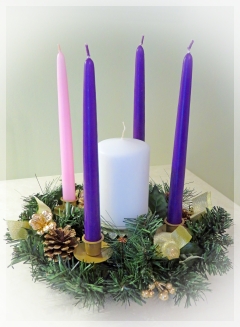
 Colors have been used to differentiate liturgical seasons since the 4th century and, by the 12th century, Pope Innocent systemized their use in the church. Originally Advent was about penance, prayer and fasting in preparation for baptism so purple (the color associated with sacrifice and repentance from sin) was its liturgical color. Like the Advent wreath, however, liturgical colors are merely traditions and have no basis in Scripture. Most denominations have added more colors to the original five.
Representing the traditional Advent color of penitence, three of the four candles on our wreath are purple. This Sunday’s candle, however, is pink—the traditional color of joy and happiness—and the day’s Scripture readings are joyful ones. They start with the good news for the oppressed found in Isaiah 61 followed by the psalmist’s promise of a harvest of joy in Psalm 126. In the gospel, the good news of Isaiah 40 is repeated by John the Baptist and, in the epistle, Paul tells the Thessalonians always to be joyful. After the somber and apocalyptic readings of the last two Sundays, these readings are a welcome change. In the Roman Catholic Church, this Sunday is known Gaudete Sunday. The name comes from the Latin translation of Philippians 4:4—Gaudete in Domino sempe meaning “Rejoice in the Lord always”—which were the first words of the introit for mass on the third Sunday of Advent.
Those words, however, shouldn’t be limited to this one Sunday because Paul’s words weren’t a suggestion; they were a command! Reasons to rejoice, however, seem to be in short supply right now and, rather than rejoicing, many are grieving. While some may grieve the actual loss of loved ones, we’re all grieving the loss of our sense of normalcy. Christmas is a holiday filled with long-standing traditions, many of which won’t be observed this year. In a season when friends and family are front and center, we won’t be home for the holidays or gathering with those we love. A malicious virus will keep us from travel, festive parties, visits to Santa, holiday parades, crowded candlelight Christmas Eve services, Christmas markets, neighborhood potlucks, cookie exchanges, and the annual sing-along Messiah. This pandemic seems to have stolen Christmas the way the Grinch did when he terrorized Whoville by stealing all the Christmas presents, food, and decorations.
But, let’s remember—when the Grinch heard every Who down in Whoville sing joyfully on Christmas morning, he realized that Christmas didn’t come from a store! The lighting of this candle of joy will remind us of that same thing. Christmas isn’t about enjoying family and friends and observing decades old traditions. It’s about rejoicing in the good news that a Savior was born—rejoicing that because Jesus atoned for our sins, rather than being separated from God, we are His sons and daughters. It’s rejoicing that Heaven will be our home someday. It’s rejoicing that, even though we plant in tears, we will harvest in joy! Whether or not you light the candle of joy on an Advent wreath, be sure to rekindle the candle of joy in your heart!
 My New York Times newsletter has a section called “What You’re Doing” in which readers share how they’re dealing with the pandemic—everything from dreaming up innovative waffle recipes to sending “karaoke grams” to friends on their birthdays. Today, M.B. wrote that she’d started 2020 with a line-a-day diary. Since March, however, she’d filled the diary with “dire COVID milestones, illness among family and friends, anger at deniers, and mourning for the loss of normal life, vacations, and more.” Tiring of her negativity on Thanksgiving Day, M.B. turned that line-a-day diary into a daily gratitude journal and reported having a positive attitude that will carry her through the pandemic.
 Last Sunday, my husband and I lit the candle of hope on our Advent wreath. This Sunday, we’ll re-light that one along with a second candle, the one we call the peace or Bethlehem candle. Because the Advent wreath custom has been adapted in a variety of ways through the years, there are several names for the candles and explanations for their symbolism that probably have more to do with the selling of wreaths, candles, and devotional booklets than with church tradition. There are no official names, meanings or rituals because an Advent wreath isn’t based on Scripture. It’s merely a tradition to help make this season more meaningful.
 With the back-to-back hurricanes that tore through Louisiana, two others that devastated Nicaragua and Honduras, and the consecutive typhoons that flooded the Philippines, a great many people must be asking, “Why us, Lord?” In spite of the meteorological explanations for the paths taken by those storms, there is something discomforting about the seeming randomness of such destruction. I can’t help but wonder, “Why them and not us?” In a universe of retribution and reward, we’d have a sense of being able to control our destiny; only bad things would happen to bad people and only good things to the good ones. If we did all the right things, life would go smoothly and, if we didn’t, we’d just be getting what we deserved! That, however, is not the way of the world and back-to-back hurricanes along with cancer, ALS, hit-and-run-drivers, stray bullets, and tornadoes hit both the deserving and undeserving.
 My daughter has become quite adept at hiding Christmas gifts from her husband. If she doesn’t, he will find the presents and open them early; patience is not one of his strong suits. It wasn’t one of Sarah and Abraham’s either. Although they’d been promised a son and many descendants, they grew impatient waiting and took matters into their own hands. Sarah gave Abraham her maidservant Hagar with whom to make a child. Although she made the offer, he didn’t have to accept—but he did. The boy Ishmael was the result of their rashness and the rivalry and strife that continue today in the Middle East came from that impatience. Like Sarah and Abraham, when my son-in-law knows a gift is coming, he just can’t wait until the correct time to receive it. Fortunately, while his wife may get annoyed when he takes matters into his own hands, his impulsiveness hasn’t resulted in centuries of international conflict.
 It’s less than a month until Christmas. This Christmas will be vastly different from past ones for us as I imagine it will be for you. Traditionally, our holiday season has been a busy and festive one of concerts, friends, church, fellowship activities, volunteering, entertaining, and family but being in the midst of a pandemic has changed all that. In an attempt to keep the spirit of Christmas alive in what has been a dreary and disappointing year, I’ve started decorating for the holiday and playing Christmas music. Christmas, however, is more than decorations, carols, presents, parties, and peppermint bark. Perhaps not having all of the fun-filled extras of this season will help us focus on its true meaning.
