TOO HEAVY

My thoughts are nothing like your thoughts,” says the Lord. “And my ways are far beyond anything you could imagine. For just as the heavens are higher than the earth, so my ways are higher than your ways and my thoughts higher than your thoughts. [Isaiah 55:8-9 (NLT)]

mockingbirdAfter Jane Marczweski’s stunning performance on America’s Got Talent last June, I posted a devotion (It’s Okay) about her. Known as Nightbirde, the 30-year-old vocalist (and three-time cancer survivor) sang an original song called “It’s Okay” and received the “golden buzzer” from judge Simon Cowell. Last week, the brave young woman had to withdraw from the competition because her health has taken a turn for the worse. In an interview on CNN with Chris Cuomo, she shared that her metastatic breast cancer has now invaded both lungs and liver and her fight with cancer is demanding all of her energy and attention.

When we see a young person like Nightbirde, a beautiful person both inside and out who seems so deserving of good future, it’s easy to ask the age-old question of “Why?” Why do some of the best people, the ones with the most to offer, seem to suffer the most or have their futures cut short when many of the worst and worthless seem to breeze along without a problem? Why, when life begins to look up does God so often pull out the rug? “Life doesn’t always give breaks to those that deserve it,” said the singer while adding, “but we knew that already.” Indeed, we did; nevertheless, we don’t like it!

When Cuomo asked Nightbirde if she ever wonders, “Why?” the young woman replied, “I try not to occupy myself with questions that are too big for myself to answer. It’s a waste of time. You know, just because it’s a mystery doesn’t mean it’s the absence of meaning. Sometimes, the mystery means there is more meaning there than we can even understand and so I accept that and I let go of the question because it’s too heavy.”

Indeed, much in our lives seems inexplicable and far beyond our comprehension. But, as the young singer pointed out, incomprehensible or unknowable doesn’t mean meaningless or pointless. It’s a mystery why Nightbirde’s promising future probably will be cut short; then again, it’s a mystery why my mother died when I was fifteen, why my brother was struck with inoperable cancer at the moment his life finally took an upturn after years of trouble, and why the God-fearing believers on my prayer list have been burdened with things like mesothelioma, Alzheimer’s, Parkinson’s, MS, schizophrenia, and chronic pain. This young woman’s words remind us all that our lack of understanding of God’s purpose doesn’t mean that what happens is without meaning.

I can’t understand quantum physics any more than I can understand the ways of God. The difference between the two is that, given enough time, effort, and tutoring, I eventually could understand quantum physics but I will never be able to fully understand God. While we can come to know and love Him, we never will be able to comprehend His mysterious ways. Indeed, some questions are so weighty that we’d never make sense of God’s answer even if He explained it to us!

This optimistic young woman says she’s planning for her future rather than her legacy and says, “I want to be the bird that sings in anticipation of the good things that I trust are coming.” As a Christian, Nightbirde doesn’t need to ask God “Why?” because she knows good things are coming, whether in this world or the next!
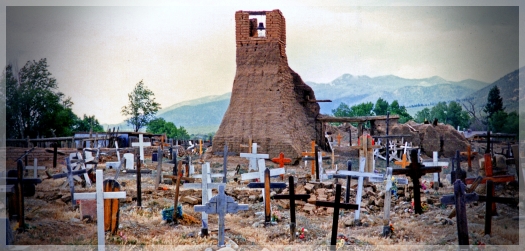
Oh, how great are God’s riches and wisdom and knowledge! How impossible it is for us to understand his decisions and his ways! For who can know the Lord’s thoughts? Who knows enough to give him advice? And who has given him so much that he needs to pay it back? For everything comes from him and exists by his power and is intended for his glory. All glory to him forever! Amen. [Romans 11:33-36 (NLT)]

Copyright ©2021 jsjdevotions. All rights reserved.

DRY BONES

Taos NMThen he said to me, “Speak a prophetic message to these bones and say, ‘Dry bones, listen to the word of the Lord! This is what the Sovereign Lord says: Look! I am going to put breath into you and make you live again! I will put flesh and muscles on you and cover you with skin. I will put breath into you, and you will come to life. Then you will know that I am the Lord.’” [Ezekiel 37:4-6 (NLT)]

The Jewish people were in despair. Jerusalem was in ruins and the Temple destroyed. Exiled to Babylon, they were without a king, homeland, or hope. God’s promise of Israel’s restoration is depicted in Ezekiel 37 when the prophet is transported in a vision to a valley filled with desiccated bones. The Lord instructs Ezekiel to speak a prophecy over the dry bones that the Lord will bring them back to life. As the prophet begins to speak God’s words, the bones start rattling and coming together as skeletons. The prophet watches as muscles, tendons, and skin cover the bones until they became fully formed bodies. Although the bodies look alive, they are no more than unbreathing corpses until the Lord instructs Ezekiel to tell the four winds to breathe life into the lifeless beings. As the prophet speaks God’s words, he witnesses the once dead bodies come alive, stand erect, and become a great army. The initial meaning is pretty obvious: the bones coming back together illustrate Israel’s restoration and the wind or breath entering the dead bodies illustrate spiritual renewal or rebirth.

Be that as it may, as a Sunday schooler who didn’t understand the story behind Ezekiel’s somewhat eerie vision, picturing those dry bones rattling and rising up gave me the creeps. Perhaps it was because of the children’s song Dem Dry Bones. Even though we sang it in Sunday school, the song was associated more with Halloween (and its ghosts and goblins) than Biblical prophecy. Sometimes, a second verse was added in which Ezekiel, after connecting those bones, disconnected them—not a pleasant visual for any child! Perhaps I’d simply seen too many Saturday matinees with zombies, mummies, or other creatures of the night. Not understanding the context behind Ezekiel’s prophecy, the whole vision seemed as macabre as does the Body Worlds exhibit that features real skinless corpses preserved in plastic.

Yesterday’s devotion mentioned how I enjoy listening to worship music on my frequent trips to and from my doctor’s appointments. When I first heard Elevation Worship’s Rattle, with its words, “And the bones began to rattle, rattle, rattle, rattle…This is the sound of dry bones rattling,” I initially thought of Ezekiel’s vision. The thought of hearing dry bones rattling immediately brought up the old ghoulish images from childhood. But, as I listened to the rest of their words, those bones weren’t the dry ones in Ezekiel’s vision. As they sang, “Saturday was silent, Surely it was through. … Friday’s disappointment is Sunday’s empty tomb,” I understood they were singing about Jesus rising from the grave and the renewal of life for those who are restored by His power.

Today, I returned to Ezekiel 37 and saw his vision as more than a simple prophecy of the people’s return from their exile in Babylon, the reconstitution of the modern state of Israel, and/or the end times and the second coming of Christ. I saw it as a beautiful story of hope and rebirth. Although the prophecy was for Israel, I see Ezekiel’s vision as an illustration of what God can do for and with us right now—the life-giving power of His word to put back together the pieces of our broken lives and the power of the Spirit’s breath to bring us back to spiritual life! No longer will I cringe at the thought of dry bones rattling and rising. They tell me that no one ever is beyond restoration—no one is ever so spiritually dead that he or she can’t come alive again. The rattle of dry bones will remind me that, without the resurrection power of Jesus and the breath of the Spirit, we are little more than dry bones in a valley.

No difficulties in your case can baffle him, no dwarfing of your growth in years that are past, no apparent dryness of your inward springs of life, no crookedness or deformity in any of your past development, can in the least mar the perfect work that he will accomplish, if you will only put yourselves absolutely into his hands and let him have his own way with you. [ Hannah Whitall Smith]

Jesus told her, “I am the resurrection and the life. Anyone who believes in me will live, even after dying. Everyone who lives in me and believes in me will never ever die. [John 11:25-26 (NLT)]

Copyright ©2021 jsjdevotions. All rights reserved.

FAITHFUL AND ABLE

God is not a man, so he does not lie. He is not human, so he does not change his mind. Has he ever spoken and failed to act? Has he ever promised and not carried it through? [Numbers 23:19 (NLT)]

 I will look up for there is none above you;
I will bow down to tell you that I need you.
Jesus, Lord of all; Jesus, Lord of all!
I will look back and see that you are faithful;
I look ahead believing you are able.
Jesus, Lord of all; Jesus, Lord of All!
[I Will Look Up (Redman, Ingram, Joye, Brown, Brock)]

columbineIn our family, the car’s driver controls the music. Since my husband usually drives, that tends to be ‘50s and ‘60s rock. My thrice weekly chiropractor appointments, however, have given me the opportunity to listen to worship music rather than golden oldies. Last week, while alone in the car, I joined with Elevation Worship as they sang of laying the worries of the world, the needs of their loved ones, their hopes and dreams, and every anxious thought at God’s feet. “I will look back and see that you are faithful; I look ahead believing you are able!” Those words are so true and yet I frequently forget to look back to God’s past provision or ahead with trust that He is able to provide exactly what is needed.

Singing, “All my life is in your hands,” I wondered if we truly believe that. After laying our worries at His feet, do we ever doubt His faithfulness and ability, pick them up, and take them back again? Do we have reservations about our incredibly faithful and overwhelmingly able God because we know how fallible and incompetent we often are? My life is filled with a series of mishaps, misunderstandings, and failures and I suspect yours is, too. We misplace our phones and have to call ourselves to find them. We read the words “dry clean only” but toss the sweater into the washer. We proof-read a dozen times only to find mistakes in the finished product and write grocery lists but leave them at home. We miss appointments, arrive late, and don’t return calls. We mean to do a task but forget and often claim to know what we’re doing when we haven’t a clue. We promise but disappoint, plan but fail to carry out, and our repairs frequently make the problem worse. We say we’ll pray for someone and don’t, intend to write a letter but never get around to it, or get exasperated when we mean to be calm. That’s not even mentioning the other assorted betrayals, deceit, debacles, and transgressions of which we’re all capable. Knowing how incredibly unreliable and faithless we can be, we often doubt God. God, however, is perfect—we, most certainly, are not!

Hearing the words, “I will look back and see He is faithful,” I did just that. I looked back and saw God’s faithfulness to me in every crisis and dark valley I’ve encountered. From Genesis through Revelation, we see God’s faithfulness to His children and, in the life, death, and resurrection of Jesus we see His promises fulfilled. Flawed beings that we are, we’re often unfaithful to our promises or unable to fulfill them but our perfect God is both faithful to His promises and more than able to fulfill every one! Although I’ve failed the ones I love and, at times, they’ve failed me, God never has and never will!

Understand, therefore, that the Lord your God is indeed God. He is the faithful God who keeps his covenant for a thousand generations and lavishes his unfailing love on those who love him and obey his commands. [Deuteronomy 7:9 (NLT)]

Your eternal word, O Lord, stands firm in heaven. Your faithfulness extends to every generation, as enduring as the earth you created. [Psalm 119:89-90 (NLT)]

Copyright ©2021 jsjdevotions. All rights reserved.

HIS MEGAPHONE

We know, in fact, that God works all things together for good to those who love him, who are called according to his purpose. [Romans 8:28 (NTE)]

Pain insists upon being attended to. God whispers to us in our pleasures, speaks in our conscience, but shouts in our pain: it is His megaphone to rouse a deaf world. [C.S. Lewis]

columbineWhen we’re hurting, it’s not easy to reconcile how an entirely good, ever-loving, and all-powerful God can allow pain and suffering. The simplest answer is that, since He gave us free will, we can’t hold Him responsible for what mankind has done with that free will. We can’t blame God for global warming, tooth aches, concentration camps, genocide, cancer, red tide, wars, tornadoes, torn ligaments, or rising COVID cases. We alone are the ones responsible for mankind’s poor choices and the disease, death, destruction, and suffering that have accompanied us since we were evicted from Eden.

Pain tells us something is wrong and often begins with little nudges, ones that are easy to disregard. However, when the pain gets bad enough, it can’t be ignored. C.S. Lewis calls pain God’s “megaphone to rouse a deaf world.” I don’t know how well the world is listening to Him but I know that my recent issues with neck and back pain got my attention!

While discerning the physical reason for my pain was relatively easy, I suspected there was more to it than arthritis, herniated discs, bone spurs, ergonomics, posture, and too many hours at the computer. God doesn’t haphazardly distribute pain and trials. If pain is God’s way of getting our attention, we need to understand what God is telling us with it—to discern God’s purpose so that we can get on board with His plan.

A little soul searching and prayer told me that it wasn’t just my body that had gotten out of alignment—so had my priorities. Like the busy Martha, I’d lost sight of Jesus while serving Him. I’d been busy asking what God wanted me to do for Him when I should have been asking what He wanted to do with me. My pain knocked me to my knees in such a way that I had to surrender to God, abide in Him, and trade self-sufficiency for God-dependence.

Pain and adversity in our fallen world can’t be avoided. Perfect health isn’t promised any more than are perfect marriages, spouses, children, weather, or jobs. When God gets out His megaphone, we must step back to get some perspective so that, instead of focusing on what is happening to us, we can discern how God is using the circumstances for us.

“If this is the worst thing that’s happened to me, I’m way ahead of the game,” said a friend who is enduring her own share of pain. That sort of puts things in perspective, doesn’t it? One glance at the people on my prayer list tells me it could be far worse! In the meantime, may we always remember that it is God’s presence in our painful circumstances that gives them meaning.

God has no pleasure in afflicting us, but He will not keep back even the most painful chastisement if He can but thereby guide His beloved child to come home and abide in the beloved Son. [Andrew Murray]

Though the Lord gave you adversity for food and suffering for drink, he will still be with you to teach you. You will see your teacher with your own eyes. Your own ears will hear him. Right behind you a voice will say, “This is the way you should go,” whether to the right or to the left. [Isaiah 30:20-21 (NLT)]

In his kindness God called you to share in his eternal glory by means of Christ Jesus. So after you have suffered a little while, he will restore, support, and strengthen you, and he will place you on a firm foundation. [1 Peter 5:10 (NLT)]

Copyright ©2021 jsjdevotions. All rights reserved.

TRYING TO SERVE TWO (Part 3)

You must not have any other god but me. You must not make for yourself an idol of any kind, or an image of anything in the heavens or on the earth or in the sea. You must not bow down to them or worship them, for I, the Lord your God, am a jealous God who will not tolerate your affection for any other gods. [Deuteronomy 5:7-9a (NLT)]

campionAlthough Elisha once worked his land with a plow and oxen, after he accepted Elijah’s cloak, he burnt his plow and oxen, left home, and joined Elijah as an itinerant prophet who depended on others for food and shelter. We know that every time Elisha passed through Shunem, he was fed and sheltered by a family there and Scripture tells us that pious Israelites commonly brought gifts to the prophets they consulted. So why wouldn’t Elisha accept any of Naaman’s generous gifts?

As a pagan Aramean who was ignorant of Jehovah, Naaman was used to priests and prophets who greedily demanded rewards for their services. As a servant of God, however, Elisha knew it was wrong to accept payment for Naaman’s healing. After all, he’d done nothing but tell the man to wash himself in the Jordan seven times. Elisha’s refusal of payment made it clear to Naaman that Israel’s powerful God alone had done the healing and God’s grace and miracles are not for sale. When Jehovah made Himself known to the pagan warrior, Naaman realized that, rather than being one of many gods, the God of Israel was the only God. Saying, “There is no God in all the world except in Israel,” the Aramean vowed never again to worship another god.

Naaman then made a rather strange request—that he be allowed to load two mules with some of Israel’s dirt to take back home. While that seems a bizarre sort of souvenir to us, it made perfect sense to Elisha. The pagan people of the ancient Near East believed that gods were tied to the lands they ruled and that a deity only could be worshiped on the soil of the nation to which he was bound. If Naaman wanted to worship Israel’s God, he thought it necessary to use some of Israel’s dirt to make a brick altar on which to make sacrifices. The man who once undervalued and scorned Israel’s Jordan River now overvalued its dirt and wanted to take some back to Damascus! The pagan didn’t understand that all of earth’s soil is God’s!

Having converted to the God of Israel, Naaman made one more request of Elisha. Even though his heart was committed to Jehovah, Naaman knew there would be occasions when he would be required to enter the pagan temple with his master the king. The warrior requested Elisha’s permission and God’s forgiveness when he bowed to the Aramean god Rimmon. Although we’d expect Elisha to respond with the first commandment, the prophet didn’t address Naaman’s dilemma. He simply encouraged the man’s desire to be faithful to God while serving a pagan king with these words, “Go in peace.”

Elisha’s words were ones of grace acknowledging that the world is filled with difficult decisions for people of faith. Unlike Naaman, we may not be expected to bow down to an idol to please the king, but we regularly face both big and small moral dilemmas when we’re asked to bow to the idols of position, appearance, popularity, success, status, fashion, fame, wealth, reputation, or sex. We must ask ourselves who is our master and to what will we bow.

We don’t know what happened to Naaman but I wonder how serving two masters worked for him! I suspect one of them was not pleased.

So fear the Lord and serve him wholeheartedly. Put away forever the idols your ancestors worshiped when they lived beyond the Euphrates River and in Egypt. Serve the Lord alone. [Joshua 24:14 (NLT)]

Jesus replied, “The Scriptures say, ‘You must worship the Lord your God and serve only him.’” [Luke 4:8 (NLT)]

Copyright ©2021 jsjdevotions. All rights reserved.

HERESIES – Polycarp (Part 2)

So, then, just as you received King Jesus the Lord, you must continue your journey in him. You must put down healthy roots in him, being built up brick by brick in him, and established strongly in the faith, just as you were taught, with overflowing thankfulness. [Colossians 2:6 (NTE)]

cross in ZermattAlthough many Christian writings refer to Polycarp, only one of his letters remains. Written to the church at Philippi sometime before 150 AD. Polycarp addressed the behavior of a greedy bishop named Valens, explained that true righteousness sprang from true belief, and warned against false teachings. Containing 12 quotes from the Old Testament and 100 quotes or paraphrases from the New, this epistle has been described as a “mosaic of quotations” from the Bible. Using language from what now are known as the books of Matthew, Mark, Luke, Acts, Romans, 1 and 2 Corinthians, Galatians, Ephesians, Philippians, 1 and 2 Thessalonians, 1 and 2 Timothy, Hebrews, 1 Peter, and 1 and 3 John, his letter is testimony both to the existence of these texts by mid-2nd century and that the early church already believed them to be inspired Scripture.

In his letter, Polycarp addressed the heresies of Gnosticism and Marcionism that had found their way into the early church. Probably a greater threat to the early church than persecution, Gnosticism was a combination of religion and philosophy taken from Babylonian beliefs, Zoroastrianism, Hinduism, and assorted cults, along with the philosophies of Greeks like Plato, Aristotle, and Pythagoras. In a nutshell, early Gnostics believed in dual realities — essence/spirit/light (considered good) and material/body/dark (considered evil) — much like the Chinese yin and yang. They also believed in the secret knowledge or gnosis of salvation. Of course, such a philosophy can’t really be put in a nutshell. Polycarp’s student Irenaeus (who later became bishop of Lyons) said this about Gnostics, “Since their teachings and traditions are different, and the newer ones among them claim to be constantly finding something new, and working out what no one ever thought of before, it is hard to describe their views.” According to Gnosticism, since God is a spirit (which is good) and the world is made of matter (which is evil), the world couldn’t have been created by a good God; rather, it was created by a lesser deity named Demiurge. Believing flesh evil, they rejected the incarnation; rather than Christ coming as flesh, Gnostics believed He took possession of the man Jesus’ body at his baptism and departed his body before the crucifixion. Believing salvation came through secret knowledge to a select few contradicted Christianity’s promise of salvation to all by grace through faith.

Marcion (85-160 AD) was an influential Gnostic who tried to create a “new brand” of Christianity (Marcionism). In a nutshell, Marcionism redefined God. Rejecting Old Testament teachings, Marcion claimed the God of the Old Testament was not the same deity as the God of the New, Jesus was the son only of the New Testament God, and the prophecies of the Old Testament predicted a yet-to-come earthly messiah for the Jews. Marcion discarded the entire Old Testament and, believing the Apostles misunderstood Jesus, cut the New Testament down to heavily edited versions of Luke’s gospel and just ten of Paul’s letters.

In his letter, Polycarp warned the Philippians that “whosoever perverts the oracles of the Lord to his own lusts, and says that there is neither a resurrection nor a judgment, he is the first-born of Satan. Wherefore, forsaking the vanity of many, and their false doctrines, let us return to the word which has been handed down to us from the beginning.” May we do the same!

If you believe what you like in the gospels, and reject what you don’t like, it is not the gospel you believe, but yourself. [Augustine]

Watch out that nobody uses philosophy and hollow trickery to take you captive! These are in line with human tradition, and with the ‘elements of the world’ – not the king. In him, you see, all the full measure of divinity has taken up bodily residence. What’s more, you are fulfilled in him, since he’s the head of all rule and authority. [Colossians 2:8-10 (NTE)]

Copyright ©2021 jsjdevotions. All rights reserved.