
That is why I tell you not to worry about everyday life—whether you have enough food and drink, or enough clothes to wear. Isn’t life more than food, and your body more than clothing? Look at the birds. They don’t plant or harvest or store food in barns, for your heavenly Father feeds them. And aren’t you far more valuable to him than they are? Can all your worries add a single moment to your life? [Matthew 6:25a,27 (NLT)]
Every tomorrow has two handles. We can take hold of it with the handle of anxiety or the handle of faith. [Henry Ward Beecher]
 While I’ve been challenged by a scarcity of things like patience, endurance, and wisdom, I confess to never facing a bare cupboard, empty refrigerator, unfilled closet, or depleted bank account and never wondering where I would sleep at night or how I would feed or clothe my children. It’s not that difficult to trust God for His daily provision when we already have more than enough. Trusting Him when the cupboard is bare (or nearly so) is an entirely different story and a new experience for me. It’s not that I’m facing bankruptcy or foreclosure but that my supply of devotions is rapidly diminishing. It seems like I’m publishing faster than I can write and I can’t seem to get ahead. Watching my stockpile diminish, I envision blog bankruptcy and worry threatens my faith in God’s provision.
When God provided manna to the hungry Israelites, they were told to gather just what was sufficient for that day. More than enough was only permitted on the sixth day when a double portion could be gathered which allowed the seventh, the Sabbath, to be a day of rest. Had I been an Israelite, however, I’m the sort who would have tried to accumulate some extra manna rather than trust God to provide enough for the following day. Since any stored manna became worm infested and spoiled, that ploy didn’t work well for the Israelites and squirreling away devotions “for a rainy day” doesn’t seem to be working for me! No matter how hard I work, I only manage to replace the five devotions I’ve posted each week.
While I want more than enough, God really isn’t interested in what I want. He’s doing that character building thing again and showing me that “just enough” is all I need. Each morning I must trust God to provide me with inspiration, words, and time enough for that day’s work. Nevertheless, proceeding without having a drafts folder jam-packed with several weeks of devotions feels a bit like feeding a multitude with a few loaves and fishes. But, remembering that there were twelve baskets of left-overs after everyone ate, I will step out in faith and trust that, if it’s in His plan, my basket will be filled.
It’s a mistake, however, to think that God’s promise of provision frees us from an obligation to do our part. God may have provided the manna but the Israelites had to do the gathering and new devotions will not appear in my drafts folder each evening unless I’ve done the writing during the day. If we want to achieve anything of significance in life, we must expect to do the work required. While Scripture tells us to trust God for tomorrow, it also tells us to use our time and resources wisely.
Pray as if everything depended on God and work as if everything depended on you. [Attributed to St. Ignatius Loyola]
 To some people, today is known as Groundhog Day but, because it is the fortieth day after Christmas, many Christians know it as Candlemas, the Presentation of our Lord, or the Purification of Mary. According to Mosaic law, the mother of a boy child was considered “unclean” for seven days following the birth of her child. She then had to wait another 33 days to be purified from her bleeding before she could enter the Temple. (If she bore a girl child, her purification time was doubled.) Once a woman’s time of purification was over, she was to come to the Temple and offer up a sacrifice of both a lamb and a pigeon or turtledove. If the family couldn’t afford the lamb, a turtledove or pigeon could be substituted. Forty days after Jesus’ birth, in fulfillment of this law, Mary and Joseph brought Jesus to the temple to make their offering and present their son to the Lord.
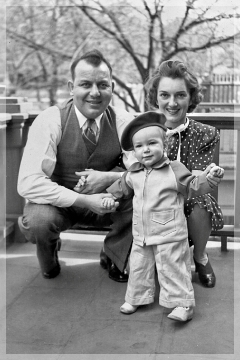 When learning to walk, a toddler takes a lot of falls and is likely to get some bumps and bruises along the way. Yet, if we ever want the little guys to walk (let alone run or jump), we need to let them fall once in a while. That’s the only way they’ll ever learn how to how pick themselves up again. Blunders and mistakes are how children learn—they’ll spill milk before they can drink from a cup, scribble outside the lines (and on the table) with their first crayons, have several pairs of wet pants before they’re completely potty-trained, and put their shoes on the wrong feet several times before they know left from right! A few mishaps are all part of growing up.
 Prayer is calling on God’s power; it’s like calling in the big guns to fight the battle. When doubt in the efficacy of prayer sneaks in, however, it’s more like calling in the big guns but not believing they’re loaded with enough ammunition. I am often like the father in Mark 9 who qualified his request that Jesus heal his son by saying, “If you can.” Like that father, I profess to believe but I need God to help me believe more! Sometimes, the enemy sneaks into my heart and causes me to doubt both the ammunition and God’s aim.
 Although Elijah had just won an amazing victory over Baal and his prophets, we find the prophet running for his life in 1 Kings 19. The journey of over 120 miles left him physically exhausted and, having endured so many setbacks and challenges, the disheartened prophet was emotionally exhausted, as well. Wanting what he saw as a hopeless situation to end, He begged the Lord for death and he’s not the only one of the Bible’s heroes to do so. Overwhelmed by the heavy burdens he carried, Moses cried to God, “If you are going to continue doing this to me, then kill me now. If you care about me, put me to death, and then I won’t have any more troubles.” [Numbers 11:15] A discouraged and frustrated Jonah told God it would be better for him to die than to live. Job, in his despair and agony, and Jeremiah, in his disappointment after decades of prophesying with no appreciable results, were so miserable that they cursed the day they were born! Even the Apostle Paul admitted having been nearly overwhelmed by his troubles. Yet, as hopeless at their situations seemed, none of them died when they wanted to and none took their own lives. God did not abandon them and they did not abandon life.
 The Bible is filled with evidence of God’s goodness and the great (and miraculous) things He’s done for His people. Daniel emerges unscathed from a lion’s den, David defeats Goliath and the shepherd boy becomes a king, wisdom and riches are given to Solomon, and Shadrach, Meshach, and Abednego aren’t even scorched from a fire. Water is parted more than once, the walls of Jericho collapse, jail doors miraculously open, and storms cease at a word. Armies are led to victory, manna falls from heaven, fish and bread multiply, the barren give birth, the sick and lame are healed, and the dead rise. The Bible is full of marvelous accounts of miracles, majesty, and triumphs.
