
And just as each person is destined to die once and after that comes judgment, so also Christ was offered once for all time as a sacrifice to take away the sins of many people. He will come again, not to deal with our sins, but to bring salvation to all who are eagerly waiting for him. [Hebrews 9:27-28 (NLT)]
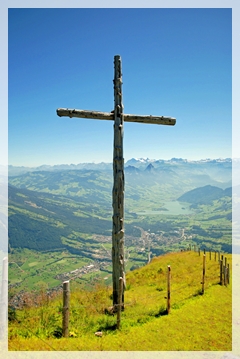 After warning us not to put them in our pockets and accidentally take them home (or put them in the dryer if we did), small pieces of paper were given to everyone in attendance at last week’s Good Friday service. Following the sermon, we were asked to write a sin (or sins) for which we repent on the papers, come forward, and nail them to a cross resting on the steps before the altar. Listening to the hammering echoing in the sanctuary, I thought of what it must have sounded like two thousand years ago when Jesus and the others were hammered to their crosses: the loud pounding of the hammers, the commotion of the crowd, the mockery of the soldiers, and the cries of agony from the men as those blunt tipped nails pierced their bodies.
Those slips of paper were made of nitrocellulose; often used by magicians, they are commonly known as flash papers. Once we’d nailed our papers to the cross, the pastor ignited them and they instantly disappeared in a brilliant display of fire. Nothing, neither smoke nor ash, was left of them. What a powerful illustration of the way Jesus’s blood, shed on the cross as those nails were hammered into Him, made our sins disappear forever.
Next to the small olive wood cross on my desk, I now have a three-inch square-cut nail, a souvenir from Good Friday’s service. The cross, with its distinctive grain, artistic shape, and smooth finish, is so beautiful that it’s easy to forget it represents an instrument of torture. The dark rustic nail beside it will better remind me of the sacrifice Jesus made for all of us. Paying the price for our sins, His death brought us back into fellowship with God the Father. After the joy of Resurrection Sunday, however, it’s easy to forget the magnitude of that sacrifice until Lent rolls around next year. Let us never forget the miracle of forgiveness that occurred when a suffering bleeding and totally sinless Jesus endured torture and death for the forgiveness of our sins.
He has redeemed me, a lost and condemned human being. He has purchased and freed me from all sins, from death, and from the power of the devil, not with gold or silver but with his holy, precious blood and with his innocent suffering and death. [Martin Luther]
 They [the Pharisees] asked him, “Why do your disciples disobey our age-old tradition? For they ignore our tradition of ceremonial hand washing before they eat.” Jesus replied, “And why do you, by your traditions, violate the direct commandments of God?” [Matthew 15:1b-3 (NLT)]
 I have told all your people about your justice. I have not been afraid to speak out, as you, O Lord, well know. I have not kept the good news of your justice hidden in my heart; I have talked about your faithfulness and saving power. I have told everyone in the great assembly of your unfailing love and faithfulness. [Psalm 40:9-10 (NLT)]
 In Pieces of Eight, columnist Sydney Harris tells the story of a dinner party at which an elderly Albert Einstein was seated next to an eighteen-year-old girl. Unaware of his identity, she asked the famed professor what he did for a living. “I devote myself to the study of physics,” he responded. Shocked that he still studied physics at his age, she told him she’d finished her physics studies the previous year! Without a doubt, Albert Einstein knew more about physics than anyone else of his time and yet he continued to study physics until his death. Harris’s explanation is that the physicist recognized that what he didn’t know far outweighed all that he did.
 But whoever is building on this foundation must be very careful. For no one can lay any foundation other than the one we already have—Jesus Christ. [1 Corinthians3: 11 (NLT)]
 On the days his restaurant is closed, a French chef friend works in his kitchen to make gallons of demi-glace. Hundreds of pounds of veal bones get roasted along with carrots, celery and onions. After deglazing the roasting pans with wine, he adds tomato paste, seasonings and water and simmers the concoction. At some point, he strains out the solids and continues simmering (and straining) the hot broth. More than twenty-four hours later, his stock has a rich brown color and a gelatinous consistency. After all of that simmering, less than one gallon of thick sauce remains for every ten gallons of liquid he added. Chef packages and sells this richly concentrated sauce to other restaurants that use it as the “mother sauce” or backbone of their own sauces.
