
Again Jesus spoke to them, saying, “I am the light of the world. Whoever follows me will not walk in darkness, but will have the light of life.” [John 8:12 (ESV)]
I have come into the world as light, so that whoever believes in me may not remain in darkness. [John 12:46 (ESV)]
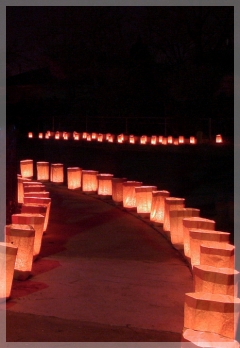 Hundreds of years ago, when Las Posadas was first celebrated, people gathered piñon pine branches into square piles to burn small vigil fires called luminaria to light the way for the Peregrinos as they searched for lodging. On Christmas Eve, bonfires were lit along the roads and in the church yard to guide people to midnight mass. Just as Las Posadas moved into the southwestern states as the Spanish and Mexicans came northward, so did the luminaria. When inexpensive flat-bottom paper bags appeared on the Santa Fe Trail in the 1870s, people started folding down the bag tops, anchoring the bag with a few handfuls of sand, and setting a small candle inside. Better than using precious fire wood, these luminaria (also called farolitos) became the popular tradition that continues in the southwest today.
While I probably won’t be part of any Las Posadas celebrations when I’m in New Mexico next week, I will see plenty of luminaria, even though many of those who set them out know nothing of Las Posadas. Although some of those lanterns will be made of hard plastic and powered by electricity rather than candles, the warm glow of their flickering lights illuminate the walkways, sidewalks, driveways and flat roof tops throughout the state each December.
For those who celebrate Las Posadas, the luminaria serve to light Joseph and Mary’s way as they seek lodging. For others, luminaria guide the way to Christmas Eve worship, are a way of welcoming the Christ child into their homes, or remind them of the star of Bethlehem. Sadly, for many more, their luminaria are lit simply to guide Santa’s gift-laden sleigh to their houses.
Wherever we are this Christmas season, we’re sure to encounter holiday light displays. Whether they’re luminaria, projection spotlights, mini-string or large colored bulb lights, let their brightness remind us that Jesus is the Light of the World. When Christ’s light came into the world, it did more than illuminate our sins. It brought us salvation by guiding mankind out of the darkness of sin and death and into the light of Christ! Jesus called us to lead others into His light but we mustn’t stop at merely pointing the way to Christ. Jesus calls us to be the light—to be His luminaria and provide light for others.
The light of Christ shines brightest in dark and troubled times—and these are dark and troubled times. On a dark night, one individual paper bag holding a flickering candle in it isn’t very impressive and it certainly doesn’t shed much light. Collectively, however, hundreds of luminaria are an impressive sight. Darkness can never overpower God’s light but His light can overpower the world’s darkness. Let us be the world’s luminaria, not just at Christmas, but all year long!
Darkness cannot drive out darkness; only light can do that. Hate cannot drive out hate; only love can do that. [Martin Luther King, Jr.]
 In the early church, it was common for believers to gather together for prayer and, when Peter was imprisoned, they gathered to pray for his release at the home of Mary, the mother of John Mark. For a people who believed in prayer, it’s ironic that Peter thought the angel that freed him to be a mere vision until he found himself free on the city streets and that the church was astonished when he showed up at Mary’s house! Amazing things can happen when the church prays for its leaders. Prayers broke Peter’s chains, imagine what they can do for our pastors!
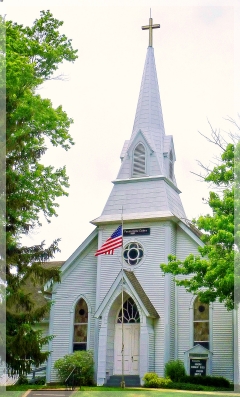 The story is told about a pastor who was shaking hands with his congregation after church one Sunday morning when a little boy handed him a dollar. After thanking him, the pastor asked what it was for. The youngster replied, “It’s for you, because I heard my daddy say that you were the poorest preacher that we ever had.” How easy it is to criticize our pastors when, instead, we should be praying for them.
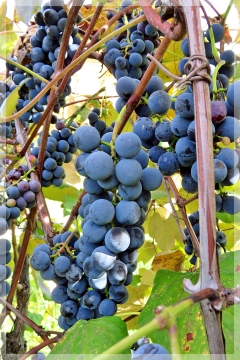 When explaining to some of John the Baptist’s followers why His disciples didn’t fast, along with the illustration of patching an old garment, Jesus compared His new way with winemaking. While many of us have sewn patches on clothing, few of us are experienced winemakers. Nevertheless, we know that today’s vintners ferment their wine in oak, stainless, concrete, or clay barrels rather than wineskins. Our only experience with wineskins may hearken back to college football games and ski trips when some fellows carried a wineskin filled with an alcoholic beverage hidden under their coats.
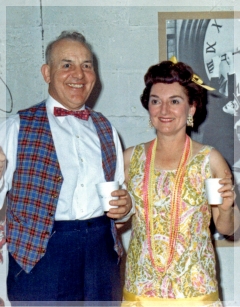 My in-laws were great ones for giving theme parties. When they hosted a “Backwards Party,” guests entered through the back door, wore their clothes backwards (which my mother-in-law admitted made it difficult for the men), and ate dessert before dinner. At another get-together, attendees came dressed as children, received jump ropes and jacks, pulled taffy, and played games like “Mother May I?” and “Pin the Tail on the Donkey.” My introduction to their parties was in 1966 when they turned their house into a Prohibition era speakeasy and guests needed a password to enter. Women dressed as flappers while the men wore fedoras, vests, and spats. Another party had the theme, “Come as You Wish You Had Been.” My mother-in-law, dressed in shorts with a whistle around her neck, came as the PE teacher she once dreamed of becoming and my father-in-law dressed as the train conductor he once aspired to be. Other attendees dressed as ballerinas, weight lifters, princesses, cowboys, or baseball players.
 Every breakfast, lunch and dinner, a recent house guest consumed between five and fifteen supplements like flaxseed and fish oils, magnesium, vitamin D, calcium, turmeric, ginger, cinnamon, and resveratrol (among others). Annually, people like our guest spend around $35 billion on supplements, vitamins, minerals, botanicals, and other substances to enhance their health. It doesn’t stop there; every year, five million diet books are published, at least 17 million cookbooks are purchased, and $33 billion is spent on weight loss products. Add to that all of the magazines, food channels, websites, blogs, and podcasts dedicated to nutrition, recipes, and weight loss and you have a nation of people who seem obsessed with what goes into their bodies.
 Devotions of the Heart