
Jesus told her, “I am the resurrection and the life. Anyone who believes in me will live, even after dying.” [John 11:25 (NLT)]
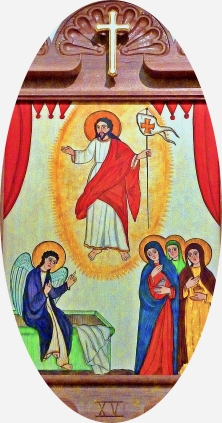 “Happy Easter,” said the Pastor as she welcomed us to worship. She was neither a week late nor four weeks early for Greek Orthodox Easter. While it’s no longer Easter Sunday and all the jelly beans, chocolate bunnies, and hard-boiled eggs have been eaten, it is Eastertide (“tide” just being an old-fashioned word for “season” or “time”). The Christian or liturgical calendar designates Eastertide as the fifty days from Easter/Resurrection Sunday to Pentecost (when we celebrate the outpouring of the Holy Spirit and the birth of the church).
Because it didn’t come by divine revelation, the church calendar isn’t sacred. Scripture doesn’t mandate the celebration of holy days and seasons like Lent, Good Friday, Easter, Advent, and Christmas. Nevertheless, God commanded the Israelites to celebrate specific events in their history and seasons of fasting and feasting tied to Jewish history are found throughout the Old Testament. Although the Christian church calendar isn’t established in Scripture, its basis certainly is.
We don’t even know the exact date of Christ’s birth, death, or resurrection and it wasn’t until 325 AD that Easter’s date was set as the first Sunday after the first full moon on or after March 21. The church (or liturgical) calendar was developed by tradition and church law so that, regardless of their location, all of Christ’s followers could collectively commemorate an act of God in the history of their redemption. People didn’t have ready access to Bibles in the 4th century and the regular celebration of events in the life of Christ and the church helped believers to better understand and remember them.
While liturgical churches such as the Episcopal, Lutheran, Methodist, and Roman Catholic still observe the seasons of the church, many Protestant churches do not. Some non-liturgical churches, however, are beginning to return to the traditional church calendar as a way of combatting the commercialization of our religious holidays. A few years ago, a non-denominational mega-church near our northern home announced, “This year we’re going to observe Lent!” as if it were a new idea rather than one more than 1,500 years old!
Although my neighbors went out and purchased half-price candy the day after Easter, we don’t want to spend the next several weeks dying eggs, making Easter baskets, having egg hunts, or consuming jelly beans and Peeps. Rather than repeating those secular traditions until Pentecost on May 19, Eastertide gives us fifty days to celebrate the meaning of Easter (and seven Sundays to sing the beautiful “alleluias” in Christ the Lord is Risen Today.)
During these next several weeks, let us spend as much time contemplating, appreciating, and celebrating Jesus’ resurrection as we did anticipating, planning, and celebrating His birth last December. After all, Easter is the whole reason for Christmas! Without Jesus’ resurrection, Christmas would simply celebrate the birth of a good man who said some wise things and was killed for his words.
The promise of our salvation didn’t disappear when the last chocolate bunny was eaten; the glorious Easter message is everlasting. Christ’s resurrection brings us love, grace, peace, forgiveness, redemption, and salvation, not just on Easter, but every day of our lives. One day is hardly enough time to celebrate a risen Christ—even fifty days are insufficient to rejoice in our salvation. We should be Easter people all year long.
The resurrection gives my life meaning and direction and the opportunity to start over no matter what my circumstances. [Robert Flatt]
 Today is Maundy (or Holy) Thursday—the day many Christians throughout the world will observe the institution of the Lord’s Supper/Eucharist/Holy Communion by coming to the Lord’s table. Regardless of what you call this sacrament, Jesus’ mention of a “new covenant” probably will be part of your service. Not a word commonly used today, what is a covenant and how does it differ from a contract?
 Brent Askari’s play, The Refugees, begins with an unusual premise. Because of a violent civil war in the United States, an upscale American family become refugees in a Middle Eastern country. When the family’s Arab social worker referred to the American refugees as “you people,” the once suburban housewife’s expression spoke volumes. In her previous Connecticut life, anyone who wasn’t white and upper middle class had been “those people” but the tables have turned and the roles reversed. Instead of being the ones with the money and advantages, her family and others like them are “those people:” a minority, seeking asylum in a new country, unfamiliar with the customs, and unable to read, write, or speak the language. Wearing clothes they once would have sent to Goodwill, they need government assistance to survive. Her once high-priced lawyer husband is now a stock boy whose boss takes advantage of his immigrant status. This family and other American refugees are as unwelcome in the unnamed Arab country as are the refugees at our border.
 Spiritual gifts build God’s Kingdom in a variety of ways including teaching, outreach, speaking, counseling, discipleship, serving, practical assistance, visitation, and prayer. Our gifts were given for the common good of Christ’s church and we need one another’s gifts for the body of Christ to function. Within the church, some gifts, like shepherding, evangelism, or leadership, are easily noticed while others, such as mercy, giving, intercession, and faith may be less obvious. While those gifted in service (the ability to see undone tasks in God’s work and get them done) often work behind the scene, the people gifted in hospitality (the ability to warmly welcome all people into home or church) are front and center Sunday mornings as they greet people by name and extend the hand of friendship to visitors.
 Jesus promised the disciples, “And I will ask the Father, and he will give you another Advocate, who will never leave you. He is the Holy Spirit, who leads into all truth.” [John 14:16-17] In fulfillment of that promise, the moment we accept Christ as our Savior, the Holy Spirit moves into our hearts. When He arrives, He helps us but, rather than making the bed or washing dishes, the Spirit comforts, counsels, and convicts us. He gives us the power to share His word, the strength to do His work, and confidence in the fullness of God’s promises.
 A century of dike-building, agricultural development, and population growth has destroyed much of Florida’s wetlands and threatened the survival of dozens of animals like Florida panthers, Snail Kites, and Wood Storks. The White Ibis, however, is an exception. Having adapted to the new urban landscape, large groups of ibis happily graze the lawns of subdivisions, parks, and golf courses. They’ve found it easier to poke at the soil for a predictable buffet of grubs, earthworms, and insects than to forage in the remaining wetlands for aquatic prey like small fish, frogs, and crayfish. Once wary of humans, these urbanized ibis pay little or no attention to people as they follow one another across our lawns.
 Devotions of the Heart