
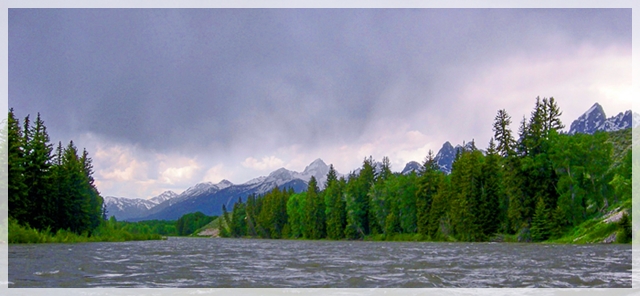
Save me, O God, for the floodwaters are up to my neck. Deeper and deeper I sink into the mire; I can’t find a foothold. I am in deep water, and the floods overwhelm me. I am exhausted from crying for help; my throat is parched. My eyes are swollen with weeping, waiting for my God to help me. [Psalm 69:1-3 (NLT)]
Every few minutes, Sunday’s service in the park was interrupted by the sound of planes leaving the local airport. A severe storm with gale winds or tornadoes was predicted and the planes (and people in them) were escaping the storm. Perhaps they remembered the storm just a year ago that brought wind gusts of 85 mph when both planes and hangars at the airport were damaged. How fitting that our pastor’s message was about the storms of life. As I listened to those private jets overhead, I thought, “You can run, but you can’t hide!”
Given enough warning, we can escape stormy weather, especially if we’re rich and/or famous as many of those flying away were. Nevertheless, no matter who we are or how much we have, none of us are immune to the storms of life. More often than not, those storms will be like last January’s—somewhat unexpected. Granted, there was a tornado warning issued in the wee hours of the morning but most people slept through it. While they slumbered, a storm battered the city and left them with downed power lines, severe wind damage, scattered debris, and a flooded downtown. As with tornado alerts, we often fail to heed life’s storm warnings when heath is fading, mental ability is lessening, a marriage is crumbling, a child is using, a business is going under, or our nest egg is disappearing. We‘re caught off guard when we wake to the storm’s presence.
While we may lessen a storm’s damage by heeding warnings or preparing for its arrival, ready or not, storms will arrive. At some point in time, we’ll be battered by circumstances beyond our control and left feeling powerless. When the storm hits, life as we once knew it will wash away in the flood. We’ll look at the wreckage that remains and be tempted to give up. After last year’s wind storm, however, people didn’t give up. They coped with lack of power and water, removed the trees in the roads, kept what could be salvaged, discarded what couldn’t, and rebuilt what was destroyed. When the storms of life arrive, we can’t give up either. No matter how extensive the storm, we must remember that our God is bigger and far more powerful than even a category 5 hurricane!
We know God can stop storms; with just a word, Jesus stopped the wind and calmed the sea for the disciples. Not every storm, however, will be quelled. Some must be endured as they run their course. They may be so severe that we’re shipwrecked, as was the Apostle Paul. He encountered such severe storms that he was shipwrecked three times and even spent a day and night adrift at sea. God can calm the storm as He did for the disciples or He can calm us, as He did for Paul. The Apostle knew that when we no longer can hold on to the debris of our lives, we can hold on to God! No matter how faithful, we will never have a life that is free from storms but, with the power of God, we can have a life that no storm can defeat.
Sometimes the Lord rides out the storm with us and other times He calms the restless sea around us. Most of all, He calms the storm inside us in our deepest inner soul. [Lloyd John Ogilvie]


 They were sailing in the Sea of Galilee, a body of water notorious for sudden violent storms. At least four of the disciples were fishermen; did none of them question Jesus about the possibility of squalls or rough waters? Jesus, being God and omniscient, surely knew a storm was brewing and yet He told the men to take the boat across the sea. As the squall came rolling in, the disciples fought the waves. While they frantically reefed the sails and bailed water, Jesus calmly slept on a cushion in the boat’s stern. To the terrified disciples it seemed as if He didn’t care that they were going to drown.
 Hoping to get a good cardio workout, I’d ramped up the resistance and programmed the machine for a variety of hills, some of which were real killers. Whenever I glanced down at the screen, I groaned at what lay ahead of me. No matter where I was in the program, I was already looking ahead and dreading the next big challenge. Every time I looked at the timer, I lamented the length of time remaining for this self-inflicted torture. After placing my towel over the screen, the workout seemed easier. No longer able to see the hills or time remaining, I stopped dreading the next challenge and the ones after that. I just pumped away, secure in the knowledge that, eventually, my workout would be over.
 “Like sands through the hourglass, so are the days of our lives,” goes the introduction to the NBC soap opera Days of Our Lives. Since that show has aired more than 13,000 episodes since 1965, something tells me the show’s hourglass has been flipped over several times. While that hourglass keeps getting turned, the hourglass that numbers the days of our lives is glued to the table—once the sand runs through to the other side, it’s all over. Moreover, none of us have any idea how large our individual hourglass happens to be. The days of our lives are both finite and unknown.
 Devotions of the Heart